(Title is a homeage to My take on RawTherapee in case you missed the joke.)
TL; DR
Currently it can restore raw into a netural TIFF, more in the repo readme. Binary is available in GitHub Action artifacts.
Novelties:
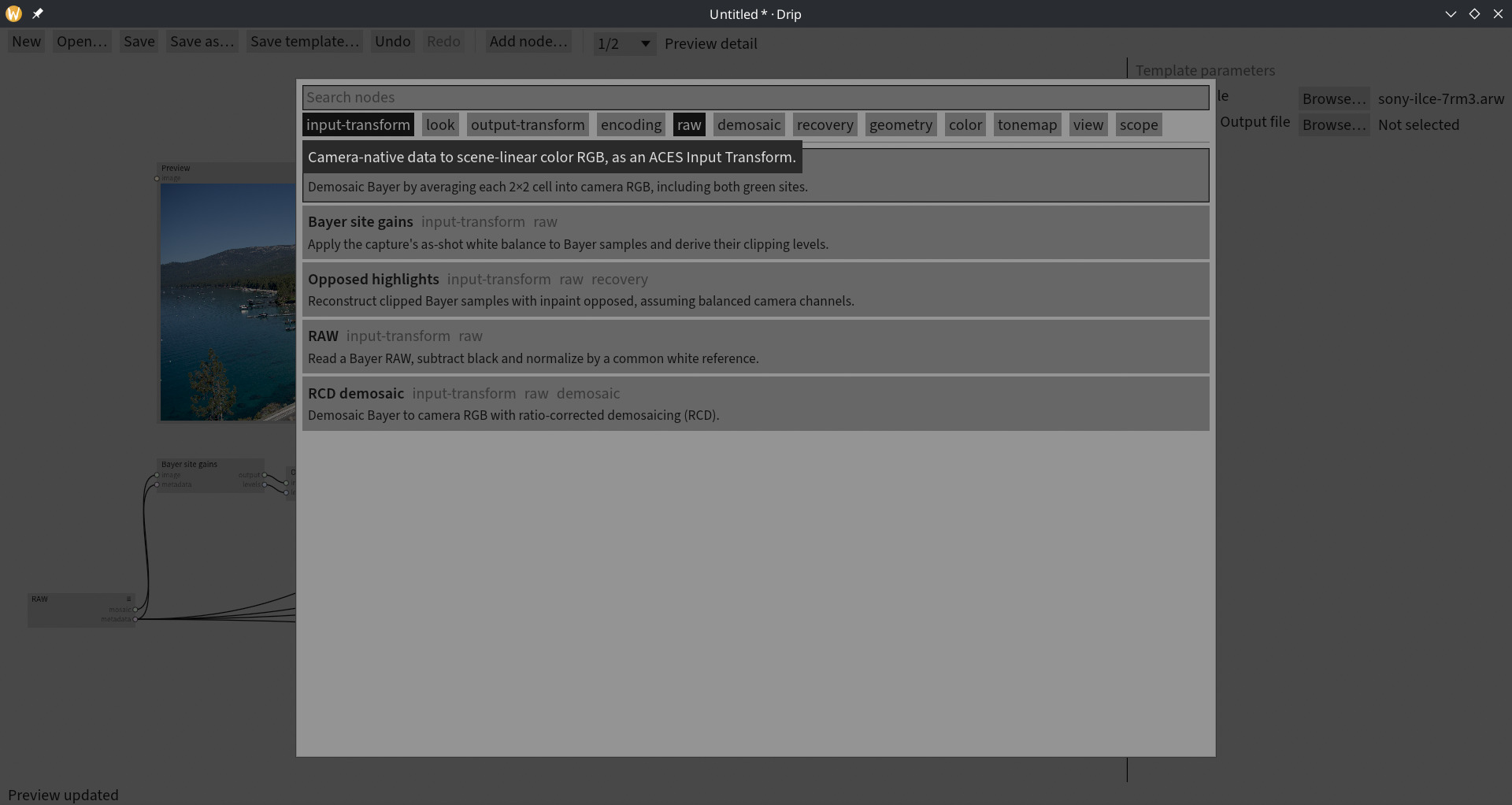
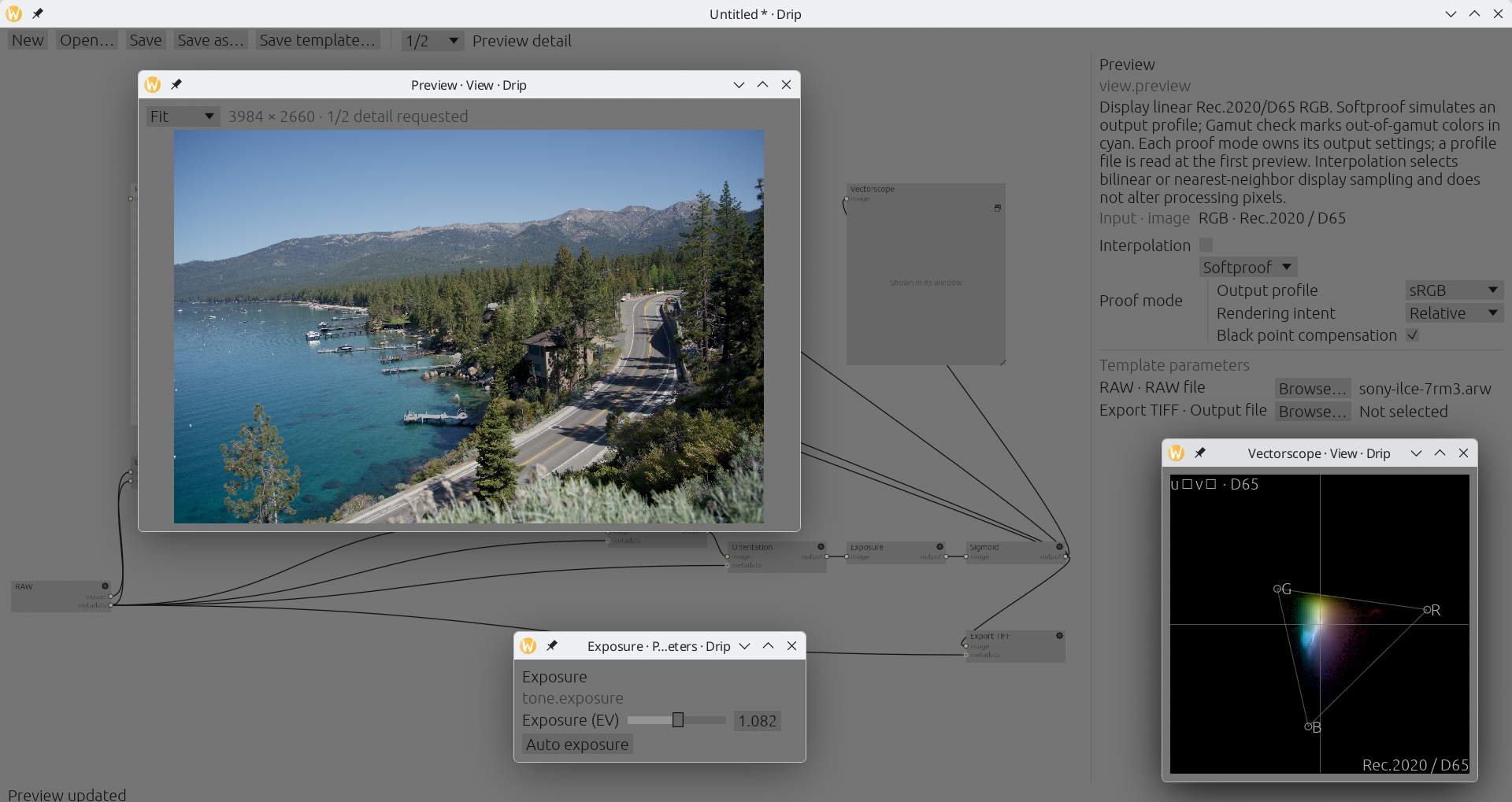
- A really really unique frontend. I generalized “nodes on a DAG” computation model into the entire UX, and managed to make it usable!
- CubeCL DSL powered heterogeneous computing across CPU(!), WGSL, Vulkan, Metal, D3D12, Cuda, etc…
- Check for most of the wrong pipeline arrangements despite the flexibility.
- Arbitrary params can be exported and binded via template, enabling flexible batch processing.
Additionally:
- It displays wide-gamut correctly on wayland, which hopefully will be available for all wgpu users.
Checkout the screenshots, they are really neat! Note that this is just a dev peek into the software, and I want to hear opinions in case I chase the wrong goal.
Motivation
I’ve read Aurélien Pierre’ various critism and that “The long-term goal is anyway to transition to vkdt”.
vkdt is really, really nice, with all the SOTA algorithms. But I still find it quite frustrating sometimes. The UX is still quite confusing (I personally never got used to it… might be preference), and only check for buffer type. It’s also hard to build, and I doubt if C provides enough abstraction facilities to reach some maintainability standard I demand. (I use Rust mainly because of proc-macro.)
What Drip has implemented so far
Rough overview of the pipeline, see the screenshot in repo for details:
Read raw (using Libraw) & Normalize Bayer
-> Highlight reconstruction -> Demosaic
-> Cam to XYZ -> Chromatic adaption -> Tonemapping
-> TIFF output
Currently not a lot of unique uses are enabled by the design given limited algorithms. I expect the node design to really shine when I introduce local edits by masking+blending.
Performance on my AMD 5600G + RTX 3080, on Fedora + KWin + Vulkan (CubeCL), with my 40 MP Sony A7R III RAW. (You can reproduce via a copy of this RAW in the repo. I took that on a trip to Tahoe.)
| Operation | Time |
|---|---|
| First load at ½ preview resolution | ~900 ms |
| Changing a parameter | ~75 ms |
| Full-resolution export, LittleCMS sRGB, u8, uncompressed TIFF | ~1.4 s |
Unfortunately the performance can never be as good as vkdt, because I do not assume the computation device is the same as display device. The syncing between host and device can never be eliminated. Both a bless and a curse.
Off-topic but…
Is this AI slop? I am indeed aware of the recent emerging photo editors (speaking of you SlopCraft) and I used agentic coding heavily, but I assure you I put a lot work into this project, and monitored carefully. In a way, I injected sufficient “bias” into the AI output such that the software deviates from average slop into something unique. My stance on agentic coding, if you are interested…
Correctness? I am a math major, and I mainly self-taught Colorimetry and Computational Photography. (And I indeed originally tried to define nodes over abstract algebraic types, which failed haha.) With that being said, given the current algorithms are mostly copy-pasta from darktable or colour py, is relatively simple, and I checked external sources like CIE and ACES, it is sound. Most importantly I know what I am doing.
Additionally, I was really tempted to call it “Yet Another Raw Processor”, but Yarp the name is already taken by Microsoft.