So I have been playing aroung with (local) AI image generation recently. I must say not so long time ago I wasnt interested in this, I even rejected it as art. But this summer is so long and so hot in europe. I could only go hiking maybe once a month or not even that. Most of the time the weather was so hot I didnt even want to leave the house. On other days, we had thunderstorms and heavy rain, but still way too little rain. Anyway, the weather was the main reason I could not go shooting as often as earlier. I mean: sometimes it looks like outdoor photographers have no other possiblilty than stay at home and generate images, nothing else is left. Besides, nature isnt as photogenic as it used to be either. This year everything is very dry, and in the winter there is no snow any more.
I think at the moment a majority of people reject images that are completely ai generated. But many of them don‘t know that its not quite that easy to create a really good image with ai. You have to try again and again for one or two hours and create dozens of images, refine the prompt many times, in order to get a few really good ones. And you definitely have to have artistic talent and have a clear aritstic imagination of what you want. Sure, all in all its less work than climbing up a mountain to get a pic of the view, but its not like you push a button and get the perfect image. Actually, according to my experience, generating images is more similar to painting than photography (is similar to painting). And you need to have good language skills.
Still, I think I still prefer real photography. I am so desperate, I wanted to go shooting yesterday after I dont know how many weeks and my mum got an angioodema.
But I think ai art and real photography can coexit peacefully. In the 19th century, there was a similarly hostile attitude towards photography as today towards ai art.
I don’t think it changes anything at all, for me the cool thing about photography is that it represents a real moment in time.
IMO that weather is perfect to get some cool storm photos. There is no colored light like that after a storm or heavy rain, when the sun is low and the atmosphere is free of dust and particles. Or clouds after the rain passes and the sun starts hitting them, creating dramatic scenes.
What about it being dry and no snow? You just gotta do with what you have. There are photographers all over the world that shoot deserts or temperate climates with zero snow.
At least for me, worthless to go out with preconceived ideas of what you might photograph, you never know what you might find that attracts your eye.
Also let me introduce another idea here, shifting baseline. Europe not even 12 thousand years ago looked dramatically different than it does today, and even 2500 years ago before the major roman deforestation, it would’ve looked dramatically different than it does today, with all its primeval forests all around it. We are already the most changed continent on earth, with little remaining nature. So what you fight beautiful now wasn’t even a thing before major human intervention. Might as well find beauty in what is left now, no matter the weather.
I think AI is an easy way out and I don’t really think it’s art. Lots of ways to bring to life the landscapes you imagine. 3D modeling and scene design in blender, painting, digital painting, etc.
I think you need to have good taste, not particularly any artistic talent or imagination. Much like photography or any art, I think it’s all about taste.
However, ai edited photos are quite accepted, even if more than half of them is artificial. I think this is changing. Its not so easy to draw a clear line.
I don’t think they really are, especially when generation or removal of bits are of concern, it just feels really wrong, and way unlike removing a bit here and there with a clone/heal tool.
Define AI edits. Is using a denoise model, trained on sample noise data, running locally, an AI edit?
I am not inherently against the technology, but… You absolutely miss most of the moral and environmental points in your original post and compare clicking on a “generate” button multiple times to painting; you do not like the heat waves yet are comfortable sitting at your home, running a model that runs in a datacenter that quite possibly directly affects the weather. I am not going to engage anymore.
Reality is the important thing. See in the 19th century, people thought photography wasnt art because it just showed the real world. In earlier centures art had to be something invented and artificial, a product of your phantasy.
So, shoot at golden hour or blue hour. There is always a way.
I don’t know much about art, but I do know that, based on personal experience, spending too much time in front of computers is detrimental to my mental and physical condition.
Conversely, being outdoors, preferably in nature, or at least a city park, is beneficial. Sometimes I combine this with photography, when I feel I want to do it. Not always, especially not when I am biking.
I don’t doubt that people can create art with computers, with or without AI. It’s just that for me, there is no enjoyment in that process, it would be more like a subtle form of torture.
So, in that context, for me generative AI and capturing images outdoors with a camera are apples and oranges, not substitutes.
Well e.g. you have a pic of a beutiful butterfly and 1/4 of the image is occupied by a white wall. People do very much prefer the edited version where you generated a background that is a bokeh that is similar to other parts of the image. Even and especially on fediverse, which is quite hostile towards ai art. I did some research on this.
Well yes, but when I said real it was in why photography is appealing to me. Paintings and other art forms are appealing to me as well, in different ways, they almost always evoke different feelings due to how they target a distilled idea or a feeling, and by doing that they manage to make it come across like almost no photography can.
I have never seen an AI generated image where I felt that. I think there are a lot of intricacies and personal things which come across in a work when someone spends a lot of time on it. Most likely I could be fooled by an AI generated Monet or something, but only if I saw it digitally, as there is no replicating the experience IRL with all the different pigments reflecting in different ways, etc.
But I am not an art scholar, so I am just blathering
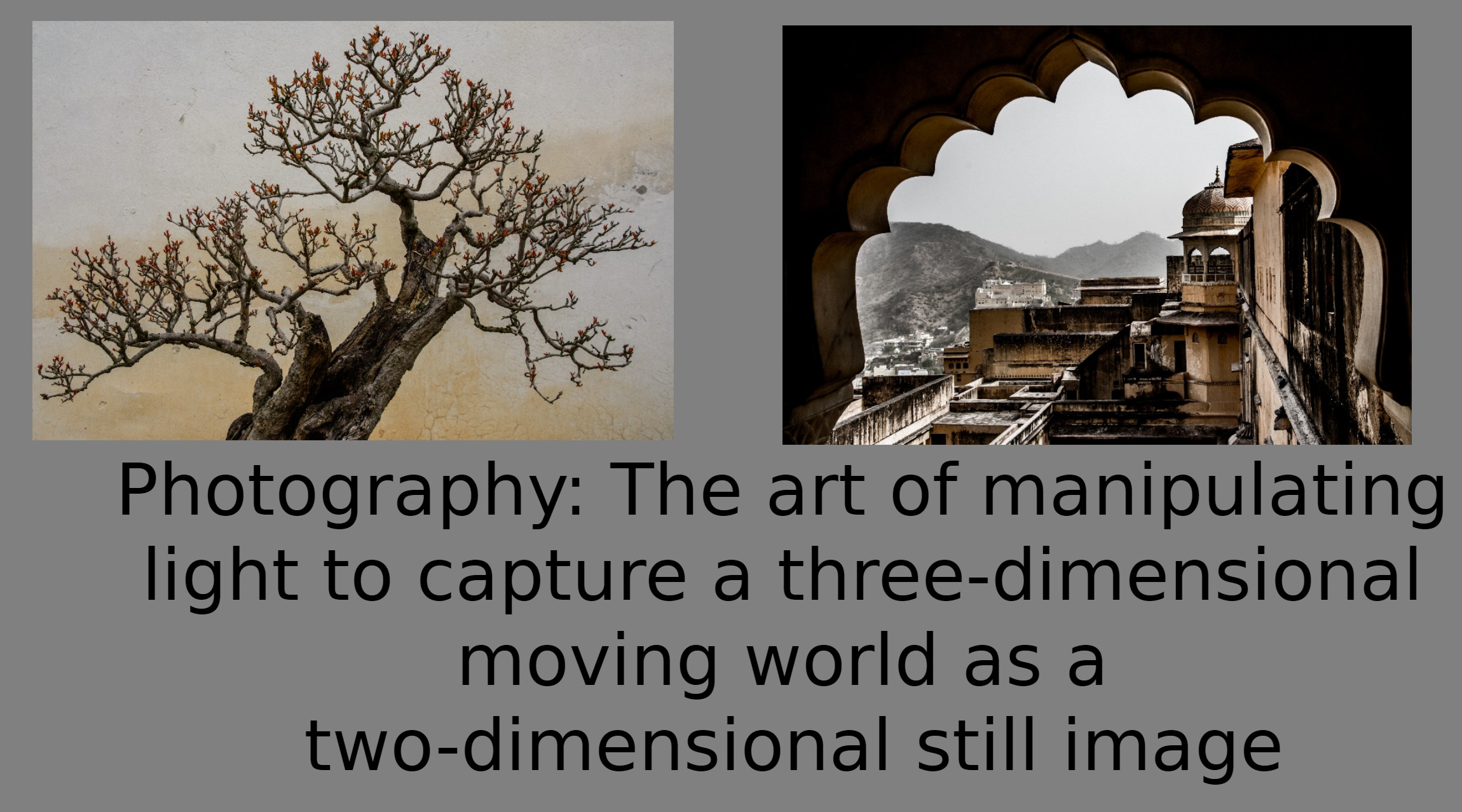
I very deliberately use the word manipulating because many students over the years have said they don’t like to manipulate their photos, but that in my view is the art of photography. We manipulate DoF with aperture, blur with shutter speeds, colors by the choice of film brand etc.
Now with AI image I would have to say Photography : The art of manipulating a computer to create an imaginary world.
But returning to the OP’s original question: Am I guilty of destroying a photograph because I clone out a distracting person in a landscape by AI or Non-AI means? I answer the question with a question…Hmmm.
Even when you are not manipulating anything, you are selecting a 2D static image from a 3D dynamic world.
That selection is the key to photography as an art form. Composition, the “decisive moment”, etc.
Fiddling with colors and noise reduction digitally is just icing on the cake, not essential to the process.
One may argue that if the artistic intent is served by it, removing stuff is acceptable, especially if it is plausible that the shot could have been taken under those circumstances and that would have been the intention, it’s just that life did not cooperate.
I would like to see this research, and how it was presented.
Art is not about the finished result, but about the journey that you took to get to the finished result. And only then, the result.
That’s why a painter can hang an empty canvas in a museum, and it would be still a piece of art (let’s say, portraying loss, emptiness, disability, etc.)
Presumably you were just comparing results.
People generally enjoy the works of other people. If you diminish the amount of work done by people, the enjoyment diminishes proportionally.
Only in post-modern times when people have learned that even if you don’t personally swallow all kinds of bullshit, saying that the emperor is naked will just make some others claim that your eyesight is not clear enough to appreciate the subtlety of the clothes (while, of course, these others can see the clothes, even, or especially, with their eyes closed).
If, say, an artist in the Renaissance tried this trick with the empty canvas, he would have been exposed as a lazy fraud. Even if he managed to convince a patron with some post-modern argument about the worth of this stunt as art, that patron would have become the laughingstock of the day: the idiot who paid for an empty canvas.
Fortunately, photography is remarkable immune to this phenomenon even in this day. People look at the photos, and they stand on their own. For a photo collection or an exhibit organized around a theme, someone (not necessarily the author) may write a blurb to give some context, but that will be it, and it will not make a meaningless photo a modern masterpiece.
Yes, well, if you try ai image generation seriously you will see that it’s not no work at all, it’s just a different kind of work than traditional photography or painting. It’s just that people think it’s no effort.
Besides, work and effort can be an important part of art, but it’s not the essence of art. A work of art expresses feelings and ideas, no matter if it are created with little or big (physical) effort, it’s about the quality of the idea.
Also, monetary value has never been an indicator of quality of art.
Skill? Sure, during Renaissance. Legacy / Pedigree? Sure. Recognition? Sure. But not art. The simplest of examples would be cave-etchings. A more complex one is how graffiti transitions from vandalism into a snapshot of point in time in history; their “value” (monetary and otherwise) fluctuates throughout time.
The fact that you called it a “trick” makes me think that you judge solely by how visually pleasing it is.
I personally do not believe in the subjectivity of art. While it is true that tastes are partly governed by society, I truly believe there is an inherent aesthetic attraction in humans and perhaps even in other animals which governs tastes on a fundamental level.
Abstract Expressionism and all that derived from it was mostly a CIA psyop: