Lack of understanding photography transcends income levels.
In the '70s, I worked in a camera department in a department store. We’d get a bit of “farmer made good with the oil well” traffic, simple folk with a sudden order-of-magnitude increase in their wealth. I remember one person specifcally asking “for the best camera there is”, and pointing at the Nikon F2 in the case. I tried to deflect him to the recently-introduced Polaroid SX-70, but he was having none of it, wanted The Best Camera Available. Two weeks later, he returned with the kit and some of his photos, wanting to exchange for the SX-70.
Looking at his photos, P-mode would have been quite helpful.
Or Because of your experience, you recognise the usefulness of each tool?
I suppose P mode is a bit like A and S mode mixed? We get the choice: choose shutter speed or aperture, and the camera will adjust the other for the same EV.
It seems like a good idea! Confession: I don’t use P mode because I find it harder, not easier, than A mode!
Sometimes, I feel baffled by how get the pic I want and, nothing to loose, switch to AUTO. And I should probably remember to try it more often!
About 23 years ago I switched from earning my money by being a photographer to teaching photography. I always tell my students that while I am teaching them how to use their cameras in manual mode because it is the best way to learn that at the end of the course I have no problems if they shoot in P mode or any other semi-automatic mode like AV or TV, but that I am a failure as a teacher if they use auto mode and they should ask for a refund.
The logic behind that is that P is still a creative mode where we can adjust exposure by EV compensation and change color through WB. Also we decide if we want flash or not. But on many Nikons and Canons all these creative options are non-existent once we select Auto.
I would recommend reaching for P mode before Auto.
On my Pentax cameras I even sometimes use the scene modes like landscape because I am telling the camera what my subject is and it sets aperture, shutterspeed, picture style to suitable settings for that scene. My Pentax still allows me to use EV compensation and flash if I want. My Nikons and Canons don’t give this same creative control if I select the scene mode, some versions of even Nikon and Canon do, but not the ones I own.
That quote made me realize a tidbit about cameras. I said before that I don’t use P, but A. But that’s actually not true, since I’m using a Fuji camera. P on Canikon is a full-auto mode where adjustments are still just one flick of a dial. That’s all-A in Fujispeak: everything is automatic, but adjustments are just one flick of a dial. (On some Fujis, there actually is a fully automatic toggle as well, which disables all dials. I never use that.)
So I guess, I take back what I wrote earlier. Actually, I use P all the time.
Just to follow-up, I spent about a month using P mode on my Panasonic GX9. The idea was to really give it an honest try, since some people here like it. But P mode and I did not become friends.
These comments are about the defaults that my camera seems to select. I know I can change them, but at that point I may just be shooting in A mode. Also some other cameras may be smarter.
Here is how my GX9 seems to work:
In broad daylight, for some weird reason it always starts out at 1/500s exposures, adjusting the apertures accordingly. This sometimes results in f/8 to f/11, which is well in the range where diffraction kicks in. Only pixel-peeping reveals the difference to, say, f/6.3, but it is there. Heaven only knows why it does this, mechanical shutter is fine down to 1/4000s and electronic 1/16000s, plenty of room there.
Conversely, in dark situations it goes as wide as possible, eg if I have an f/1.7 lens on, it picks f/1.7 before cranking up the ISO from 200. This again I don’t understand, as the camera is just fine to about ISO 800, so when there is room for that I would go with f/3.2 or something like that, for a wide depth of field, unless I am really using DOF to separate the subject.
In between, it seems to stick to f/6.3 and similar [for micro 4/3, this is the “everything sharp” territory, except for stuff really close to the camera]. What is in focus does not seem to make a difference; I thought it would be clever and choose the aperture accordingly but apparently not. Curiously, the iA (intelligent auto) mode does seem to select the aperture based on the topic (but that does not allow exposure compensation).
So, for my purposes, after giving it an honest try, P mode is a waste of space on the dial. YMMV.
Hi all,
On Pentax K5-II, I have a P mode (hyper program), which sets exposure time and aperture according to a “program line” chosen in the menu.
Auto: The camera determines the appropriate settings.
Normal: Automatic exposure of the basic program (default setting).
Exposure time priority: Automatic program exposure that gives priority to high shutter speeds.
Aperture priority+: Automatic program exposure that reduces the aperture as much as possible for a large depth of field.
Aperture priority -: automatic exposure program that increases aperture as much as possible for a shallow depth of field.
MTF priority: automatic program exposure that gives priority to the best aperture settings for the lens mounted when a DA, DA L, D FA, FA J or FA lens is used.
I use FV mode. I haven’t used it enough so that it’s muscle memory but it definitely gives you more flexibility in changing settings while looking through the viewfinder. Otherwise I would just use aperture priority, setting aperture with the front dial and exposure comp with the rear. This is quicker for me right now but doesn’t give the ability to take control of ISO or indeed any of the other three main variables, switching them individually in or out of auto on the fly, without removing the camera from my face. There’s a Tony Northrup (yeah, sorry) excerpt explaining the operation here:
I thought I would add to this old thread. I just went to Africa and I bought myself a Sigma 16-300mm lens so I could shoot landscapes and animals without changing lenses. Before I left I tested a few zoom positions and determined the best aperture for the sharpest images. I discovered f-8 to f11 gave very good results at all zoom ranges. So I actually never once used P in Africa. If subject motion was not a big issue I used Av mode set to f8 or f11 and let the camera pick ISO and shutter speed. If subject movement was a concern I selected manual mode with a suitable shutter speed and again f8 or f11 with auto ISO. Bracketing for exposure was used at all times. This method seemed to be very efficient for me. BTW at f16 and smaller the 16mm zoom length is greatly compromised in resolution. I suspect this would be the case with many wide angle lenses and recommend people to test the various apertures for the sweet spot of sharpness.
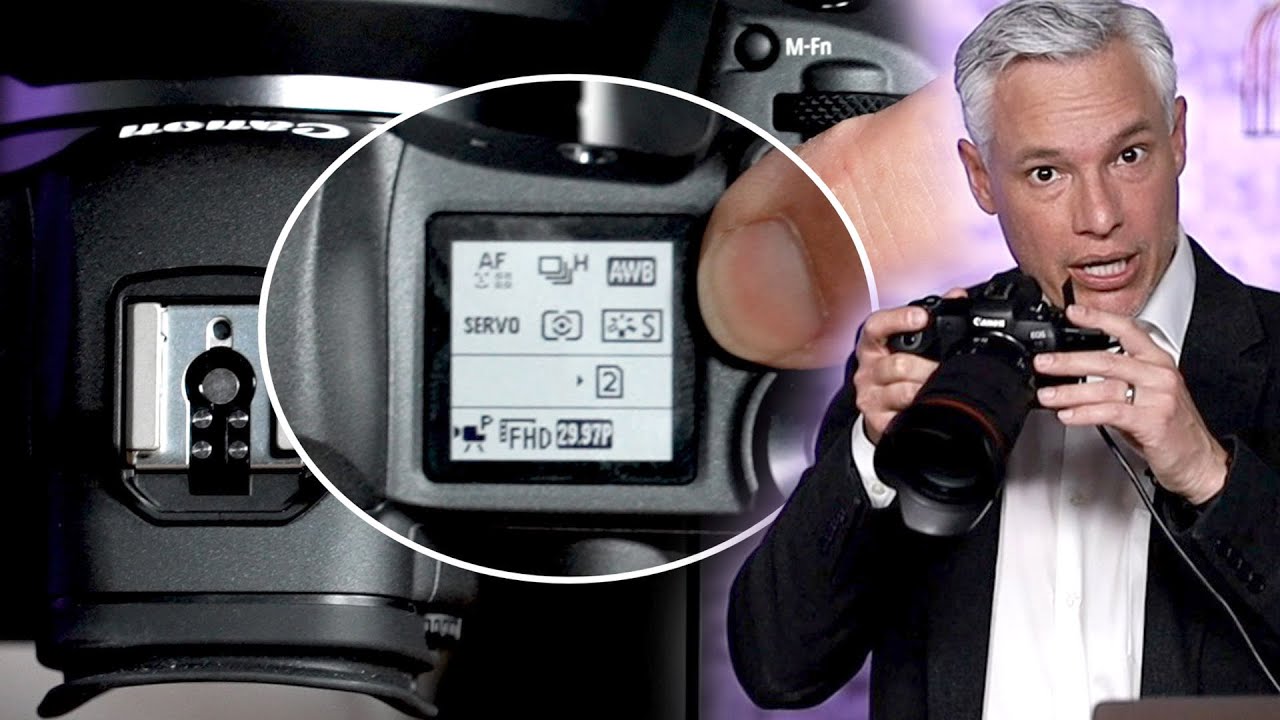
I usually use [P] mode with Auto ISO on my Canon R7. One of the places I am often found taking photos is a small wooded nature reserve next to a river where the light can vary a lot (for the UK anyway) one shot under the trees next shot on the river. Getting the subject in the frame takes enough of my ability without adding any other “complication”. One wheel on the camera lets me adjust exp comp. to save blown out spots on a sunlit bird on the water. And the other dial lets me shift SS & f: keeping the same Ev so once I have the subject and have perhaps taken a couple of shots I can then look at whether I should adjust towards a favoured SS or f:. The camera also has a rather neat [Fv] mode that lets you switch between what you want to control, SS, f:, ISO or Exp Comp or set one or all to Auto. I keep trying it because it makes sense but it has yet to become second nature.
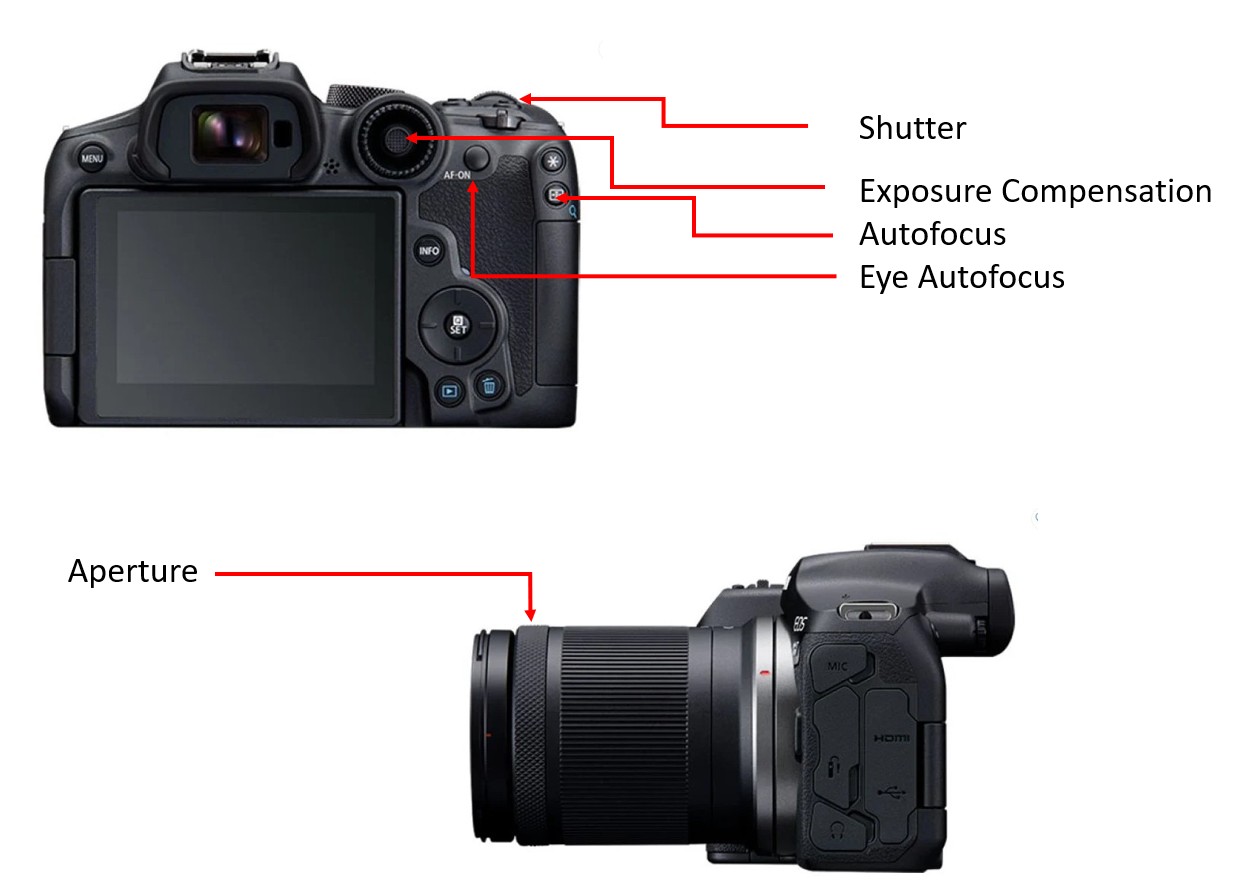
Shutter is in its traditional place, but I have ISO exposure compensation assigned to the back dial. I usually have the aperture set wide open but I assigned the the lens control ring to aperture so I can still change that if needed. And finally have back button focus with assigned buttons to autofocus and animal eye focus.
This setup gives me all the control I need at a single touch. With auto-ISO I have the histogram engaged so I can adjust the right side with exposure compensation to set my shot and avoid blowing out highlights.
I use this most of the time, but I have another custom setting for macro photography and I can still go back to the dedicated manual mode when needed.
This actually makes tons of sense, and I’m going to try it. I usually shoot in Aperture priority mode with auto-ISO, and then I just use exp. comp. to protect highlights and/or brighten/darken the image for creative effect. It works well most of the time, but there are instances where I quickly want to use a faster shutter speed but keep the same exposure, i.e. dynamically adjust the aperture and keep the exp. comp. constant.
Am I right that this is exactly what your method does? Does it essentially do the same as switching to SS priority mode but quicker and without needing to take your eye away from the EVF?
I’ve shot a lot in P since I need to get some practice in, first (or at least I feel that way). From what I’ve read, I “should” (for given values of “should”) use A or S, and I actually do now and then, but P is for when I just want to not think about the technical end of things too much.
Might try focusing on A or S more, it can’t hurt to be more specific about things.
Ok, so I tried using P mode with my new PASM camera, and I didn’t find it any easier. I didn’t feel I had the control I was wanting because one dial is essentially adjusting two parameters at once (aperture and SS).
I still prefer either Aperture priority or semi-Manual. By semi-Manual, I mean M mode with auto ISO. I use one dial for aperture, one dial for shutter speed, and Auto ISO ensures correct exposure. I then have another button set up to quickly adjust exposure compensation for max control.
Sorry, not exactly sure what you’re asking with your math formula. Exposure along with whatever exposure compensation you’ve set stays constant, yes. The shutter speed and aperture are adjusted concurrently to maintain the correct exposure in what’s known as “program shift”.