In case this refers to me: I didn’t say (or believe) that, and I think there is nothing wrong with having “pretty” as a goal.
The question is not if “pretty” is a valid goal but if the “rules” only produce “pretty” images. I doubt that.
I not only doubt it, but suggest it clearly isn’t true.
1 Like
Well, what can we conclude from this very interesting discussion that stirrs “uneasiness” (something that I like very much)? From my point of view that video was great for many reasons:
- The author clearly states that he wants to create “wall-(b)hangers”.
- I assume that this is his definition of a “simple, un-cluttered, pretty image that follows certain rules”
- In so far he has created a very clear and comprehensible guideline.
- There is nothing wrong in following this approach as it is totally okay to completely disagree.
- I can find joy in pictures which are completely cluttered, technically trash and without definite subject (aka my sons finger paintings or pictures of my basement table full of stuff). I make them wall-hangers.
Anyway, I enjoyed watching the video, I learned a lot from it and I appreciate this discussion. Thanks everyone.
2 Likes
I didn’t find the discussions here uncomfortable. I thought they were generally respectful alternative viewpoints. I am still amazed this video could inspire such a deep conversation, but that is what the forum is here for.
2 Likes
Rambling thoughts trigger warning.
I don’t disagree with this but I would put the emphasis the other way around. Obviously we’re bounded by our biology to some extent. Without eyes, etc.
Still, what we’re doing is cultural production; even our cameras are products of culture.
If the biological means is universal, then beyond the scientific investigation of those means, it’s probably not that interesting. “Hey, look, this photographer clearly had eyes” is not something you hear people say.
(I realise there’s more to say on the biology of perception and aesthetics but I don’t think what goes through our minds when we create or view a work, generally, is “this is done this way because it’s done by a human to be viewed by another human”.)
I think culture is more significant, at least in the aesthetic frame we’re talking about here (rather than, say, a neuroscience paper). There’s also a risk of falling into the naturalistic fallacy.
There’s been talk of Constable and Vermeer as though they demonstrate universal values but, while clearly they’re a product of biology, they can’t be removed from their or our cultural context. Art has a history and looked very different before and after their time, so apparently ignored these “universal” values.
When we see a photo that looks like a Vermeer today, there’s some element of surprise that “it looks like a painting”. (Though perhaps the causation goes the other way, given speculation he used a camera obscura). But if all photos looked like Vermeers, we’d probably get bored and want something else.
I also think there’s a history and anthropology of taste. Van Gogh now seems ascendant over Renoir, though both were radical in their time, perhaps because of our time’s emphasis on psychological truths and, no doubt, the tortured artist cliche. Vermeer seems comfortingly familiar because of the invention of the camera and its ability to capture bourgeois life?
On prettiness, I think the thing that can make it boring is that it leaves no questions unanswered. It follows guidelines or conventions (whether biological or cultural in origin) and so is literally unremarkable.
Worse if it’s like Soviet realism or motel art. It might even be pleasing, but we can see what the makers or hangers are up to, and the defense against such gross manipulation might be to laugh or sneer at it as kitsch. There’s a bit of a “screw you” to Peter Kennard’s (kinda lumpen) Haywain With Cruise Missiles.
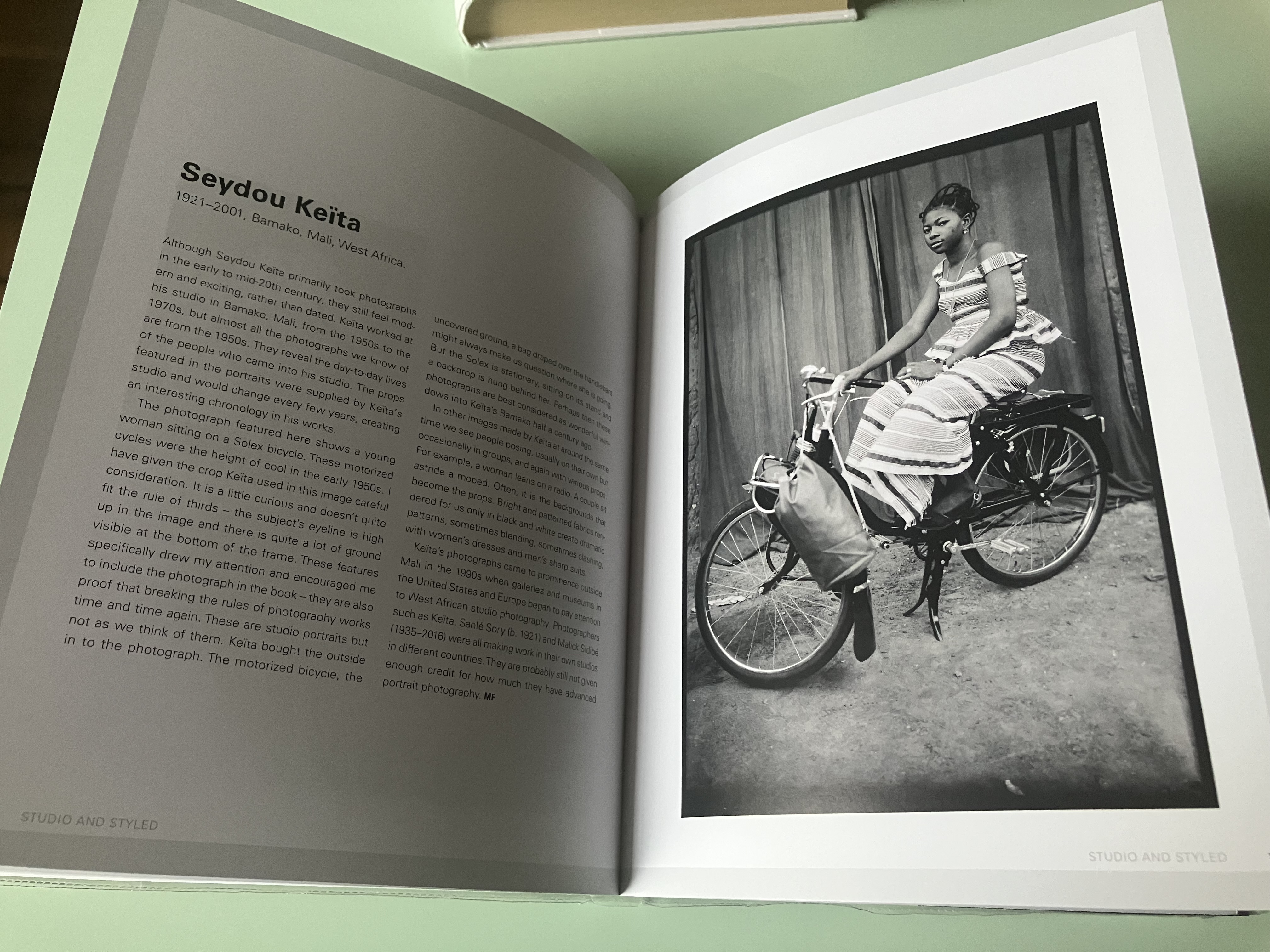
Looking through this library book on portrait photography, the text mentions that the subject below is pictured high in the frame. In that sense, I suppose, it breaks the guidelines and becomes remarkable. The effect, to me, is that the girl seems to ride higher on the bike, giving her grandeur. Simultaneously, the dirt floor of the Malian photographer Seydou Keïta‘s studio is also highlighted. These make it more interesting to me and make we want to know more. I think these aren’t even necessarily intentional on the part of the artist. He seems to have framed quite a few of his portraits this way. Maybe it was a hassle to move his tripod.
4 Likes
Thanks for your post, which I find quite interesting and inspiring. I totally agree with the opinion that culture is the main pillar of art. Creating and receiving art at a “higher level” is mainly based on cultural imprint and individual experience.
The biological basis I see mainly relevant for the “basic levels” of art. That is where most “rules” come into play, the original topic of this thread. Is a picture aesthetically appealing or not, is it coherent, balanced, irritating, etc.? That’s what artists use as a foundation (perhaps even unconsciously). But following the “rules” is never enough to create art. The fascinating stuff happens on other levels. On the other hand, I am convinced that you can not create art without the consideration of human perception. At least no art made for humans.
1 Like
Thanks for reading my jabberings. Totally agree that ultimately it’s a combination. I’m just borrowing from authors I’ve been reading and podcasts I’ve been listening to that kind of circle around this idea:
I never heard of that. Would have to read in more detail. But it sounds quite strange to me because cultural changes and biological evolution work on completely different time scales. As a scientist I am familiar with the principles of evolution but much less with theories regarding cultural changes.
Yes, that’s interesting. My readings are at the popular end of academics’ output so I’m not capable of checking their models or anything. I think that they’re more talking at the level of, say, the human necessity for reputation management rather than a particular artistic movement. FWIW, I like Hugo Mercier (and his late mentor Dan Sperber) who argue kind of against the Thinking Fast and Slow model of cognitive bias, or at least the purpose of that bias. I’m now reading Michael Muthukrishna’s book, with the disturbingly ambitious title of A Theory of Everyone (yeah, smells like publisher’s BS). The Dissenter podcast (much better than the silly name) of interviews with academics is pretty good. Dr Alice Evans has a podcast called Rocking Our Priors. I haven’t read Joseph Henrich’s book The WEIRDest People in the World yet but have heard him interviewed and found it interesting. WEIRD (Western, Educated, Industrialized, Rich and Democratic). Of course, this being academia most of it is contested and these areas of evolutionary anthropology and psychology are prone to just-so stories so caution is needed.