They already maxed out megapixels for practical purposes. Readout speeds are now at the point where they support high-res raw video. Electron wells could be made a bit deeper I guess, but dynamic ranges are, again, more than what is needed for practical purposes.
I assume there is a factor of 2 in light-gathering capacity before we reach theoretical limits. Designs that split RGB inside the pixel (so no need for demosaicing) would be interesting, but again, demosaicing does not bother most people with the high resolutions we have today.
AFAIK the Xiaomi 14 & 15 Ultra have one 1" sensor, and that is the wide-angle one. If you happen to like 28–50mm equivalent photography, you get a smaller “effective” sensor size (because of digital zoom).
I think that the primary purpose of 1" sensor in phones is fooling consumers into buying a phone that costs more than a camera. Unless you are building up a gallery of people with weirdly distorted heads on the edges of the frame, you don’t reap any benefits.
They bin the pixels in blocks of 4, so it’s effectively a 50MP camera. Even if they advertise it as 200MP. But there are really 200MP in those tiny sensors.
Welcome! There are dozens of us!! I’ve had my Fairphone 4 for two years. I have no complaints and am waiting for the 6 to drop in price as its $900 here in the US.
I think after two years I’m ready for a new battery.
Its not the fastest phone, and it’s not the thinnest or the prettiest, but it gets the job done. And it has an SD card slot!! I have all my music in flac locally
It does what it needs to do, I’m not a demanding phone users. I’ve enjoyed it and I’ll have the 6 eventually.
The point of the high megapixels is to reduce blooming. Or so I’ve read. Apparently, blooming is a fundamental challenge for tiny pixels. Electric charge escapes to neighboring pixels. But you can reduce the effect by building more walls between pixels, so a 200MP sensor binned to 12 MP (4x4) has much less blooming than a native 12MP sensor.
And regardless, these tiny sensors are pretty much diffraction limited wide open. There’s not much more resolution to be gained by increasing the megapixels. (And anyways, 12MP is sufficient for most purposes).
Yeah, I think the $900 is pretty high, I hope it comes down in price once they stabilize the imports.
Exactly, one of the many reasons why I picked it 256GB base storage + SD card slot. That way I can finally carry music with me instead of relying on streaming. Even a 512GB card is only 40€ or so.
And I’d say the 6 has a charm of its own, much prettier than a lot of current gen smartphones that have huge camera bumps and glass backs
My understanding was that the motivation is digital zoom: at wider angles they just bin those 200 Mp to a ~12 Mp image, do a 4x digital zoom and you get those 12 megapixels directly (the Bayer components are grouped in islands, so clever algorithms are unleashed to recover detail).
This morning I thought I would take a photo of my daughter dancing (to the soundtrack of Frozen. It has been Frozen for 6 months now. I know all the lyrics). It was indoors on a rainy day, but I actually wanted to get motion blur so I did not mind. I tried for about 5 minutes using my phone, and no matter the mode, some algorithmic cleverness was always applied. No motion blur, but horrible and creepy artifacts.
Finally I gave up and grabbed my camera, nailed the first shot. I like cameras because they do what I want. Even an ancient digital camera with a 1/2.3" sensor is preferable to a flagship phone with a 1" sensor, especially if it has an EVF. An 1" premium compact is bliss. An outdated micro 4/3 body with a prime lens is heaven. An APS-C Sony from last decade with their tracking AF is magic. A prosumer DSLR from 15 years ago is a finely tuned instrument for capturing moments.
Just give me a viewfinder and don’t try to process my bits unless I ask for it, that’s what I have Darktable for.
I’m writing this message from a Fairphone 3, which I bought close to six years ago. Never had to repair anything so far, even the battery is still okay. It did get slower at some point recently, which can be quite annoying. I haven’t yet tried things like a factory reset or replacing the SD card, though, which apparently fixed that issue for some people.
The main motivation for me was the promise of long software support. FWIW, it shipped with Android 9 if I remember correctly, and by now it is on 13, still receiving updates. So I’m quite satisfied.
To keep it a bit on topic: The camera of the FP3 is pretty crappy, but I anyway don’t like photographing with a phone, so I don’t care much.
You’re right. I was thinking especially of interchangeable systems, and Canon had the M system and Nikon had the 1 system. Both of which I wish had survived. But all those manufacturers have very strong full frame lines, and to a lesser extent APS-C lines, so I can understand why they aren’t as interested in compacts right now (although Canon does seem to be reviving its PowerShots).
I mentioned Panasonic and OM System specifically because their compact M4/3 cameras are still very popular, and the lens ecosystem is already large and established. They really just need to invest in the bodies again, rather than lots of lenses to flesh out the system. I think OM System especially could really benefit because they’re struggling to find their niche.
Yes, I’ve been looking at the Pixel 10 too as my Pixel 6 is starting to show its age. In many ways, I want to get away from Google but the addition of the telephoto camera to the regular Pixel 10 line piqued my interest. I don’t enjoy taking photos with my phone, but it is in my pocket almost all the time. Just the other day, a rare woodpecker was in my walnut tree while I was out in the back garden. I took out my phone and managed to take a few shots, but I was really missing having a decent telephoto that wasn’t just a blurry digital zoom.
I had come around to the idea of having a compact camera and regularly wearing a small sling type bag, but I’ve come to the realization that I’m not going to be wearing that permanently when just out in the garden, for example. So, I still want a good camera on my phone. My current phone is good enough for wide-angle shots, but if I can get a half-decent telephoto lens on my phone, why not? For that reason, I think my next phone will have a telephoto, but I won’t be buying a flagship phone because I don’t have money to burn, and my phone camera is really just for emergency purposes.
By the way, did anyone see the Petapixel Pixel 10 review? It showed the 100x Pro Res zoom in action on a sign. The AI couldn’t “read” the text properly so just put an alien language in there instead. I really don’t like that direction for upscaling. I’d much rather have blur than some AI-generated crap.
At least they’re honest and label the picture as “AI generated”. As the review said, it’s probably mildly useful for up to 30x or so, but utter BS at the extremes. It’s the same problem as all AI content: if I wanted AI content, I’d have asked an AI to generate an image, instead of using the camera app.
It’s just so lazy on Google’s part. Instead of actually trying to solve the engineering challenge of telephoto photos from a smartphone, they opted instead to just fake it. It’s as if BMW’s next car did not actually go faster than 100 km/h, but played “woosh woosh” sounds if you keep pressing the accelerator.
The portrait mode looks good and one of the pics even looked a bit like medium format, the improvement in the bokeh/depth model is pretty good. Other portrait mode shots she showed didn’t look that great, there was no transition at all from in focus to out of focus, and the focused area was all at the same focus, which couldn’t happen with a “real” camera unless the photog was using a long telephoto lens.
I don’t think you will get decent telephoto (~200–400mm equiv) in a smartphone-like package, or even something larger. Panasonic had some 1" travel zooms but they are no longer in production, similarly some of the Sony RX100 have extended zoom range, they are now pricy and pricier on the user market. As for systems in production, the smallest I can think of is micro 4/3, one of the f/4-f/5.6 lenses, eg the 35-100mm which is good enough for daylight. Phones top out at ~100mm equiv and, because of size constraints, are unlikely to go further unless there is a drastic breakthrough in optics design.
There should be a law requiring that all AI-generated content on phones produced using an image from the camera should come from a single fictional universe (one for each manufacturer), like the Lord of the Rings or Star Trek. Eg text should be enhanced to Elvish, photos of distant elephants should be enhanced to mûmakil, etc. At least it would be fun.
Yeah, I wouldn’t be expecting anything amazing, but just more than what I currently have on my Pixel 6, which is a 24mm focal length equivalent with purely digital zoom (looks crap after 2x zoom). The new Pixel 10 (non-pro version) has a 112mm equivalent focal length telephoto lens, so that’s a big improvement on what I currently have.
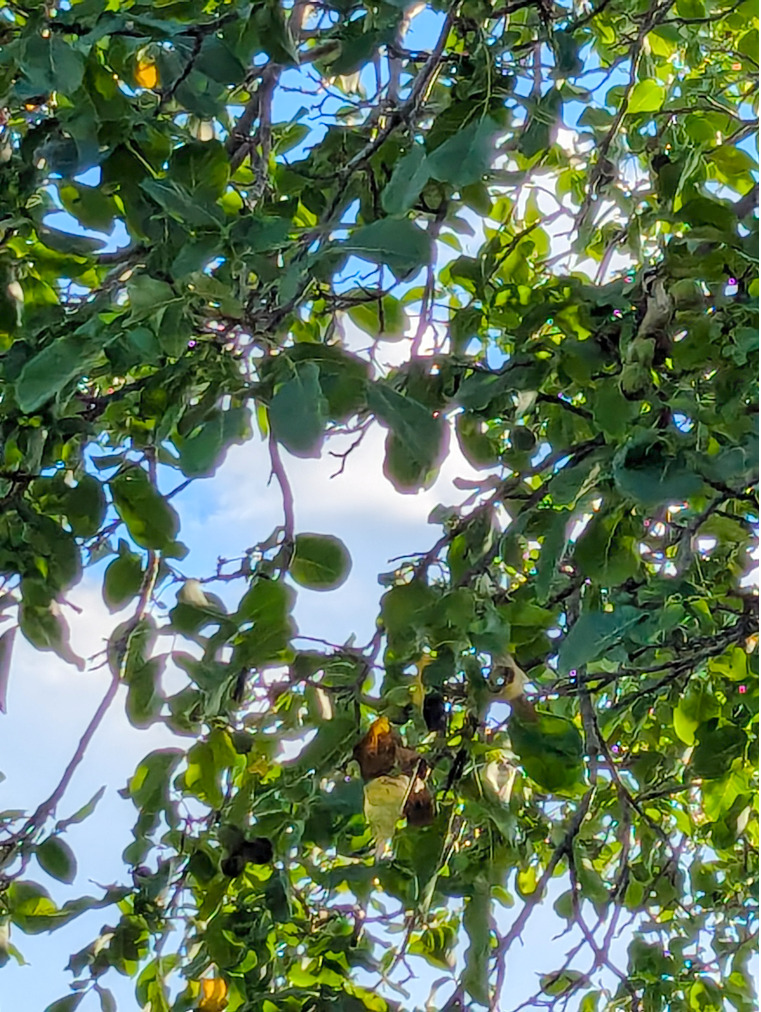
For the woodpecker the other day, I was literally under the tree, about 4 metres away from the bird, but all I could get was a bunch of shots like below. Can you spot it?
My plan is still to get into M4/3 with both a compact (something like the e-pl8 or e-p7) and an E-M1 (Mk2 or 3). I would have a pancake zoom for the compact, and the E-M1 would be for larger lenses when I want to do some proper birding rather than backyard smartphone birding
James Popsys, ever the contrarian, bemoans that “everyday camera” means compact, but unless it fits in your pocket, then size isn’t really that important. Except that he rebought the GR IIIx.

 256GB base storage + SD card slot. That way I can finally carry music with me instead of relying on streaming. Even a 512GB card is only 40€ or so.