What a waste of time and electricity
9 Likes
Interestingly, due to more and more AI entering search engines, I find it more and more hard to perform this step.
For example, I chat with a LLM for a while to understand the domain and get used to their “slang”. Then I would go to other search engines and look for original work. However, because these search engines now also give me LLM responses, I’m stuck in a loop…
4 Likes
Usually LLM’s give you direct sources or at least some places that might suggest those primary sources themselves. You can also ask them for books, websites, for other primary sources, sometimes it works. Overall I agree with you though.
I believe that non standard protocols like gemini(Gemini (protocol) - Wikipedia) or similar will start becoming better and better places to preform this task.
You can use startpage.com; they rely on Google, but without the AI results. Or qwant.com, who do the same with Bing. Or duckduckgo.com (based on Bing). Or kagi.com (based on several providers; they cost money, and some of it goes to Yandex). Or swisscows.com (formerly based on Bing, now they mention Brave, which itself is partly an aggregator). Or ecosia.org (also based on Bing; they spend ad money on planting trees).
(Edit: added domain name for all engines. I did not re-check the providers backing these alternative search sites.)
3 Likes
Well, yes - LLMs now are combined with sources etc, but I had cases where what the LLM stated was nowhere found in the source. But of course, some LLMs do a better job than others.
In school (i.e., before 2009), I learned how to write good Google queries. Back in the days, I was very confident to search online and usually, I found good results even on the first page. My feeling is, that it degraded since they integrated LLMs. Now, boolean statements with keywords just bring you garbage, but stating the problem in natural language gives you decent results - but not exactly what you searched for. I of course don’t have a benchmark problem, but my subjective feeling is, that search got worse.
But maybe this is just a transition period. One could say, that “back in the days” we learned the language of machines to get knowledge (i.e., boolean operators, keywords, …) but now machines learned our language. Is it good? Is it bad? I have no idea. I only know that looking for information online often does not work like it did before (for me).
2 Likes
At least when you point this out to the LLM bot, it will praise you for being extremely perspicacious and smart.
2 Likes
I will probably never read “You’re absolutely right” the same way again.
Also, I hate the way LLMs praise you for correcting them and such, especially voice replies. It feels so off, but people seem to like being treated like that.
3 Likes
I hate it too, but I am guessing that it must be heaven for narcissists.
You can try to add things like “be technical, precise, objective; do not flatter me; point out any assumptions explicitly; back all claims with verifiable links”. Of course, it’s better if you can add that to the system prompt. (Note: with aistudio.google.com, you can get free access to the models and do research; as it’s a dev account, you don’t have to pay, as long as Google believes that you are ‘experimenting’. Assume absolutely no privacy there, of course: the non-paid version is used for subsequent training.) The relation to search is that ‘Grounding with Google search’ is on by default, so it does search the web. Using the Gemini Pro model, I find it is a useful tool.
1 Like
Can we do that at all with anything google offers us – including privacy from google itself?
Sure, but here it’s explicit. Normally, Google ‘just’ makes a profile to tailor ads / sell ‘anonymised’ data. With the AI Studio in unpaid mode, your chat details may appear verbatim in training data, and thus also in output.
1 Like
I have added something like this to the model I use (atm usually GLM4.7) and it works reasonable well. The “back all claims” is a bit odd, though. At least GLM tries to add always some citation in the end - which many times are hallucinated. Perhaps it depends on how you wrote the instructions… But in principle, yes, using a system-prompt / memory works good to fine-tune the response.
I find chat gpt to have gotten okay at app coding over the past several months, especially from model “4o” to “5.2-thinking”. Before it could easily handle individual algorithms for you, but now it can give coherent ready-to-run code systems. It doesn’t keep repeating the same errors over and over. It now plans future code revisions in a final analysis step. It can display how it is linguistically parsing your prompt. The responses are more precise and academic, without all the personality flavorings and cliché.
At the time coding with AI was becoming more of a big deal, it was actually kind of a headache compared to now. Hallucinating non-existing functions as wishfull thinking was a big problem then, but now relies more on evidence-based decision making.
In non-programming, it’s been useful in deciphering hand-written math formulae and crunching numbers, I’m sure that whole process has improved as well as the coding situation.
In image creation, it is doing better at changing a photo into a painting style.
It’s not doing any more “thinking” than before, but it is adding layers of antagonistic reiteration as a means of double-checking itself before presenting a solution.
1 Like
I’m near the end of reading this book and found it a useful introduction to the efforts by the main corporations and governments involved to try to profit and/or become dominant in the technology. From interviews I’ve seen elsewhere, the author is on the left, though to be fair that mostly doesn’t come across in the book, which I think remains pretty neutral in its analysis.

https://www.wiley.com/en-us/Silicon+Empires%3A+The+Fight+for+the+Future+of+AI-p-9781509550487
He has a substack that I haven’t read.
1 Like
@HIRAM I use Copilot at work as part of my personal tool set because it included. I would say that it is improving overall with fits and starts.
I think it comes down to a few things.
First, it is about priority. How much is your employer or are you paying for it? The more you pay, the more giving it is.
Second, it is not just about training the LLM, but training the human. I have built a high tolerance for sessions now, which can be a bad thing because it sucks one in like doom scrolling. I know how to write prompts that maximize success.
Third, newer iterations are more honest. Not super honest. Copilot conks out saying that it cannot proceed any further because it is not allowed to. Not because the user talked about anything forbidden or illegal. In most circumstances, it just did not have enough computes or tokens, or something crashed. Before, it would ramble; now, it just fails.
1 Like
Haven’t read the book, but as an economist I am curious about how people expect to make money from an industry currently making a loss.
Sure, the story they sell investors is that there will be a few dominant players (or even a single one) and then, being in a monopolistic situation, they will be making tons of money. But historically, as technologies mature they become commoditized, which means lower margins. The people who will be making profits may not be the original innovators, but those who can run it the cheapest.
It is interesting to see how Apple is staying out of this, even though they have been innovators in a lot of areas.
1 Like
Yes, general purpose technologies like electricity, railways, etc. mostly benefited society over their innovators but, ya know, “this time it’s different” 
1 Like
They’ve just bought an AI startup (recently, there was an announcement that they rely on Google Gemini for AI). Though it may be more limited in scope:
1 Like
Claude does an ok job of summarising the various strategies outlined in the book (screen grab below), though it misses that Meta’s Llama isn’t really open source and the goodwill it hopes to leverage for reduced programming costs is by now more PR than reality. Also that in the author’s view, as of mid-last year, it was falling behind frontier models. Amazon’s strategy is to use scale and cost efficiencies with vast volume to try to create a moat for its data centre network, as I understand it. OpenAI and, maybe more so, Anthropic hope to benefit from breakthroughs in “cutting edge” models (while hinting at transformative AGI to try to keep investors on board). But they have to balance resources spent on the general models with the need to invest in making AI tools with use cases for specific industries. Like this:
There’s also been a lot of chatter about Claude Code (and some even arguing that it means the end of standalone software!)
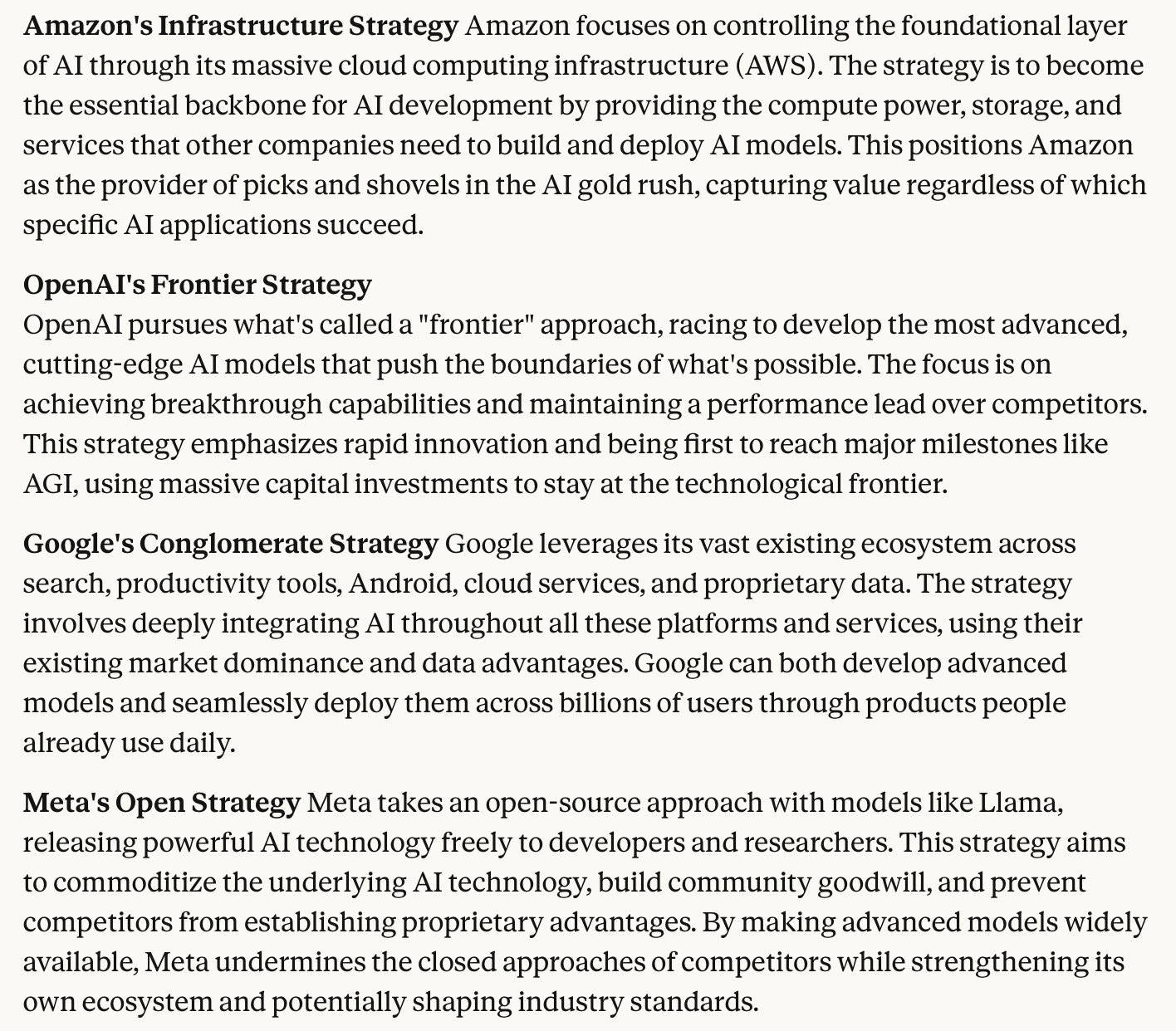
The book also compares this bleeding edge stuff in the US with the Chinese strategies of just rolling stuff out into society, or “diffusion”, partly because of a lack of squeamishness among people there over privacy, given the place is already deeply and obviously surveilled.
Edit: Just realised this might breach the no AI answers policy… will remove screen grab and summarise by hand if so.
1 Like
I studied non-LLM keras machine learning years ago before the AI slop takeover. I built a system that predicted crypto price fluctuations, and confirmed prior research that yes you can predict it, and yes, the trading costs would probably erase any profit (we only predicted and pretended to trade).

It tracks 8 different time series to train the predictor, in this case, 8 different coins. My trainer ran for 60 days, updating every 5 minutes and produced a coherent and, after algorithm tuning, a verifiably usable set.
Those were simpler days, although maybe it is actually simpler now that the agents can manipulate really complicated GANs on the fly by themselves.
I don’t buy into the writing, research, and artistic use-cases for AI at all, mindful that we are supposed to resist the tempation to code and put max effort into study and design.
4 Likes