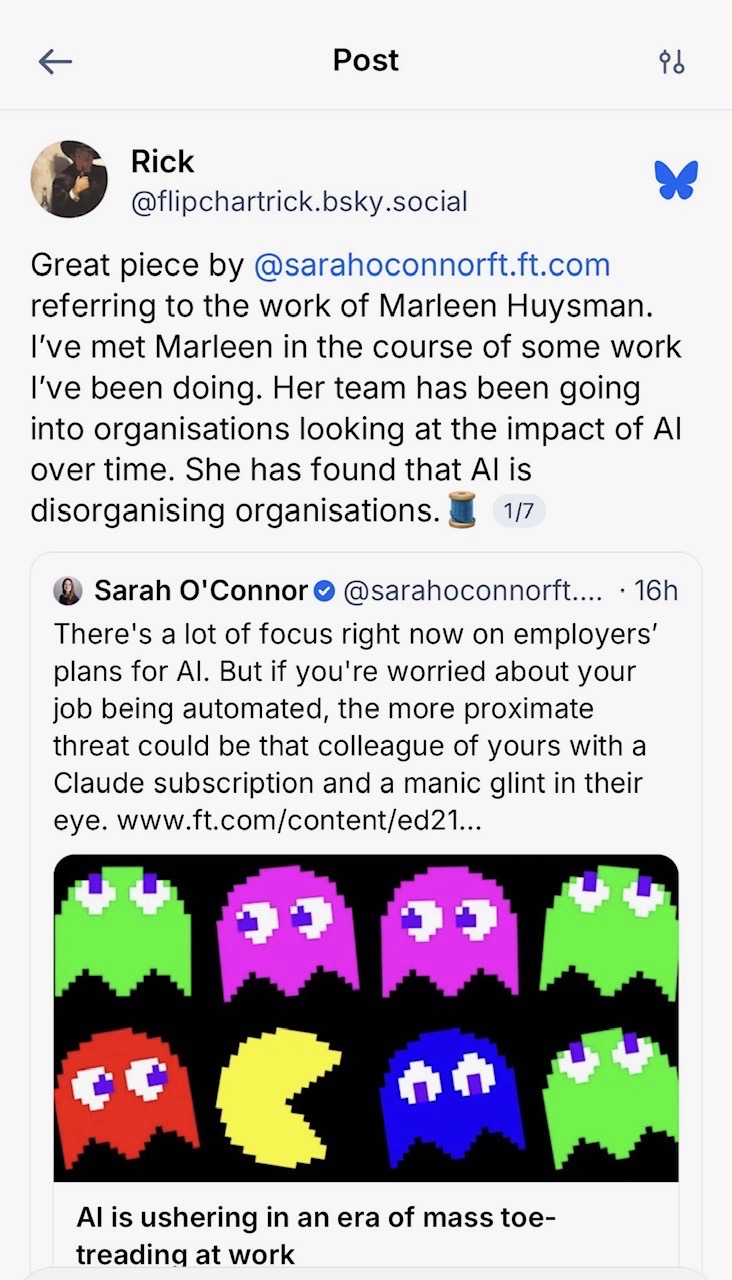
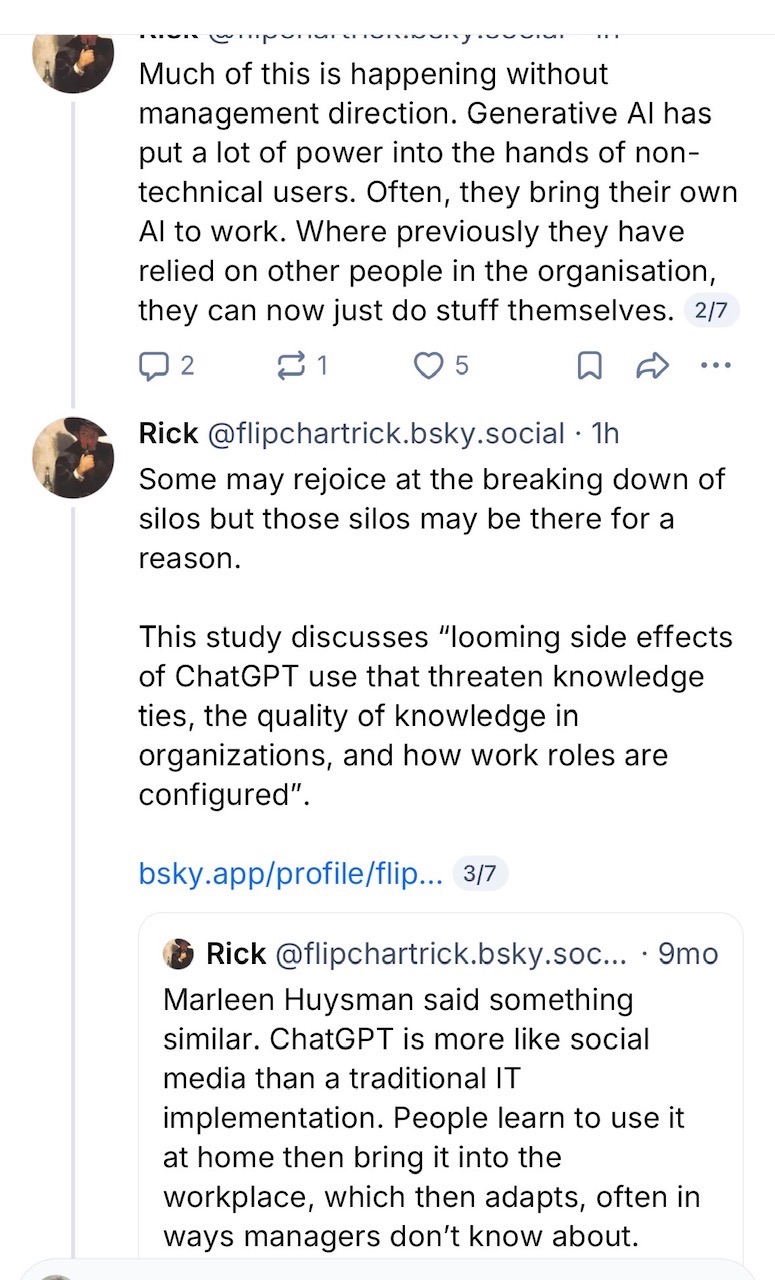
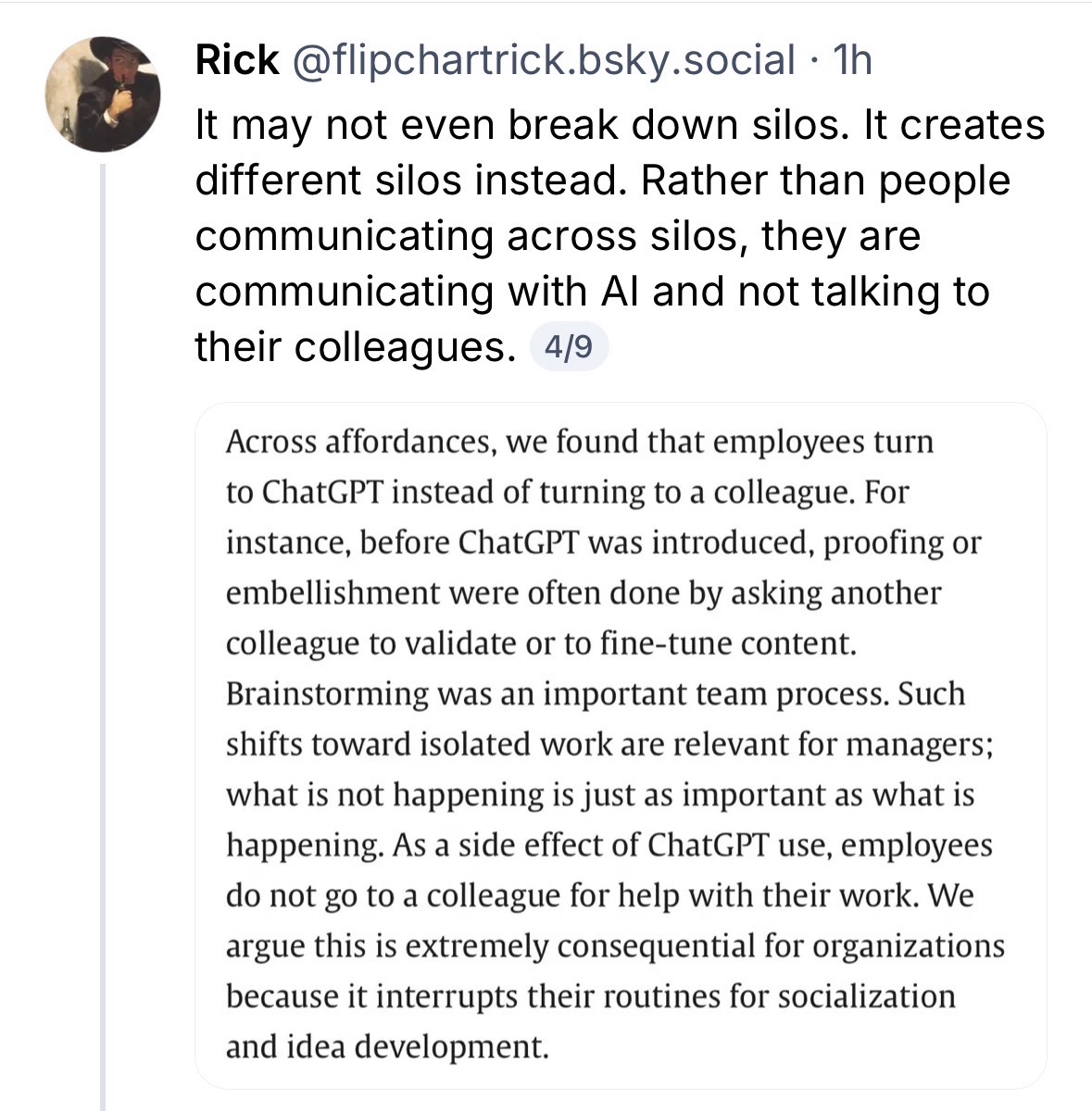
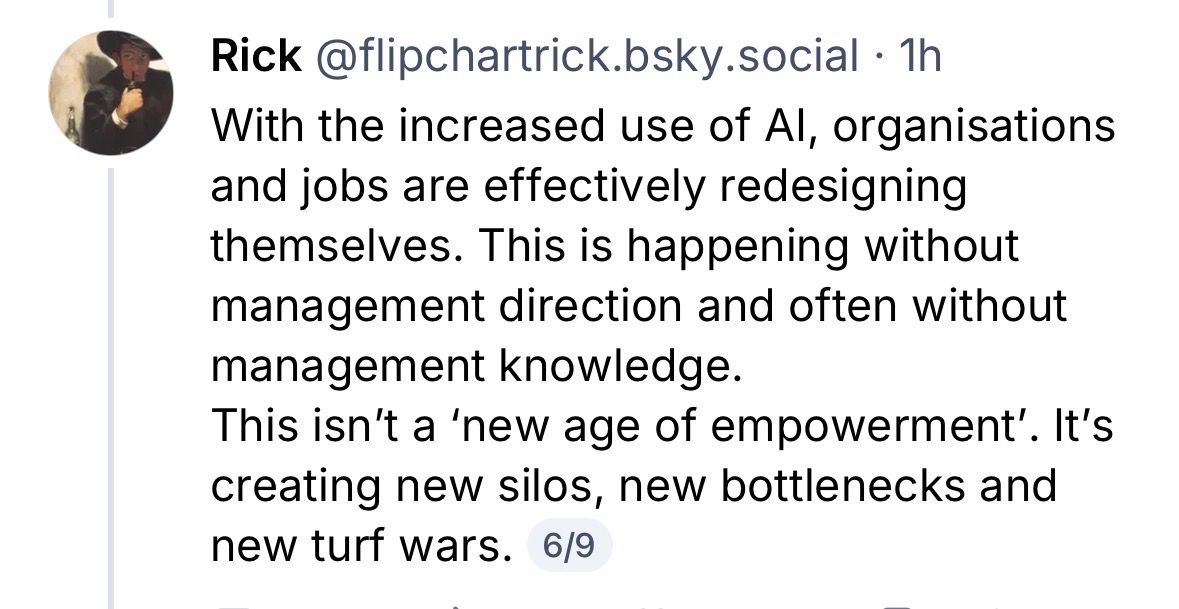
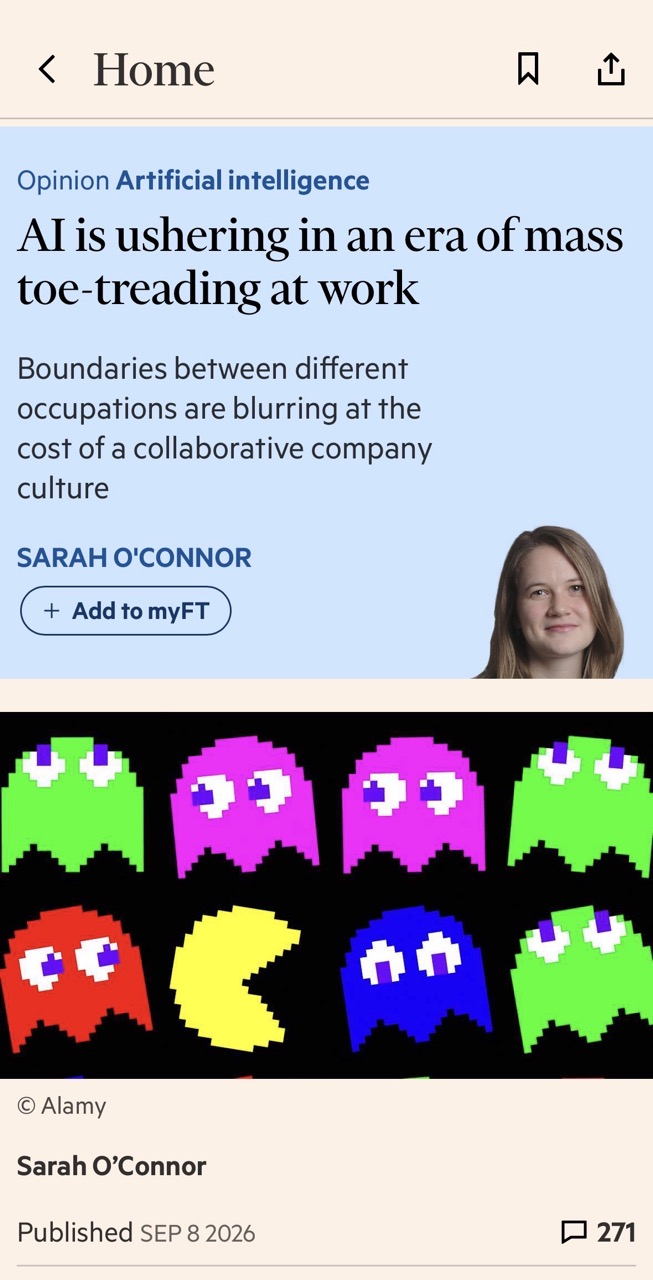
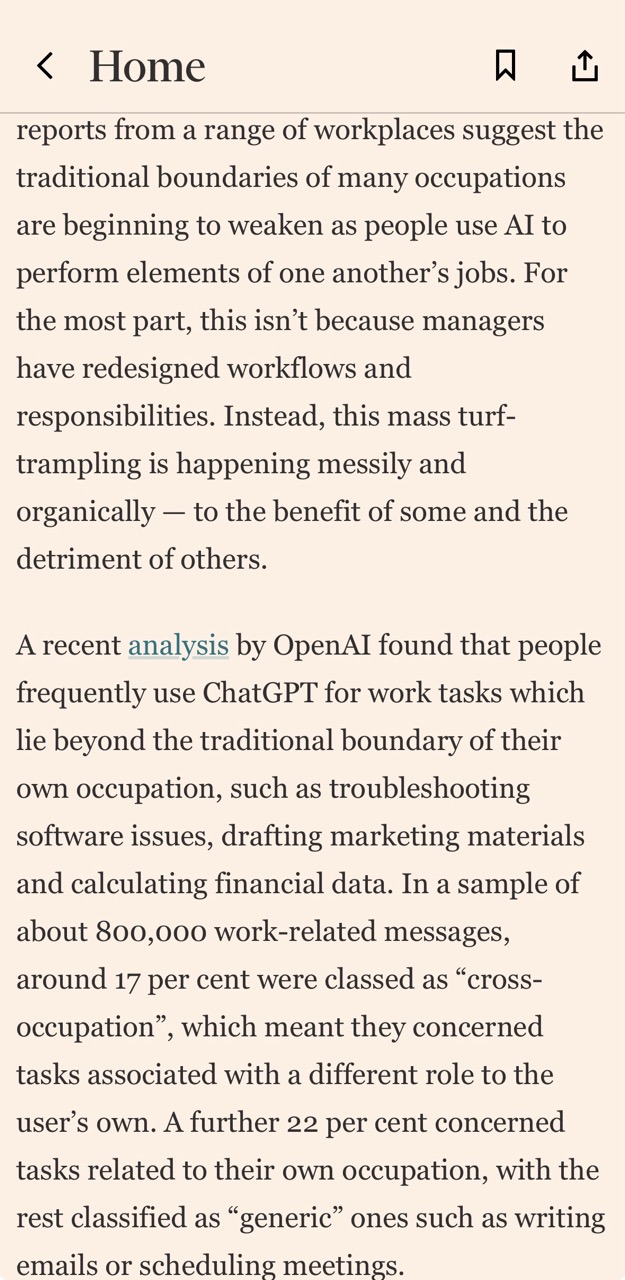
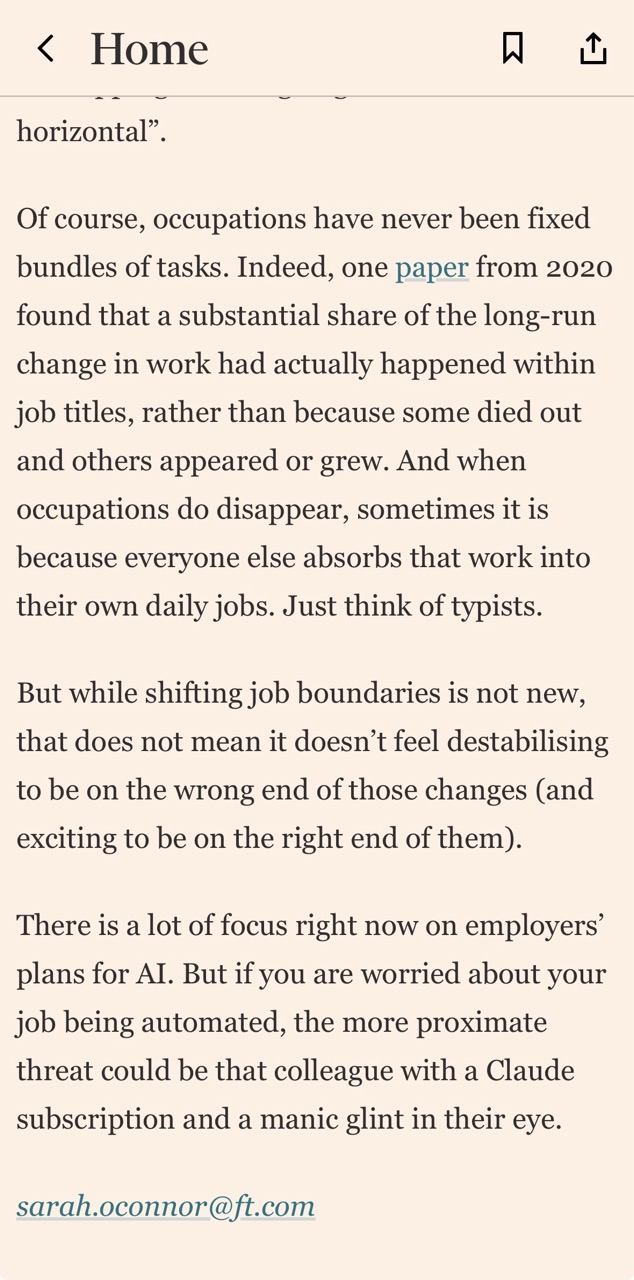
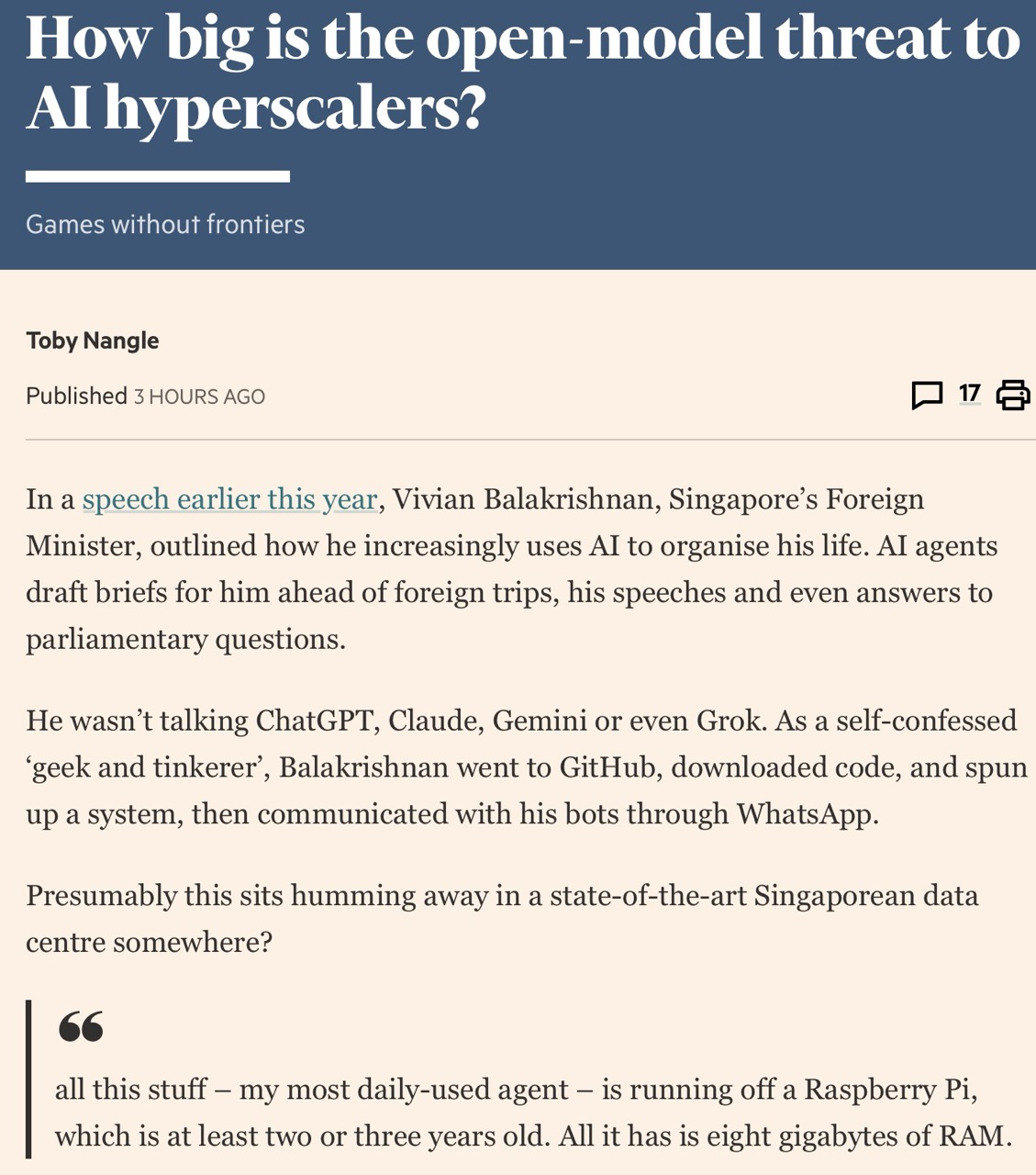
I saw some some Bluesky posts related to an FT story about use of AI in the workplace that seem kind of relevant.
3 Likes
Free to read by creating non-paid account.
https://www.ft.com/content/48588acb-8026-4c8e-aac7-8b5588294dbf?shareType=nongift
1 Like
So the foreign minister of Singapore is using a small and probably dumb as hell model to influence all his decisions? What could go wrong? 
3 Likes
Don’t need much intelligence to copy and paste China’s foreign policy, tbf.
2 Likes
Once upon a time, this would have been a sexist remark


4 Likes
There’s currently some hubbub about the Dutch prime minister apparently having slopped some social media posts. Because of course he did. He’s not sorry about it, either, it’s a handy timesaver as far as he’s concerned.
Not sure why he needs to spend time creating soundbites on social media to begin with, but that’s probably just me being old-fashioned.
1 Like
Of course I don’t know any details but superficially somehow I can’t escape the feeling that an important – and potentially non-reversible – threshold may have been crossed by your coworker. Just my impression but once a human starts implicitly treating a computer as human / sentient / whatever, it’s a profound concession that’s non-retrievable. Maybe it’s my personality, but I get internally cringy if I get too close to “talking with” a computer rather than directing / operating it as a machine.
4 Likes
Just being curious: did you manage to fix the issue? If yes, did talking to this LLM help?
As a manager, this would be my primary concern. My second concern would be about how much and what kind of internal data is going through Anthropic.
1 Like
That’s the feeling I got, too. But in reality, I suppose it was merely a difference in tone and trust.
My colleague is in a much more functional-programming style environment, with long test cycles with large data. Claude is a fantastic help for running various data sets and code versions over night, or while you work on something else. That’s a low-risk job, and my colleague learned to trust it with these jobs.
My code usually can’t be so rigorously tested, so I need to verify a lot more, and use my own domain knowledge to think things through. Claude is much, much worse at that. Thus my trust levels are much lower. I also need to switch tasks much more, so Claude can’t build up as much knowledge.
2 Likes
Yes indeed, we did fix the issue. It was the darnedest thing: we had changed a heuristic for a detector, which was now more sensitive. A new image type triggered it on a false positive, which lead to a crash. But the heuristic in question was loaned from a different system, so the log messages pointed to the wrong system!
This was very difficult to debug manually, as it didn’t occur to us that this system was even connected to the issue. The LLM just doggedly stepped through the log without even trying to understand, and correlated each log line with the possible code paths that lead there.
Once that mechanism had been established, the fix was relatively trivial. No doubt we would have found it manually, too. But this had come right after a hairy merge, so my bias was squarely on a regression from that merge, not a coincidental new image type. I find LLMs very useful in general for triaging bugs like this, and log analysis in particular.
2 Likes
Same here.
I also find them useful for checking math implemented as code. Though recently I had a false negative where the LLM in question assured me that my code was correct (and also praised me for writing, small modular functions). But the code wasn’t correct, which I only found when I refactored.
I’ve been doing a bunch of metadata things of late, and I’m finding out how obscure that part of image processing really is through the incomplete responses of some of the agents. Gemini in Google search, for instance has told me a couple of times a particular library can’t do something I know specifically it can, so, what, that’s not a particular element of its training corpus?
Heh, no one wants to learn metadata… 
4 Likes
LLMs are widely known to provide positive reinforcement, rather than point out your errors or fallacies.
2 Likes
I don’t know if this the thread for it, but once a week we get a new ai vibed raw editor in this forum. And they come and ask for feedback and to join their solo team of ai vibers. They outsource all they can, not only developing, but also testing the tool.
Edit: sorry, maybe I went on the wrong direction on my rant. Of course we need to get help from others in a big project.
2 Likes
Yes this is something I’ve noticed in the self-hosting space as well, it seems the vibe coding is starting to erode people’s will to work together, because why deal with other people if you can just make the thing yourself with minimal effort.
There are now a ton of jellyfin clients, epub severs, arr managers, homepage dashboards, etc etc. 
4 Likes
Yeah, I agree with you, it’s starting to get a bit annoying tbf. Each week a new photo manager or raw developer. Many will end up as abandon-ware soon enough with nobody to maintain it. Unlike one man shows before, which had a developer very intimate with the code base, these new developers have one developer limited by how much money he can spend on tokens.
In counter part, I have been following darktable’s development a bit, reading issues and prs, and at least there’s cooperation, bots are used to catch and report issues, gtk4 migration is finally picking up steam, and I think a good job is being done dealing with the influx of stuff.
Don’t get me wrong, I wish we had no LLMs at all, but sadly it’s not avoidable especially for big projects, so good strong maintainers are necessary.
Before this I could almost always trust any project to self host because it was a labor of love, now anyone picking what to install has to do even more research…
Fascist distros…
2 Likes
This very recently published website is super relevant to this thread https://mathandai.org/
3 Likes
Darktable has the momentum of having been developed by a lot of really great people who took the time to understand the code. Hats off to them because they did an amazing job. In a project like that, a bit of LLM assistance at the start isn’t going to degrade the project. And maybe it will stay at some stable level too.
What I’ve seen in the new Raw editors though is emphasis on new features but not much understanding on the final polish. Maybe AI will get even better one day to add some of that. Hard to tell, but I don’t think so.
But regardless, even if so, something has been lost. It was quite impressive how developers in the past put some of their own will into the software and really pushed it through with their own hands. With some sufficiently large percentage of the codebase AI-assisted, that fades away. It’s a continuous process so the more the AI, the less the software represents the hard work of someone putting love into the thing.
I’ve seen a lot of vibe coded apps too, or heavily assisted ones. It’s just not impressive and it takes something away that’s hard to describe. I know a lot of people won’t agree with me, but I think that’s just justification because they enjoy the shiny.
To me the feeling is almost like this: a friend takes me out for a birthday dinner and it tastes great. But the next day I hear that friend talking behind my back. Because no matter how practical software is, I still consider it important that it brought people together in the first place, and too much automation, whether it’s from AI or something else, erodes that and to ignore it is to be a fool.
4 Likes
Exactly. It somehow reminds me of another ‘period’ in the software world.
When I got into computers in the mid-'80s for some reason I really got into text editors (on MS-DOS at the time). I tried all I could get my hands on, constantly downloading them from BBSes.* It was really interesting how each developer had their own idea about what made a good text editing tool – especially before CUA and standardization really set in. And that doesn’t even include the whole *nix world once I got into Linux in the early '90s.
But the point was, a text editor was a stage where a good programmer could really show off their chops, at least for those who were willing to see it. Then editing libs / components (e.g., Synedit, Scintilla, etc.) showed up and, for obvious reasons, really took off. Having a competent editor was then a fraction of the effort required before they were available. Certainly not trivial, but MUCH easier. And that’s no slight AT ALL against the components – They’re great (I love Scintilla, in particular). But a sort of “sameness” set in. And soon there was no compulsion to try a new editor, because you already knew what it was like.
Not exactly the same as vibe coded raw editors, but both contexts somehow seem conceptually similar to me. The difference is, text editors got “better”, but vibe-coded apps…??
* Side note – I found a Windows version of TSE (The Semware Editor, descendant of QEdit) the other day and have been playing with it for a while. I won’t keep /use it long-term in light of other tools I already have and know, but it reminded me of what fun all those TUA apps were, back in the day. Anyone remember TurboVision?
<memory_lane_trip = OVER>
3 Likes
Here is where you’re wrong: just make a strong s visible stance against it as a project. Reject additions at seem to be using LLMs. Doing that will pretty much avoid it, it seems.
2 Likes