I was thinking something similar the other day. After accusing its critics of continually moving the goalposts on whether LLMs are impressive (we already passed Turing Test!), the LLM community is continually moving the goalposts on what counts as AGI.
2 Likes
I think this is currently the most relevant aspect of AI/LLMs.
2 Likes
I am a .net developer, and every time I run dotnet build in one of our projects there are new warnings about security vulns in one or two of the packages we are using. Most of these packages come from Microsoft directly, as they have decoupled functionality from the .net framework, so now a lot of stuff is distributed in additional imported references. I reckon they are running bots 24/7 on all their code bases to find and fix whatever they can find.
1 Like
The great thing is: eventually,
- most vulnerabilities will be discovered with current LLMs,
- second-tier LLMs or small open models will be good enough to discover problems like this, yet cheap enough to run in routine CI,
- catching most vulnerabilities before they are released.
This is something AI is getting to be very good at: a thankless, unrewarding, combinatorial task that has to be performed relentlessly and repetitively, and is very important but very few humans can or like to do it.
And as a result, it also eases the way for even more software complexity in our lives; more advanced operating systems, more advanced, devices, etc. I for one would rather that society hit a wall in terms of how much software and computers invade our lives, rather that move further forward with it. AI is only a good thing if your objective is to introduce even more innovation in software.
Like all things, I think the level to which computers and software should be integrated into life has an optimal point at some finite time of development, after which further development only decreases the quality of life. It seems to me that every technical development these days solves one problem but brings five new ones, resulting in an exponential increase in our problems.
1 Like
I think our world is already wildly oversaturated with software. Look at how many raw editors there are, how many Linux distros, how many text editors. LLMs won’t change this dynamic significantly.
The challenge is already, how to pick good software in a sea of stuff, not how to find software. This does not change with the sea getting a bit bigger.
As for software development, I’d wager that 90% of business software is accidental complexity. But the challenge of large scale software development has never been, how to solve a business problem; but how to manage thousands of software developers. Necessarily, you need to introduce layers and abstractions, and complexity every which way, just to allow this level of parallel development. And again, this complexity only gets worse with LLMs.
Without squinting too hard, LLMs are just another way of outsourcing; and we all know how difficult it is to successfully outsource software development. Now everybody is doing it, and I have popcorn ready for the inevitable realizations.
What we need to figure out is how to build smaller software. LLMs are utterly terrible at that, as their mode of thinking is intrinsically additive and synthetic. They do not posses an analytic mind. In other words, what we need, is good software engineering, not faster coders. Same as it ever was.
3 Likes
100%. I still like the old UNIX philosophy of having small, simple tools that perform well-defined tasks and are self-contained. They could be troubleshot (is that a word?) and audited, easily. They were combined by the user or programmer to accomplish more complex tasks.
Those days are long gone.
4 Likes
I wish, and I doubt. People are just lazy and will take the path of least resistance, which means less and less optimization with more and more RAM and CPU available. (Note, when I say lazy, I don’t mean individuals necessarily are. Some devs really do care about this stuff. But when put in the system where the goal is to make a profit, laziness is the inevitable emergent phenomenon of the system.)
This is true and software has actually gotten simpler over the last 10 to 15 years. Both due to better hardware, new languages, and corporations embracing open source and leaving proprietary frameworks and languages behind.
There was so much legacy Microsoft, IBM, Oracle, etc, bloat everywhere in corporate software. There still is, but to a far lesser degree.
I don’t get this argument. You talk about complexity, but optimization is a lot of times what leads to unnecessary complexity in programming.
2 Likes
Seeing these moving goal posts, I am thinking about where AI sits today on the Gartner hype cycle…
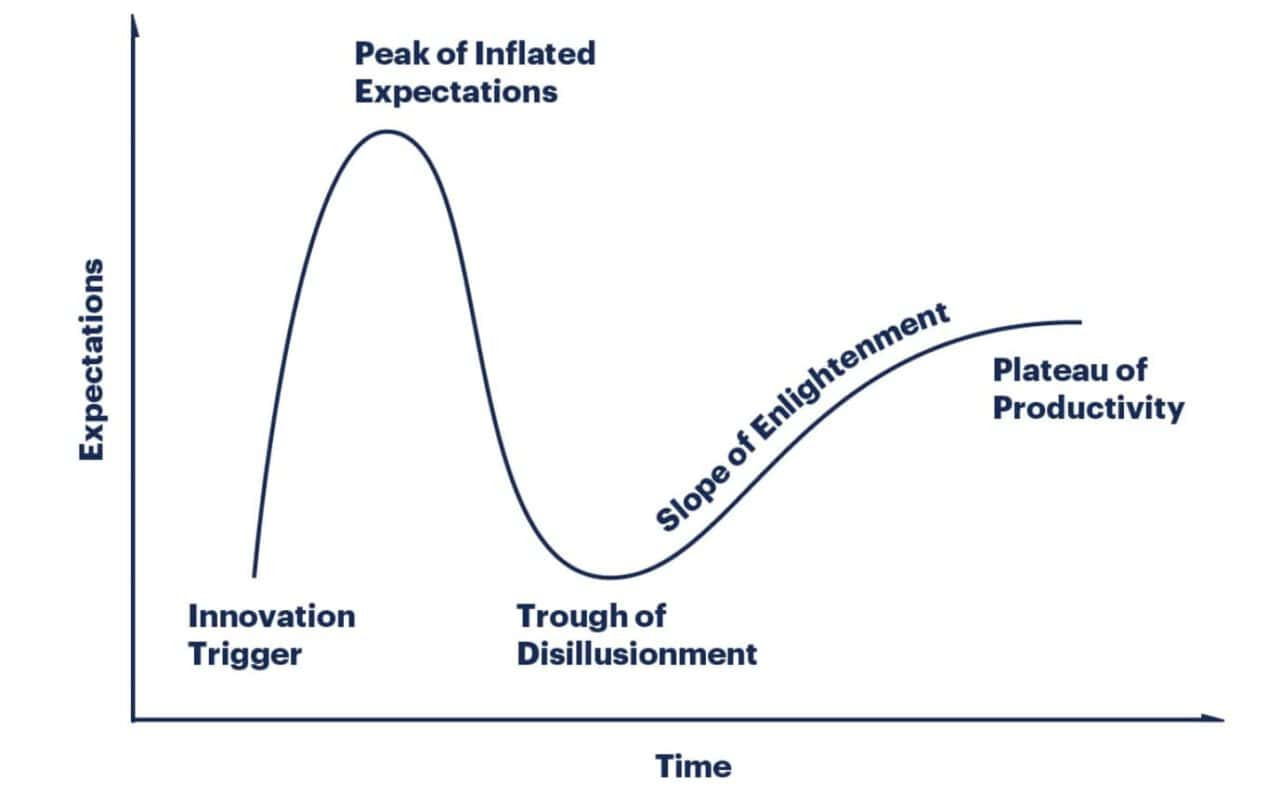
I would say that we have slowly left the peak, but we are still rather close to it. However, we are starting to go towards the Trough of Disillusionment.
5 Likes
Do one thing, do it well
6 Likes
I just watched 30 seconds, realised it’s from the UK, and now I am embarrassed for my country.
4 Likes
In a few years your photo will only be “verified” if you use “verified” devices, “verified” cameras and a “verified” RAW developer 
1 Like
I’ve been embarrassed for my mother country (I moved out 20 years ago) since 1979. But some moments are worse than others. Reading this review in The Guardian (online) yesterday was not one of the better ones.
It caught my eye on account of the rare Guardian zero stars rating.
…all for a nominal auto-renewing service fee subscription, naturally.
4 Likes
I think this chain of verification is answering the wrong question. In a flood of images, a tiny percentage of them will be “verifiable”, but as for the rest, they could be real, totally AI generated, severely manipulated, something in between, etc.
I think the EU’s Article 50 labeling (starting this summer) is a much better approach: if you, as a company, show consumers AI content and don’t label it as such, be prepared to pay up to €15m or 3% of your global turnover as a fine.
3 Likes
Well of course it’s better, the EU still has some public good in mind, meanwhile Apple only cares about selling more iPhones 
Just like TPM, this is yet another chance to lock people into proprietary hardware and software
1 Like
I foolishly clicked a “starter pack” to instantly add a load of AI/ML-related people to my socials (BSky) thinking it might balance out the accidental anti-AI bias in my feed. And now, in and around California hours at least, I’ve created a rabbit hole of cultish lunacymaxxers and their critics. This stuff seems deeply weird even after i’ve observed the (not unrelated) effective altruism phenomenon go off the rails in the past decade, from the idea of providing malaria nets to poor countries, to one of accumulating all the money in the world to spread trillions of future humans across the universe.
2 Likes
2 Likes
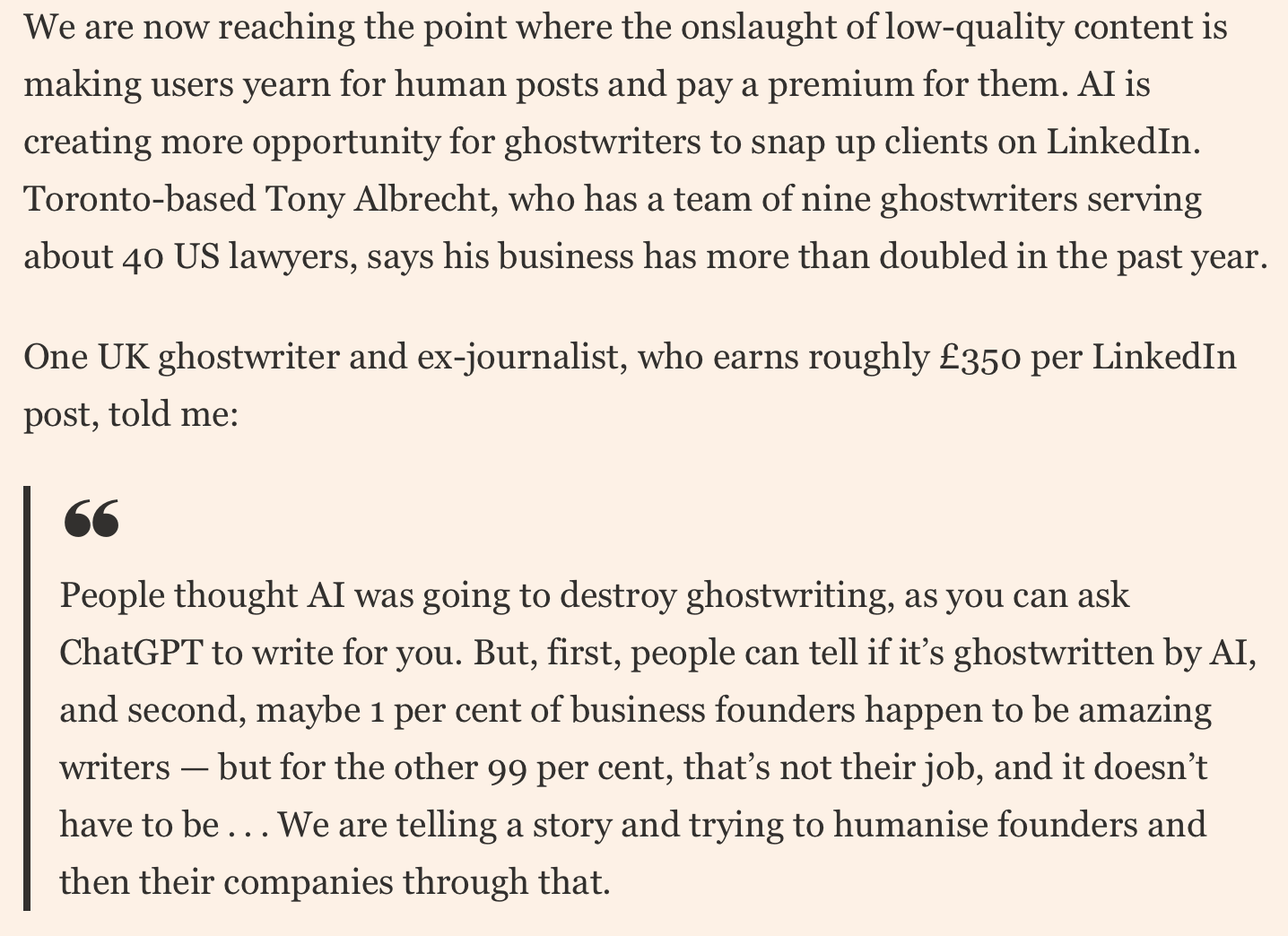
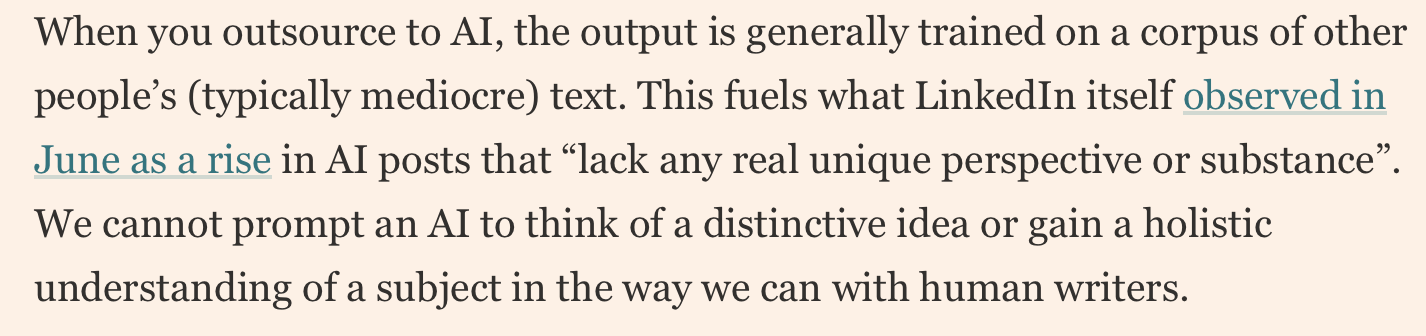
AI is creating ghostwriting jobs on LinkedIn
CEOs are looking for a more human touch
https://www.ft.com/content/7a5e15e4-799a-4476-ba9f-018b1d82c76f?syn-25a6b1a6=1
5 Likes