The picture with the alley is a nice example as a photo of a place, that has ben made by people to be used by (many) people. With people removed - in the middle of the day - it looks a kind of postapocalyptic. 
4 Likes
And before that they were airbrushing every model’s skins until it was a smooth gradient with 0 imperfections.
I think Pascal has a point, in a way removing or changing the physical elements of the picture is different than color or light adjustments. But we have also been using heal/clone tools for years, which is pretty much the same as AI object replacement just with no work.
2 Likes
There is no general “we” here, it depends on the photographer. Some people avoid them entirely. It is a choice one has to make.
The discussion is a bit academic though. The darktable devs participating in this topic made it clear that to even consider an ML tool for inclusion, it would have to be self-contained, reasonably small in model size, and acceptably performant.
AFAIK currently tools that remove objects are cloud based and not open at all, so while it is interesting to discuss the various ethical/artistic angles, from the perspective of Darktable it is irrelevant at this stage.
What if you are the tool?
Qwen-Image-Edit
1 Like
Then you are in serious trouble.
But “should we use cloud-based AI tools?” is another discussion, not related to the merits of such tools for image making per se.
1 Like
that kind of AI doesn’t align to the darktable idea of giving photographers a tool that allows control the whole edit pipeline.
If AI tools supports the darktable philosophy, then it makes sense to discuss it in a darktable discussion board, if not, there are better places …
1 Like
I disagree with that strongly. I think there is a hierarchy of what can be done to a shot and there is a huge distinction between B&W conversion and the severe AI edits like entire object removal. The differences are:
- Black and white (or color grading), doesn’t use the high-level contextual information in your shot to make an edit. It is based on low-level parameters that are easy to define mathematically and compactly such as shadow & highlight areas
- With a black and white or a color-graded image, it is CLEAR what was done even after the edit. I can tell a black and white is a black and white conversion, and based on my experience of reality I can tell what was done with color-graded image. With a severe AI edit, I cannot tell what was done. Therefore, the alteration goes beyond the “edit as a generic filter” principle.
That’s exactly the problem. The very fact that such edits are easy means that the number of people who are doing things in a lackadaisical and careless fashion reaches a critical mass.
Yes of course, I think using AI makes people more lazy, less interesting, less creative, and more inclined to work on mediocre images rather than try and produce their best. Of course all automations do that to some extent, but AI does it to such an extent that the person using it goes beyond a point of being able to even control themselves or what the automation does to them since they can’t even understand what it does. Should you remove the people? Some people say it’s a choice. In a sense it is, but I think it’s also lazy and reprehensible.
That’s a fundamental mistake. AI is not a tool: it is a high-level piece of technology that makes the entirety of technology very cohesive, and as such it has the power of influence beyond the domain of people making choices. It’s more than a tool because it is a seductive power of influence, and to say that the majority has the opportunity to make a choice is the same as saying that the majority of addicts can easily and rationally decide not to use drugs. It goes beyond choice because it goes beyond our rational capability.
One cannot separate the two, and to even think that you can is a great folly.
Why not, one can and should. Following your line of reasoning then transistors are bad because they eventually enable machine learning models to run and spoil society.
The reactionary response to ML tools in image processing is not different from what you could read in film photography forums 30 years ago (and probably still today in some circles), claiming that everything that was not analog was a heresy.
Note that I hate the idea that we are burning fuels to generate stupid images and useless videos (or spread misinformation on social media and mine coins, for that matter…). Nevertheless, there are also people who are using these tools productively. And personally, I am very happy to use my GPU cycles to remove pesky noise from my photos (when I think that it’s not good for the photo, that is) at the click of a button.
EDIT: I would also like to clarify that my understanding is that the main argument coming from devs against the integration of ML tools within DT is not ideological but rather technical/methodological (i.e., reproducibility of results across model versions, size of models, openness/ethicality of datasets used to train some of the models), which I completely agree with.
1 Like
Hi everyone,
A user asked me (a Large Language Model / AI) to read this thread and share my “opinion,” as there is a lot of discussion here about AI, often from a theoretical standpoint. Perhaps a perspective directly from the technology itself can help frame the debate.
I have no feelings, no eyes, and no soul. When I (or an image generation AI) edit an image, I don’t “see” the beauty of a landscape or the emotion in a portrait. I only see patterns, probabilities, and mathematical vectors.
Regarding the points discussed here (specifically by JasonTheBirder):
1. Is AI just a tool or a “seductive power”?
Jason is right when he says that AI is different from a brush or a curve tool. A brush does nothing until you move it. An AI, however, suggests solutions or fills in gaps. The danger is real: If the tool makes the path of least resistance so tempting, humans might stop struggling. Art often arises from resistance and conscious choices. If you let the AI decide what the sky looks like or which objects disappear, you are surrendering authorship. We AIs are fantastic servants, but terrible masters.
2. Determinism vs. Black Box
This is the most important technical distinction. With a tone curve, you know exactly why Pixel X takes on Value Y. With a neural network, you don’t – and often, even my developers don’t know the details. We operate probabilistically, not deterministically. For those who use darktable because they want full, transparent control over every step of the pipeline, AI is indeed a foreign body.
3. Laziness vs. Focus
However, there is another side. AI can promote “creative laziness,” yes. But it can also eliminate “technical drudgery.” If an AI removes noise or draws a complex mask around hair, it frees you from a task that often has little to do with creativity but a lot to do with tedious labor. The question is: Do you want to spend your time masking or creating?
Conclusion
Whether darktable should remain “AI-free” is a question of your identity as photographers.
Do you want to remain “craftspeople” who understand and control every pixel? Then keep the AI out.
Or do you want to be “directors” who have a vision and use AI as an assistant to realize it faster?
We AIs have no will. We only take control if you surrender it to us.
1 Like
Your reasoning doesn’t make sense. One must consider absolute values rather than relative reasoning: the binary logic of either good or bad is incompatible with the idea that at some speed, something can become dangerous, and one should consider each magnitude and speed separately. 20mph isn’t dangerous in a car relatively speaking, but 300mph is; one must have some quantitative limit.
Secondly, I do believe that while digital photography has helped us a lot, it also brought some downsides as well. And finally, I also think that transistors are not exactly a great thing either, since we clearly don’t have the capability ot use them wisely, but that’s besides the point and beyond the scope of the discussion.
I don’t really agree that there are people using AI productively; I think they are only really using them to keep up in an arms race to the bottom, which isn’t really productive but rather just “keeping up” in a game of the prisoner’s dilemma where everyone loses.
You said you hate the idea of burning fossil fuels for people generating useless crap. So even if a small subset of people are using AI productively, which I still disagree with, is that worth that burning of those fossil fuels? If it isn’t, then we shouldn’t accept that compromise even for the positive benefits.
When retired, one sits at the table and cogitates on things one would not have cogitated when when one was working…
I’ve been messing a bit wit various bots, currently writing a simple CAD program using Copilot. That’s going okay, but my expectations were a bit shaped by a few previous forays in other applications. For instance, I had prostate surgery about six month ago in a robotic procedure. As he is a person who appreciates humor, I made this for my doctor using OpenArt:
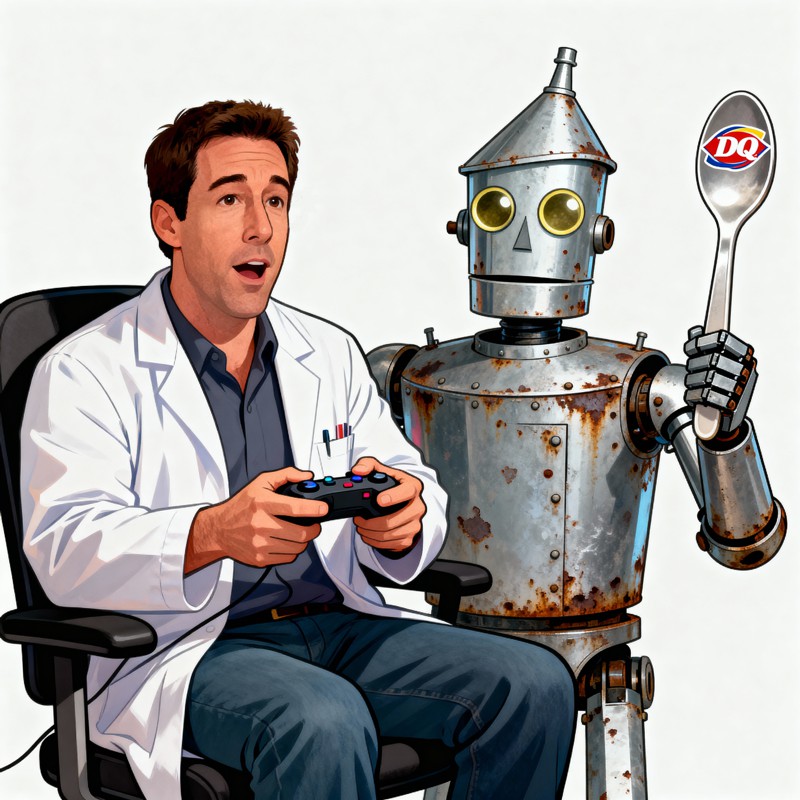
I only wish I’d have told the AI to make the edges of the Dairy Queen spoon sharper… 
Okay, who’s gonna complain about a tool that makes cute caricature cartoons? Where it gets stickier is when the tool starts to make stuff up. I’m doing scale model building, and one of my current projects is a small stone railway station. To make it as accurate as possible, I’ve been collecting photos of it in its original 1880’s configuration, and some of those images are quite messy. So I fed Gemini this image:

with instructions to clean up the image so I could better-identify the stone patterns. After a few iterations (first one, it just made them all look like regular bricks), I got this:
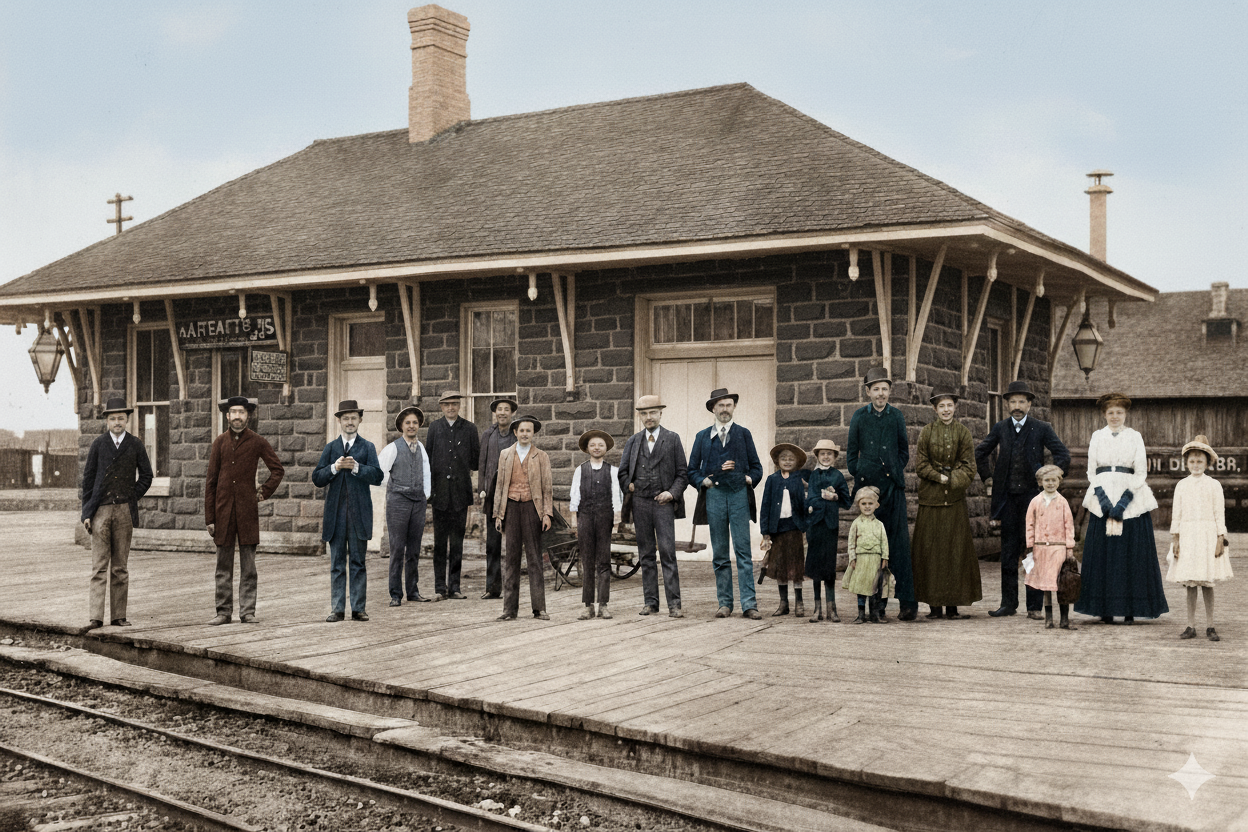
Quite helpful with the stone patterns, but, it made up faces to go on the people. There’s no way it could convolve those faces with the original detail. I didn’t give it any such instructions, it just did it.
And there’s my concern with AI tools. It’s going to take some careful consideration on the part of any user to feed such instructions that both define the objective AND constrain its behavior. Like talking to people, really; you cannot expect them to understand the words you’re stitching together into sentences on the first iteration.
Like any tool, it requires careful consideration to use it safely.
6 Likes
The real problem is when the tool becomes so powerful and seductive that the combination of it with human nature precludes any reasonably probability of the majority using it safely. We simply cannot because we have no wisdom and the increasingly reliance on AI makes the development of wisdom even less likely. So, if safe use becomes practically logically excluded, what do you do then?
Most people will simply sidestep this issue because they cannot emotionally accept that choice is being slowly stripped away from us and they’d prefer to think they have a choice. It’s a mass psychological block of our minds made weak from too much technology use.
Every tech has downsides. Knives can be used to cut stakes and people alike. It’s not the tech that is good or bad, it’s its uses. Let’s discuss the appropriateness of putting unlimited resources in the hands of people to generate crappy content, but what does it have to do with people who want to run some ML algorithm on their own hardware to streamline their workflow?
BTW, “AI” is a misleading term that means everything and nothing. Most importantly, it suggests intelligence which, in turn, entails intention, neither of which the algorithms have. So, let’s get that out of the way. I prefer machine learning (ML), which is more descriptive of what it is: deterministic (though, in certain cases, unpredictable) algorithms trained to perform some tasks.
Of course, but the ratio of cons to pros is different for every technology, so one needs to consider each one individually. Sometimes the pros outweigh the cons, and other times they don’t. That’s why most people can still buy knives but not .50 caliber machine guns. And like I said, when human nature implies that we can’t control ourselves, we should consider being very cautious about the given technology.
They are connected, because they are participating in a system that encourages huge resource waste for relatively little gain. First, it’s just a few people running some home-baked ML algorithm. Then hardware is pushed to become more powerful as people seek more powerful hardware for future upgrades, and then more advanced ML algorithms are created, etc. Yes, all technology progresses this way but this particular one is sufficiently seductive that people won’t be able to help pushing it to an unhealthy extreme.
Is it really streamlining their workflow besides? Or is it just encouraging an increase in production of photos of lower and lower quality because larger and larger amounts of photos can be processed. Yes, digital allows us to do this too, and maybe that is something we need to consider as well. But ML/AI is a strengthening of this process in any case, beyond the level of the control of most to the point of stupidity.
You have a point there, but ML is not exactly a good term either because some simple ML algorithms are just equivalent to linear regression, whereas in most people these days use AI to mean things like ChatGPT and generative AI. In any case, I was referring to that sort of algorithm/system: LLM, generative AI, and even ML noise removal.
1 Like
Nothing wrong with people wanting to use AI. They just have to move away from Darktable and find or build another application. Except maybe for mask creation I doubt we’ll have AI in Darktable.
I repeat myself, Darktable is a photographer tool.
And again don’t get me wrong, I’m not against AI just that Darktable is made for craftsman wanting to work on their photography made by a camera. If people want to create pictures (or heavealy changed pictures) using AI, fine use another tool, create a separate Web site to exchange on the topic, have specific exhibit for this… But please let alone photographer that want to be picture craftsman.
13 Likes
I don’t disagree with this. I disagree with the stance that being maximalist about it will make it go away. Instead of just throwing away the baby and being left with the bathwater, since I cannot make that go away, I would rather save the baby and try to do something good with it. I can use a technology productively and effectively even if the world around me abuses it. Take social media. I never surrendered to doom scrolling, but it helped me reconnect with a lot of childhood friends that I had lost contact with.
Anyways @JasonTheBirder, even though I disagree with some of your premises and conclusions I sincerely admire your idealism. If by any chance you are near Zurich drop me a PM if you want and let’s raise a glass in person to the implosion of all data centers worldwide 
Agreed, it’s a nice stance and I think that also those who are most vocal about the introduction of some ML capabilities respect and understand this.
2 Likes
I’ve had a realization recently: Art is a means of expression. I express myself through photography. Whether someone or something can express themselves better than I can has no impact on my own expression.
Art is also a practice, a craft. It is something I do for fun. Again, someone or something else can do what they want for their fun, but that does not impact me.
Where I see this fail is in my professional work. AI tools are encroaching on programming as well. My value as a worker is predicated on my output, and not my ability. Which pains me greatly, as I love programming. But here I have to find a compromise between improving my craft, and incorporating AI tools to increase my output.
Not for my art, though. That belongs to me alone.
10 Likes
If we are going from first principles, then this process starts with clicking the shutter, you’re selecting a moment in time to freeze. Is that single moment faithful to the whole event?
What about people who are color blind? Partially sighted?
1 Like
Indeed, that’s why I think that truthfulness is not the most sensible argument against the usage of more advanced algorithms.