The growing popularity of YouTube and analog film and digicams are I think symptoms of a society yearning for authenticity.
AI is the opposite of that.
The growing popularity of YouTube and analog film and digicams are I think symptoms of a society yearning for authenticity.
AI is the opposite of that.
Yes, I think that in this conversation have been conflated a bit too many things. An “artist”, whatever that means, is not someone who does things necessarily by hand. An artist is someone who can take some raw materials, infuse them with their vision and (for successful artists only) make the resulting product appealing for an audience.
In the process, an artist will use whatever tool they have at hand if it does what they need. Not only that, but artists generally are at the forefront of innovation and pave the way to use existing tools in new, unexpected ways.
The difference between an artist and other users of a technology is that the artist has something to communicate, and the tools that they use (more or less advanced) are just a mean to this end. For non-artists, the tool is the end, there is no message to convey.
I guess that what I am trying to say is that it’s not the tool that you use to make something that qualifies the artistic value of what you accomplished. The purpose of the creative act, the message behind it and the ability of the result to stir thoughts or emotions in the audience are what makes the difference.
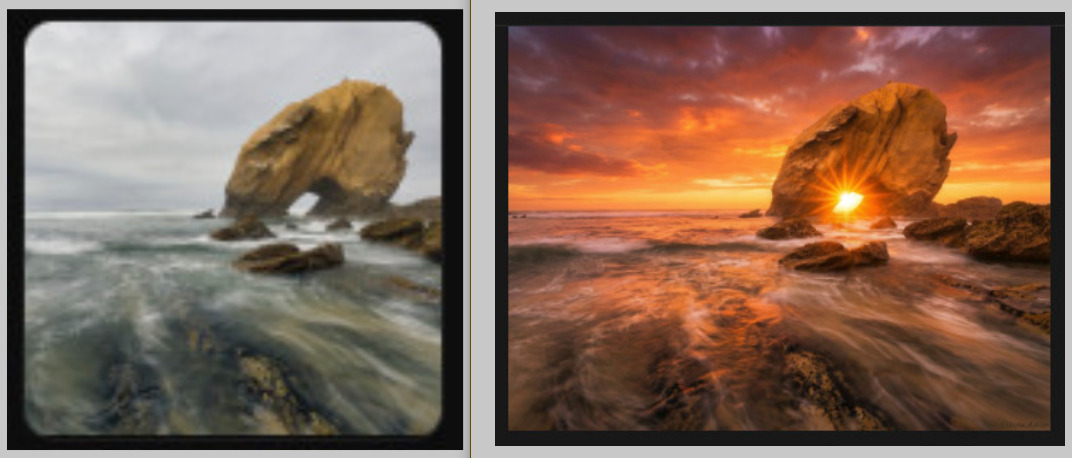
@Steven_Adler1’s example above, for me, is an example of non-artistic usage of a tool (I apologies for picking on this example, but it’s just above here, nothing personal). They took an image and “beautified” so that it looks like any other stereotypical landscape photography of the last 20 years (high saturation, hyper sharp, very dramatic). The result is imitative at best, and it does not communicate me anything. Does it matter if that photo was not shot as is? For me no, because I would find it boring nonetheless, because the end result looks just like 1 million other photos of a similar subjects. (Edit and being aesthetics that we are talking about, this is meant purely subjectively.)
I take your disapproval as a compliment. Thank you
By now this entire conversation has become programmatically boring.
If this is the future of what it means to be an artist, then I quit now. Never ever do I want my art to be anywhere near the term “product.”
“Art” without process is exactly the nano banana above. This is what we are getting. This is what you are arguing for me.
For me it isn’t even a photograph anymore, but a photo realistic image, fwiw.
Words have more than one meaning, as you know very well. In this case:
It’s difficult to argue that a work of art is not a product.
I don’t know why but it seems that there is an active effort to twist what I am saying, so I will stop here.
They’re also in a numbered list for a reason 
But I also take issue with “make appealing” as much of the impactful art made recently is not what I’d describe as appealing in the #1 definition of that word.
For me the overall disconnect in your statement was that you seem to be arguing for the nano banana tooling but came to the conclusion that the specific and probably most obvious application of that tool was banal. It doesn’t line up for me, but to each their own.
Okay, I will not stop I guess 
I have been arguing against it since the beginning of this thread, and I have been trying (and failing) to steer the conversation to focus on “technical” tools (e.g., denoising, masking) that can make our life easier and produce better results. So, definitely not, nano banana is not what I am arguing for.
I am totally convinced that you cannot produce anything that is remotely artistic giving some high level instructions to an LLM, iterating 4 or 5 times and that’s it. For the very simple reason that the generative process when the model in charge is at the very best emulative (if not outright duplicative), so it cannot produce anything new in a meaningful way. You can make something that is visually appealing, but you cannot make something that I haven’t seen already.
A work of art embodies an intention and a design, and you cannot remove that from the equation and still call it art. Asking a model to “beautify” a picture or “make it look like X” is not an act of art. Everybody could do the same and obtain the same result, hence there is no vision behind it, it’s purely result oriented and there is no desire to communicate, no personality, no vision behind the output.
But the artistry does not come from the grudge either. So, if one step in the production of a powerful, expressive work of art included some controlled, deliberate manipulation with a prompted LLM (e.g., to selectively change some colors) I wouldn’t be offended.
If one can express their vision using tools that require less fiddling, as long as they are in control, and not the algorithm, then I don’t see why not. At least in principle, using an LLM to “make the brown in the sand more yellow, and desaturate the leaves” is not very different from using sliders to achieve the same result. Again, the key aspect is the intention. You tell the tool what to do, and not the other way around. You decide where this thing is going, not the algorithm. The algorithm is just making the UX friendlier, if you will. There is no intrinsic artistic value in my muscle fatigue or in the time that I spend finding the right balance of 5 sliders to achieve exactly what I want.
(NOTE: this does not account that the generative process is extremely wasteful in terms of resources and what not, I do not condone their widespread, pointless adoption and I don’t like many of the social implication of their usage, but this is a completely orthogonal topic which warrants a completely separate discussion.)
(ALSO NOTE: This is about “visual arts” in general. If we are talking about photography then there are also other considerations, such as adherence to reality etc., that are orthogonal to what I tried to say above and would warrant a separate discussion).
Hello,
Just a personal opinion, but this debate about integrating AI into Darktable touches on the very philosophy of free software. As users, we must defend the Freedom, Control and Sustainability that define our favourite software. Darktable is a tool for creative photographers and certainly not a ‘click-and-magic’ solution.
For me, generative AI has no place in Darktable; it takes artistic control away from humans. Utility AI (masking, denoising) could be acceptable only if it is 100% FOSS and optional.
AI must serve our control, never replace it. That is the price of our freedom as Darktable users.
Greetings from Luberon,
Christian
If all you want to do is produce computer generated art, or hybrid photo-graphic art, then it works. But for a lot of people, photography is to be admired because the final edit at least somewhat resembles the original scene and is an artistic interpretation of the scene. Your scene is pretty much on the level of a 3d-render. Even with black and white, or more heavily edited photos, a person, if they could go back to the original scene, they would agree that such photos have some basis in that reality. Your digital art is nothing of that kind.
The fact is, the scarcity and uniqueness of experience is lost when one crosses some nebulous border into the realm of easily-produced graphic art. While having the possibility of looking attractive, it also is bereft of personality because it is sufficiently uniformized by the statistical nature of the generative machine. Yes, straddling that border may be the domain of philosophy, but there are also clear examples of the machine-like sameness and such heavily modified images as yours fall under that category.
You said that,
A sad state that embodies the soul of the machine that technology so badly “wants” to imbue into us all. One of the core pillars of art is the unqiue expression that arises out of trying to do something yourself through determination and hard work. It is the very opposite of the ruthless efficiency of exchange, in which the value of a thing is only what it can do, and it underscores the qualities we have beyond the machine.
When you reduce producing imagery to writing a 30-second prompt, you exclude that core pillar from art. You may have taken that initial image and even have had the vision of this monstrosity while taking the image, but because you delegated the key piece of magic to a machine, you have excluded the soul from the art.
One may argue that it would be possible to wait for the sun to be just right and get a very similar image. What’s the difference, then? And what’s the difference between using autofocus or manual focus? Well, in the first case, by waiting, it would demonstrate your own character through the art. And at least with some algorithms like autofocus, at least in principle you could easily replicate the effect of the autofocus algorithm yourself.
In using AI models, you don’t really have an exact idea of what will come out of it, and you can’t help the statistical sameness from bleeding into your image.
Yes, you might indeed get clicks or likes on this image, and people may enjoy it…but then again, who is enjoying it? Those who have been conditioned by the machine to consume without critical thought, and those who don’t care at all whether you waited there or not. To my mind, it seems rather pitiable to be in the admiration of those steeped in unthinking hedonism.
Yes, automation has existed in photography for a long time. But AI is the first to offer modifications of your photo without effort and without knowledge of the final outcome; it takes over creative decisions and it removes the need to be good at anything. No doubt that some AI inventions such as cloning dust could be argued to be still within the realm of some sort of human art, but your example is far outside the bounds of it.
That we have come so far in the sharpening of our tool-use and civilization only to be creating such monstrosities is one of the greatest disappointments of modern times.
Definitely not, because producing real art has nothing to do with how efficiently one produces it. You should be more precise with your words: the closest truth to your statement is the “people” who can gain the most attention in a world populated by unthinking automaton consumers are those who can use AI most effectively.
But popularity in such a world is not something to aspire to, nor can it have anything to do with art. And I put “people” in quotation marks because I no longer consider the ones to be doing so as real human beings.
I find your arguments unpersuasive.
So we are staring down the 3 month mark since this thread was started.
For those who think dt should be incorporating AI in some form, can we get a status update on your project? What milestones have been reached? Have you completed your scoping and requirements documents? Are you in development? Is there any slippage? If so, what plans have you implemented to mitigate the effects? Have you completed your RCA’s?
If you could come in on Saturday to ensure the critical path tasks stay on-time, that would be great.
Thanks.
edit: this is an attempt at levity in case that didn’t come across
Of course you do. At the bottom line, beyond arguments, beyond morality, beyond the good and meaning of art, comes purpose. Our two purposes are entirely different. Your purpose is simply to produce, and you’ve accepted that into your psyche. It is like two people at a restaurant, one who wants chicken, and one who wants beef. It’s just a preference, a desire in life, but in this case, it is what you want yourself to be. As human beings, we can make ourselves into almost anything, and you have chosen your path.
Two can only come to an agreement via argument if they have some common goal, some common thread, some commonality at all. I suspect our entire philosophies towards life are entirely disjoint, and that is just part of the endless flow of life.
That is absolutely your right, and if you enjoy it, go for it. I don’t think there is anything wrong with using whatever tools we have at our disposal to have fun with and create what we want with them. I think my objection is to conflate this with an evolution of photography, as if it’s some kind of natural progression.
To me, this is a completely different image to the one that was captured:
Again, if it brings you joy to create such images, then you should absolutely be left to enjoy it and not criticized for doing it. However, it’s also ok for others not to enjoy this kind of image and what it represents. I personally would not feel right showing that to other people as one of my “photographs”. I would need to describe it as an AI-generated image based off one of my photographs. I think that’s a crucial difference, and as far as Darktable is concerned, I don’t think such an image is part of its role as a RAW developer.
I know that wasn’t aimed at me, but the fact I’m not a fan of the AI-enhanced image might elicit a similar response. When art is displayed to others, it’s open to criticism. I don’t think this discussion about art and AI has become boring, so much as a bit heated because of fundamental disagreements.
I can’t predict the future, but neither can you. These are all personal opinions; I’ve already written mine. I’m using a translator, so I hope the point is clear.
It’s not about predicting the future. We are already in the future of what you seem to call a prediction.
We already seen the declining of art, community, and human expression. So, instead, it’s about defining what matters and understanding the present in terms of one’s own core values.
Your point is indeed clear: just throw up one’s hands as a form of self-protection and remain in the bliss of endless relativism, claiming everything is just some opinion because we are hopeless to take any sort of control, nor should we try. Any attempt to define what is good or what the intention of art should be is bound to fail, and we should just enjoy whatever will be. I do have an opinion on doing that though, and it’s that it’s a rather sad place to be because it pushes our responsibilties to foster healthy communities into irrelevancy.
I recently visited an exhibit at my local art museum of ceramics made by Japanese women over many decades. Not something I’d usually be into but I came out of it blown away by the exhibit. The ceramic pieces were intricate and detailed and amazing to look at.
But the aesthetic quality wasn’t what impressed me. What impressed me was two things:
The idea of bypassing those two aspects and simply reducing it to “they look pleasing” seems really sad and reductive. That’s what genAI comes off as to me. Art is about way more than the end result.
I think it’s pretty clear that the devs aren’t going to be putting nano-banana into dt any time soon, so the discussion getting derailed towards large generative AI models is just not useful to the original question. A more productive area to discuss is small ml like debayer algorithms or image segmentation driving parametric mask generation. The objections there have been reasonable, but also didn’t feel absolute.
The funny thing is, at least in the US, the image isn’t really his anymore as the output from AI is not copyrightable. Anyone who has this image has just as much right to it as he does.
Hi all … this is quite an interesting topic !!
I am open to all new features that are coming into the mix , albeit I might not use them !!!
Some of the users think they do loose the whole creativity and other things in the process … just having fear of latest technology .
On the other hand they do might use the latest camera gear … with AI included in the AF system !!!
Or are you focusing manually … for fast moving subjects ???
So where is the point of what is accepted or acceptable in the whole process from capture to final output … i.e. print !
Unless one is using analog from start to finish … it is a pretty much pointless discussion .
If one wants to use AI … go for it … if one does not , go for it as well !!!
But nobody should blame the " other " way …,
Just my 2 cents
Andreas