“Many positive things may be said about analog photography. Not the least that we don’t have to do it anymore.” Knut-Sverre Horn
6 Likes
Kindred spirit…
Game-changing for me was regarding the linear image, with only black-subtract, as-shot white balance and demosaic. The starting point.
1 Like
This is so true. Look at the work of Ansell Adams and you would see how important the final processing of the image was and not just the capture.
4 Likes
I kept a few film cameras for that exact purpose. When I get the analog itch, I shoot a roll of film, and after the hassle of having sourced the film, developing it, and realizing how many of the photos are meh I gladly go back to digital.
I kept a Panasonic TZ superzoom for similar reasons: so that I am never, ever tempted to buy one or anything remotely similar.
Call it GAS protection. Worth ten times the resale value of these items, in the long run.
5 Likes
I guess I’m pretty late to this and you guys have already made all the points, but the take on the blog post is not good, and he is just outsourcing his editing.
Then, at the start of 2022 I got my first analogue film camera: a Leica M6. (I know… I dived straight in the deep end.) This was my first introduction to how editing could be easier.
I do miss the darkroom. It was quiet. I miss the people who were around the darkroom at my local city college. I liked them.
But if you’re doing a lot of the film process yourself, film is hard. Like really hard. There is a ton of craft involved in getting a good negative and a decent print. Not even a good print, a decent print.
There is something to be said of the slowness of making a traditional analog print. I liked that too. But now I just start at the image on my monitor and think about it and my editing is just as slow.
6 Likes
The author is saying that if you cannot get an editing workflow you enjoy you should outsource and enjoy only the parts of photography that you want to.
2 Likes
In a sense, every bit of imaging contained in your camera is out-sourced. Modern photography (film and digital) is a heavily-leveraged endeavor.
When I was making my spectral camera profiles, I got a visceral satisfaction from making my optical bench from scratch, with cheap materials. Did spend about $100US on a diffraction grating, but the rest was shaped by my own hand from my own design. Wasn’t my motivation for taking on the endeavor, just wanted spectral data for my camera, but the process and effort was really the greater reward.
5 Likes
That’s interesting. I also shoot Fuji commercially (X-H2S) but haven’t encountered the kind of pushback from clients that you have. That said, almost everything I deliver is either from a direct Fuji X sim or a derivative that I’ve created. Occasionally I will see them try to apply a social media filter to something I’ve already edited, and I just cringe at the results.
1 Like
I could just suck at editing and freely admit that. But I think my results are more than serviceable.  After doing this for around 20 years you’d think at be at least moderately skilled but I’m definitely open to the idea that I’m not.
Mostly what I think is going on is I’m not currently in style with the popular looks. As you do this for more and more time you develop a certain look, style and way your end result looks. Since most clients, especially young people, are trend driven there will be times in ones career when your personal style decouples from whats popular on the social media de jour. Most of the complaints were about cropping not right for Instagram and the client thinking some phone filter looked better. Some of the complaints were valid I think as due to turnover expectations I tend to speed through editing these days and missed some stuff. In my market no one is waiting more than 24-48 hours for a set of photos and they expect dozens, not a few. Fuji JPGs have been a godsend.
I have a demanding day job as well so I don’t have the hours upon hours to edit like full time pros either. My wife and family would like some time with me.
2 Likes
I have never developed my own film, but now I wish it was something I had done, or at least chosen my lab more carefully.
I have scanned a ton of negatives over the last 15 years, and even though the initial step of developing the film into stable negatives had already been done, it was a revelation how much difference there was in the final “print” after the scanning and processing stage.
I have successfully recovered an amazing amount of shadow and highlight detail that was a blown-out or crushed mess in the prints I actually received from labs back in the day. Granted, I never used high-end labs, mainly because my gear/skills were mediocre at best back then. But certain rolls of film I wish I had entrusted to better labs.
Here’s rather an extreme example:
(Original print on the left, scanned negative on the right)
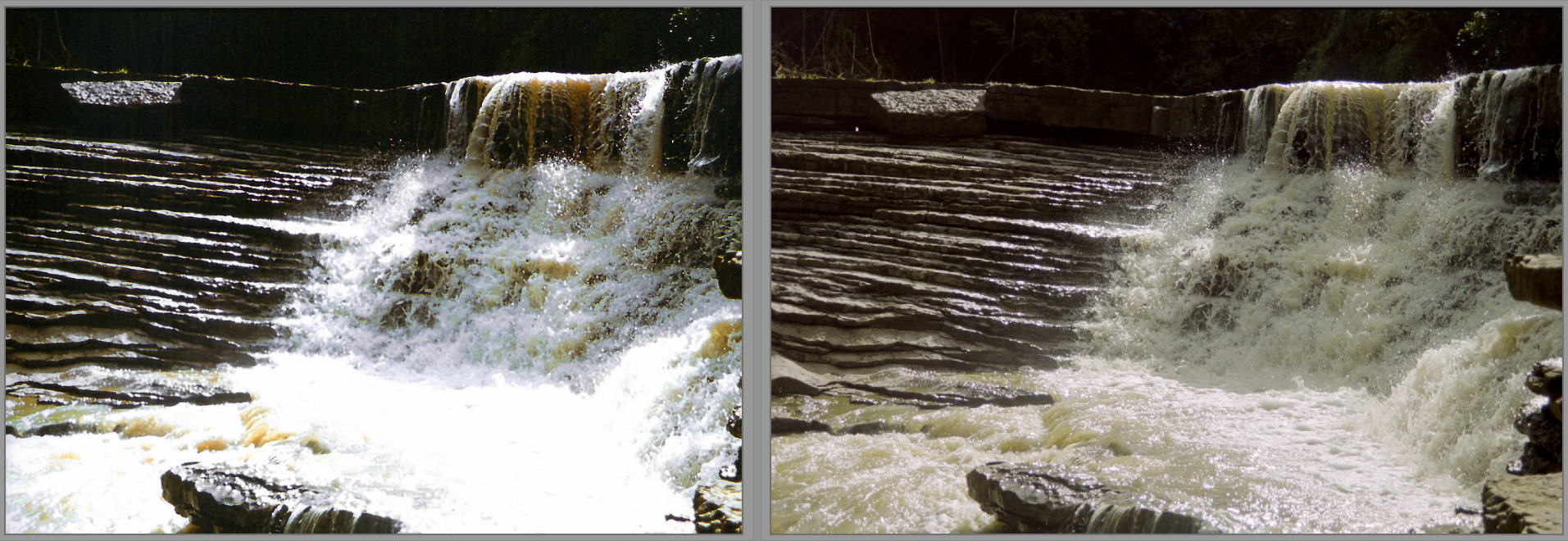
Anyway, I just wanted to weigh in on that “accept what we were given” point you made. I used to accept what I was given 99% of the time, and to my knowledge, I only ever sent back one set of prints I was unhappy with.
It makes me wonder how much of the “film look” I knew so well was merely just down to the person operating the machines in the high-street lab that particular day
3 Likes
Minilabs always applied some degree of autoexposure and auto contrast, resulting in some pretty bad output for scenes like that.
1 Like
This was more a limitation of film rather than the lab itself. Digital processing is so much more capable of recovering both shadow and highlights in the same image, while film often became a choice between optimising one or the other but not both. Hence why I love to embrace digital and don’t feel nostalgic about film.
2 Likes
I find that a lot of people are going for a certain look that I’m unable (or unwilling) to achieve. I classify my own work as “classic and contemporary” and try to be up front with clients about the type of images they’ll get back. That approach has mostly been successful.
Forgive my ignorance, but doesn’t my example above show that the film captured the detail, but it was the next two stages of scanning and printing that were the problem?
2 Likes
Yeah I’m always up front and show my previous work. It was going to be hours and hours of getting every flaw out everything. I got tired and threw in the towel on one of them. They wanted everything edited and flawless skin, that sort of thing. Was looking at sinking 80-100+ hours into the editing alone on what in the past was a pretty typical headshot and book shoot.
In the past I pick the technical winners, they pick from those and I edit out 10-30 finals. Not so bad. That has changed in the last 3 or so year. Clients want to see “all the unedited RAWs” and then they want dozens to hundreds from those edited out, beauty filters, you name it. Smart phones have made it seem like doing this is a breeze and you’ll spend 5-6 seconds on each image. I’ve gone from being trusted with the vision to more or less a shutter button pusher.
Digital editing even by default offers tools and options that were not available when developing color print film. There was no contrast control for instance. There was not shadow and highlights tool. We could shift the color for the whole image, we could make the whole picture lighter or darker. There was no tone mappers.
The only way around any of these issues was to hand print ‘each’ image in a darkroom. We could dodge shadows (maybe) and we could burn highlights (maybe). If we printed B/W film we also had a choice of contrast grades for printing so that helped a lot. With color the different brands of material might have slight contrast differences but it was not practical to switch brands for individual shots.
It is not a case of the detail captured by the film but the printing materials limited capability to reveal that detail. Your image was color, but the work of Ansel Adams in black and white shows what can be done to an individual print in the darkroom, but that is not practical in a commercial lab printing thousands of pictures a day. Ansel Adams probably produced a single printed image per day.
2 Likes
If you scan film you no longer have a true analog film image. You have a digital image. That is something that bemuses me by people who currently shoot film and then take it to a lab where it is scanned and then printed. It is no longer true to the analog process. So in my eyes, why bother. But everyone to own when it comes to what they enjoy in photography.
BTW, I scan old films from decades ago and do digital restoration and can achieve better prints for some than my original analog printing would achieve.
3 Likes
As a reminder of how good we have it now with digital.
Working with film is also a great cure for GAS. After a week with film, a 15 year old digital camera will be experienced as extremely capable and convenient.
Everyone who has a digital camera should keep a film camera.
4 Likes
Thanks for your explanations.
Admittedly, I don’t know much about film development, and I think I got my terminology wrong.
I guess what I meant to say is that the film medium itself wasn’t the problem (because it captured the detail), but it was the next stage of enlarging and projecting onto light-sensitive paper where the problem arose in terms of crushed blacks and blown-out whites.
In a modern workflow, negatives are digitally scanned, but in the analogue workflow, negatives were enlarged onto photo paper. I’m assuming that many of my prints from the 80s were done using enlargers.
So are you saying that this was the issue where there was no real contrast control?
With color printing there was not contrast grading of paper. In black and white printing you could use low to high contrast paper based on the dynamic range of the capture. This was not an option for color printing.
The one case I recommend film capture over digital capture is star trails. A film camera doesn’t mind being left with the shutter open for hours, but digital cameras are compromised in those circumstances. There would be other similar scenarios as well, but for me I am not nostalgic for the good old days of film. It took a lot of work and expertise to get prints.
On two separate occasions I had representatives from photographic suppliers of materials look in my rubbish bin and say that the prints I was throwing away most labs were striving to achieve. I was a professional printing lab for portrait and wedding photographers as well as a one hour lab for the public.
2 Likes