Camera Black/White Level ISO dependency

I played around with RAW files and noticed for my Canon RP, that there is a dependency of the reported black level and the ISO of the image.
I gathered black/white level with rawpy:

import rawpy
with rawpy.imread(filename) as raw:
    bl = raw.black_level_per_channel
    wl = raw.camera_white_level_per_channel

The interesting thing is, that all ISO values from 50 to 250 have a black level around 512, while all ISOs above have a black level around 2048:
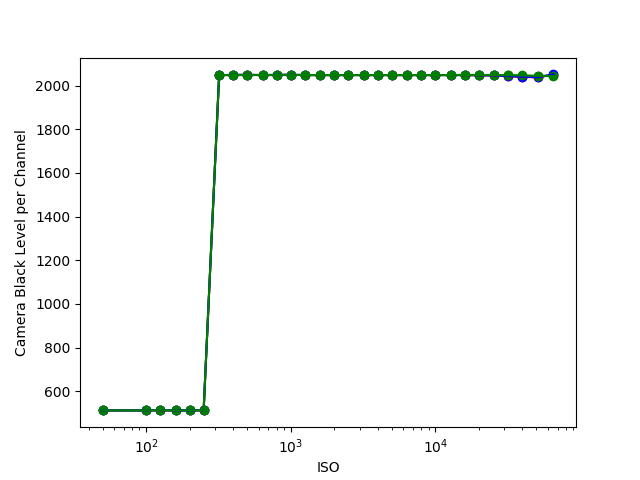
black level per channel

(The ISO levels are [50 (L), 100, 125, 160, 200, 250, 320, 400, 500, 640, 800, 1000, 1250, 1600, 2000, 2500, 3200, 4000, 5000, 6400, 8000, 10000, 12800, 16000, 20000, 25600, 32000, 40000, 51200 (H1), 65535 (H2)] - the last one is actually 102400, but stored as a ushort in EXIF data)

It coincides with the dynamic range curve shown here: Canon EOS RP Sensor review - DXOMARK (See Section “Landscape (dynamic range)”), where there is an increase in dynamic range for around ISO 400.

Also interesting is the camera white level:
white level per channel

I’m curious what the camera does in these cases and furthermore if that means that certain ISO values should therefore be avoided or if that really does not matter.

Look; DCG (Dual Conversion Gain)

Maybe Canon has started using DCG like Panasonic. The information you provided shows this. So you get a wider dynamic range and less noise with higher ISO. The latest Xiaomi 14Ultra model also has this system. DCG4 and DCG16 work at different ISO ranges, increasing dynamic range and reducing noise.

Also, check out the PDR and shadow improvement charts from Bill Claff.

They also confirm there is a multi-stage ADC present with different conversion gains possible.

The “shadow improvement” basically says you can benefit from some noise performance w/ no or modest dynamic range loss by bumping the ISO somewhat. (E.g. there seems be no “technical” point to shooting at ISO 125/250/500/1000).

Another example: ISO 200 and 320 give you seemingly the same dynamic range, but for different reasons - w/ 200 you preserve more highlights, while w/ 320 you sacrifice just bit of highlights for less noise in the shadows.

As always, the ISO you choose is up to you and the tradeoff you are ready to make depending on the subject.

There have been several similar questions and discussions on the forum already, so please feel free to look for those.

1 Like