I like a good stress test, as long as I’m not the one getting stressed. It’s very useful because it shows the limitations of the feature, which I think is invaluable because we can’t always work in perfect conditions.
I suspect the OM System version would do a worse job in this scenario, but we can still see that Panasonic has trouble removing blur with slower shutter speeds. I wonder if OM System are waiting until they can do a better job or whether they aren’t even bothering…
I did read that Panasonic’s solution simply upscales the subject from one of the frames to remove blur. Although not confirmed to be true, it makes sense because how else could they do it? So I guess we aren’t getting a true high-res image of this blurred subject. Still, I imagine that smartphones are using upscaling, and they do a good job so it doesn’t really matter if it’s upscaled or true high-res.
Yes, this kind of thing is a bit annoying. It’s a bit different with my OM camera in that it’s the image that shows rather than a black screen, but it’s still hard to tell how much you’re moving and how long you have to wait until the capture is finished. With lots of light it’s fairly instantaneous, but it can be several seconds in low light, and it can catch you off guard.
The OM-1 and OM-5 Mk2 have something called Handheld Assist, which shows your handheld motion while capturing the exposure, including the boundaries of how much the camera can auto-correct. I have not tried it but it sounds quite useful for these kinds of shots. It’s one of those features that you don’t read much about but may have convinced me to get the newer model if I’d known.
Yeah, Artisan Roast is good. Has a couple of venues around town. There’s a new, tiny Aussie-owned one called “the source” that opened up near the castle for really funky fermented coffee. I’ve only been once as it’s a bit of a walk up the hill from where I am but it’s a real taste experience.
You would not be the first to do that. In fact, it just might have happened to yours truly in the last week, and it just might have also caused confusion and annoyance, as well as the inevitable “ah ha” moment with facepalm.
Yeah, I agree with you - the key point in my case was that I already owned the X-E2.
When shopping for alternatives, there was no MFT body that was comparable for the same mount of money (ie if I sold it and bought something else, I wouldn’t have to add money on top), while not being weightier.
The Fuji 27/2.8R is the same weight as the Lumix 20/1.7, so that was a wash as well.
I did look into GM5s, but they’re into unobtainable realms of money for a camera of that age. Simply not justifiable. They fetch north of 500 euros used around here, body only.
My experience really isn’t much of an advice really - just sharing my scenario for whatever it might be worth.
I can fully understand your thinking, and it’s clear to me that there isn’t always an obvious choice when shopping around the different formats/brands. Each has its own strengths and weaknesses, and more importantly, the differences are getting less stark.
I’m very happy with the size and weight of my new M4/3 kit, and I’m enjoying getting to know a different brand and philosophy. But I could probably have built something quite similar from any other brand, especially with Fuji and Sony (Nikon bodies are still quite a bit bigger I think). On the whole, there tends to be a greater number of small and light options with M4/3, but if you don’t need tons of choice, there are still good options with other brands, especially if you get a high-res sensor and make use of cropping or digital zoom.
As for the aperture ring on Fuji lenses, I’m still making up my mind whether I don’t really miss it or whether I actually miss it a lot. It’s all I’ve been used to for the last 4 years with my X cameras, but I’m back to control dials with the OM-5. It’s obviously very easy to use the command dials, but having the aperture ring on the lens does free up a dial for another command. In manual mode, for example, it would be nice for me to use one of the command dials for ISO, but my two dials are already mapped to aperture and shutter speed, so I have to click another button to access ISO and exposure comp.
I’d love to try a M43 system for a while. But I remember what an enormously long process it was to find a set of lenses I’m happy with on Fuji. I’m not ready to go through this again. And besides, I like my Fuji system a lot.
I’m someone who doesn’t use the back LCD - on my big bodies with flippy screens they stay closed inwards and I use only the EVF. On the bodies with fixed screens they have a histogram and whatever else. Having the aperture ring (or control ring on RF lenses, much as I hate them not being clicky) is way more muscle memory-friendly so I don’t have to finagle dials that are in different places on my cameras (I only use that and a single dial for exposure compensation - the rest of stuff is in auto).
I’d honestly have loved a GM5. It’s just not a reasonable purchase for me at the moment. Maybe some other day.
I enjoy the process, except for the shelling out money part. But if it’s a chore, then I can see why you wouldn’t want to. I enjoy the research and building a kit. I also build PCs and I get similar fun from researching and selecting all the components. It only gets frustrating when you can’t quite fulfil your wishlist and/or you need to increase your budget to get what you want.
I don’t have a lot of disposable income, so getting the max out of my budget is both a challenge and a source of satisfaction. Thankfully, there is a lot of value to be had in photography, even though I find prices too high on the whole. But the difference between spending $1000 and $4000 is not always as big as the outlay might suggest. My photos with my OM-5 are just as good (or bad) as with my X-T5 and probably as with an A7RV. Any differences would be small.
Of course, that doesn’t stop me from lusting over certain gear and seeking out those incremental differences. After all, that’s part of the hobby.
I solved that problem by having both I’m certainly not selling my Fuji gear yet and I may well invest in it more in the future, depending on what gets released. My M4/3 is a very nice travel kit but I’m still not sure whether it will become my main kit.
Even though my Fuji rings are clicky, I still tend to look down at the lens when adjusting the aperture. I don’t know why, because I don’t really need to, but I still like to do it to make sure I’m going straight to where I want it to go. It definitely slows me down a bit. Like you, I’m also an EVF user, and I’ve been setting up my OM-5 to avoid taking my eye away as much as possible. Easier said than done though sometimes.
Incidentally, does anyone have any experience with Canon’s Flexible Priority mode? I always wondered if that would solve some of my annoyances with dials and modes.
Canon’s FV mode for me is bloody brilliant and I’d dare say essential.
Much like you’d take a Fuji body, set ISO, shutterspeed to auto and control exposure with the compensation dial, Fv lets you do exactly that. I have the control ring mapped to aperture and the top dial mapped to compensation.
I just couldn’t bring myself (or could be arsed) to wrangle dials in M mode again after having shot Fuji for so long. Fv on the new EOS R bodies is a game changer.
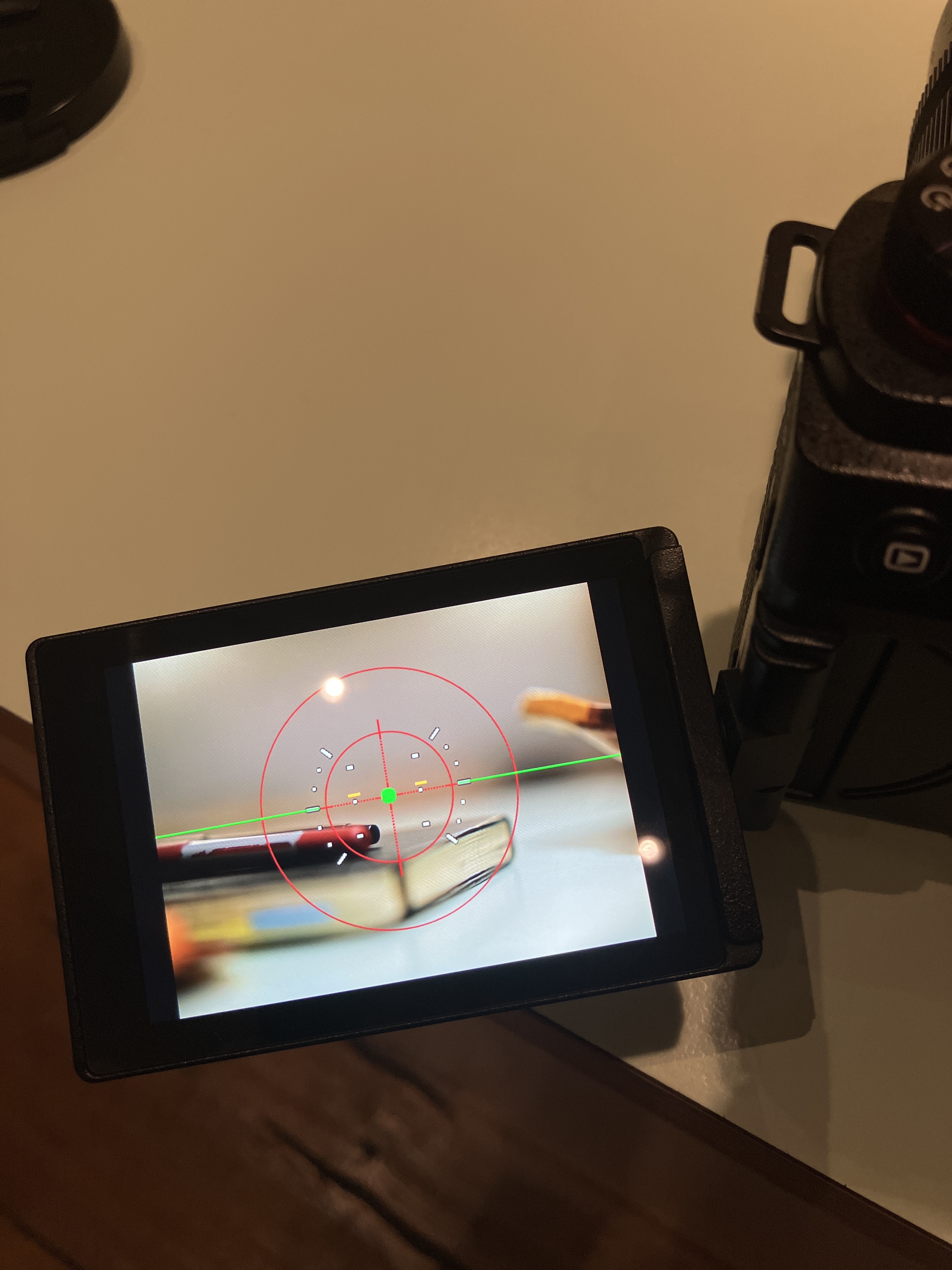
Hello, fellow G9ii owner! I may be a little late to this discussion, but have you tried the I.S. Status Scope? It’s a niche feature on Lumix, but when I find I want it, I love it.
(It’s a circle scope overlaid on the viewfinder, and while the view is blacked out, you’re playing a game of “keep the dot in the circle.”)
I used it for my 4-second exposures for this aurora photo (play-raw). No tripod. It was available, I just hate using one, lol
It’s good to hear some feedback from someone who actually uses it. I’ve read mixed reports online, with some saying it’s unnecessarily complicated to use, while others use that mode and nothing else.
So, in your comment that I quoted, I’m trying to work out how it’s much different to shooting in A priority with auto ISO on most PASM cameras. In A mode (Av on Canon), your shutter speed is in auto, your ISO is in auto (or set to a preferred value), and you use the front and back command dials to control aperture and exposure compensation. That sounds exactly how you described. Obviously this needs a camera with two command dials.
From what I’ve read, Fv mode is different in that you can then quickly change any of the other parameters to Auto in varying combinations, so you don’t need to switch between S mode (Tv on Canon) or M mode. However, since you still need to switch those settings to Auto, I’m not sure how different it is to switching to S or M mode in terms of actual time saving or ease of use. It still sounds like it comes down to muscle memory.
Am I right or is there a reason why it’s easier than switching modes? And do you feel the need to switch the settings often, or do you usually use a particular settings config for 95% of your photography?
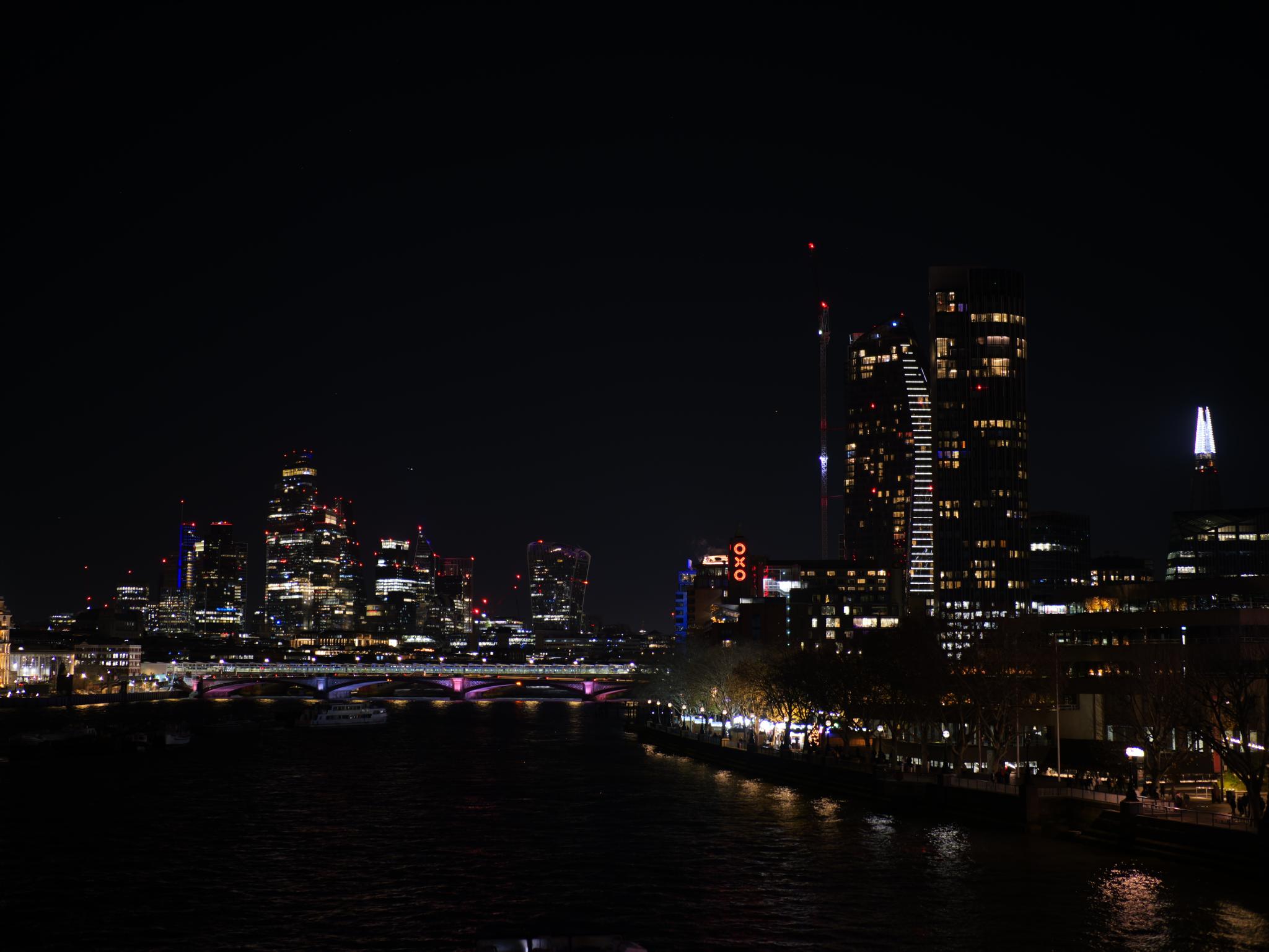
I’m in London tonight after working a very behind-schedule flight last night/today. Spent a few hours walking around Christmas markets hoping to wear myself out enough to get a long night’s sleep for the flight back in the morning.
I took some photos from Waterloo Bridge and remembered our talk from earlier, so I turned on the I.S. scope and tried out some hand-held-high-res shots myself. I haven’t tried out that option nearly enough.
Here is a very downsized camera-processed jpeg. Looking forward to getting the raw into darktable.
Fantastic shot. Set the I.S. Scope to one of the front function buttons as it’s quite large in the viewfinder. Finally found a something useful to put there. Thanks again
So, is this IS Scope a way to help you keep the camera steady? I guess the equivalent is Handheld Assist in OM System. I don’t have it on my camera, which annoys me a bit.
It’s funny, I went for OM System thinking they had best computational features, but Panasonic actually has some of the ones I’d appreciate most!
It gives a big red rifle target and you try to keep the green dot in the middle. You kind of have to have it on a function button because it’s so huge.
 I’m certainly not selling my Fuji gear yet and I may well invest in it more in the future, depending on what gets released. My M4/3 is a very nice travel kit but I’m still not sure whether it will become my main kit.
 I haven’t tried out that option nearly enough.