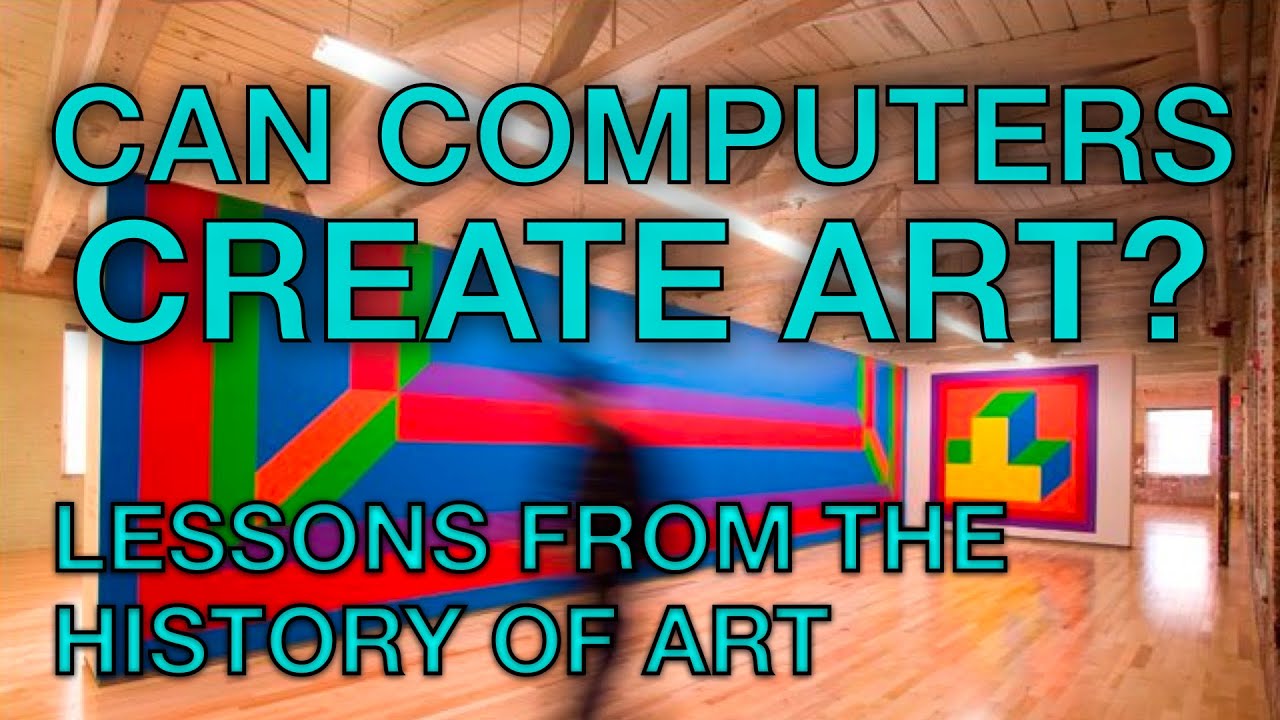
Today, I stumbled upon this amazing video by Aaron Hertzmann:
Aaron is a renowned researcher on the subjects of algorithms and art. He has been a major source of inspiration for me in recent years, and his views on the subject have always been very measured and well-argued.
A video that is a must-see (and yes, he worked with Adobe sometimes ).
Well, he admits there will be (are) ‘many painful disruptions’ and ‘difficult ethical challenges’.
Sure, there is ‘high art’, and ‘superficial art’. Right now, where we live, it’s extremely hard for someone to get started in ‘art as work’. One of my children wants to become an illustrator. Here, there is art college, but is you are just out of basic education (after 8 - 10 years of school), you can’t go there. First, you should to a 1-year art prep school (done), and then find a company who offers you apprenticeship (3-4 years). Now, this second step has become almost impossible. Two kids from the prep school had applied to a company before the prep year, and were accepted. They were assured they’d get the places if they return after the prep year. Guess what: they returned, and were told: ‘sorry, we use AI now’. It’s ‘only’ illustrations and graphic for marketing, of course, so ‘superficial art’, but that’s the one that helps one earn a living.
There is nothing to prevent one from becoming a hobby artist, or a hard-core, starving artist. But one who is employed?
So, I think it is completely justified if the average applied artist is afraid of generative AI.
I completely agree. Today’s artists who want to make a living from their art have reason to be concerned.
But I believe, like Aaron, that generative AI will also likely develop exciting new forms of art (I’m not talking about text2image).
As with any technological development, there will be pros and cons. But simply fearing or bashing it, as many do (here or in other forums), is not the right approach in my opinion.
Testing and experimenting with it is surely better advice!
Actually, they have always been worried about this topic. Think about Van Gogh for instance. Aside for Picasso, and a few others, most artists are always been penniless
The truth is most paying artists were just average, like every human is just average at his job and hence very susceptible to be replaced by automation. I agree that AI art does not replace “artists” who try to express their ideals etc through their art, as in, make “real” art, but it definitely does replace the 50000th “artist” who spent their days doing vector corporate memphis graphics for some company. I mean, how much personal expression really is there in such a work? Probably about as much as I get doing CRUDs all day. I guess in one or two years a lot of programmers will be on the chopping block too, and the reasoning is exactly the same.
I am sure top of the line corporate artists will still continue to get jobs, and the rest imo should get some form of UBI and get to spend time doing “real” art, with or without the aid of AI tools. I have compassion towards the people who will lose jobs, or want to get into the field and can’t, and I hope a solution is found even if it’s after this transitory period.
All they had to do is take everything they could from everyone they could without compensation or even attribution to arrive at the incredibly mediocre point that we are now at.
The saddest thing is that, as an artist, we have always been told our copyrights on our own work will protect us, except now it doesn’t.
This. I don’t fear for art, as such, I just severely dislike the entire way this industry currently functions and got where it is. It’s built on exploitation, grift, greed and disregard for anything involving “ethics”, at the cost of the environment and the unfortunate souls who happen to find a water and power guzzling datacenter next to them.
I’m not against LLMs, they certainly have their use (I work at a uni and I see plenty of nifty stuff being done with them), but the slop generators we have today fill me with disgust.
I actually thought the video was pretty interesting, and it’s not really a defense of the current state of generative AI. I appreciate that he seems to think that the current state of AI tools (text2image stuff) is not interesting.
However, I do disagree with his statement that all computer generated art is human made art. I guess I could argue myself into believing that with a lot of caveats. The examples from history that he provides are where someone made the computer / mechanical thing that produces the art, so in those cases the person was directly involved. When using generative AI tools of today, many humans were involved in getting those models built (whether they know it or not) but me as a human did not have a direct connection with it.
Just a thought experiment along the lines of the Chinese room or other thought experiments…
If my boss tells me that some team needs an app to facilitate some process, and I make the app, I don’t think anyone would agree that my boss made the app (a bad boss would take credit though). All he did was facilitate some information but I did the development work.
So with many of the AI tools of today, if I tell it to generate some image, why would I get to take credit for creating the image? I’m just the boss in this scenario, delegating the creative work to something else.
IMO, knowing the outcome you want and initiating the process to get to that outcome, does not necessarily make you a meaningful part of the process. It just makes you a manager.
That’s precisely the issue.
And what makes me a little sad, as someone who is interested in the algorithms behind generative AI, is that people blame the algorithms and not the big companies that illegally collect data to train their neural networks.
I’d like to hear “Microsoft, OpenAI, Apple, Amazon… are doing a terrible job,” rather than “Generative AI is terrible.”
And the worst part is that these companies have been doing this for years, even long before generative AI existed. But it didn’t seem to bother anyone (or at least not many people), and the same people who complain about data theft continue to use web services where data theft is even allowed in the legal terms of use for the service.
When an artist who exhibits its work on Facebook, DeviantArt, Instagram, or whatever proprietary web service, loudly proclaims that generative AI is crap, it’s problematic.
At some point, we need to name the real offenders, and it’s never the algorithms
(just as the artist is not the computer, the offenders are human beings).
For my part, I plan to integrate generative AI (i.e., generative neural networks) into G’MIC in the future, and I will certainly only use public databases with the appropriate license for training my networks. The few filters currently available in G’MIC that are based on convolutional neural networks (but that’s not really “generative AI”) used a public database (DIV2K) for training.
I don’t see how this poses a problem, except for people who confuse algorithms with the right or wrong way to use them.
I completely disagree. For anyone who is even slightly interested in training algorithms and architectures of generative network, it is, on the contrary, incredibly ingenious and powerful. Personally, I am still quite impressed by what it can do and by the algorithmic developments that have taken place to achieve this in recent years.
To be honest, I never imagined I would see this kind of thing in my lifetime.
I did not watch the video, but, rather, read the “paper” ( Hertzmann, Aaron. 2018. “Can Computers Create Art?” Arts 7, no. 2: 18. https://doi.org/10.3390/arts7020018). Given how far social and evolutionary psychology have fallen in the last decade, I wonder if he still believes the same things today. Sadly, I wouldnt be surprised if he did given that most of his statements lack any hint that the ideas he is relying on are even remotely controversial inside of academia. I bet he has watched a lot of TED talks and read all the relevant books in the nytimes bestseller list though!
Maybe we have to consider how to harness AI to make our photography art better without giving away the creativity. For instance the shadow highlights tool that first appeared in Photoshop was by a stretch AI at work for us. It selected the highlights and darkened them, it selected the shadows and brighten them. It replicated the concept of dodge and burn but took it to a level of precision hard to replicate in the darkroom (although not impossible). Some might argue the semantics and tell me this is not AI but it is the same concept for me of depending upon a machine to do a task for me to save me lots of pain. I would love to tell AI to select the background in a portrait or the sky in a landscape so that I could manipulate that area to achieve my desired result.
I would assume that marketing companies would want bold, novel work that distinguishes them from the competition. I am not sure that AI, in its current incarnation, can really provide that. What I see is well-executed but boring creations, either imitating the style of someone, or a mashup of various visual fashions. Technically well-executed of course, but not having anything to say.
It reminds me of computer synthesized music, perfect rhythm and pitch, an exact reproduction of the score as written down, but ultimately not something people want to listen to.
 ).
).
