For those who fear or denigrate generative AI.

The technology itself is interesting I definitely agree on that. There are applications in the hands of training professionals I can see as being useful. Not to mention the knock on boost effect to other machine learning and neural network research.

But, ultimately technology does not exist in a vacuum. I believe evaluating it’s overall value one must look at its net effects. I work in higher education at an institution that is very gung-ho on LLMs and gen AI. I just see people thinking less and piling everyone else in 60 page reports no one is ever going to read. Professors are just as guilty as students. “How dare you use AI in my class!” While they use it to write letters or do their email and other things they don’t want to deal with. Most people seem to want it to make their job easier but hate it when it gets used on them if that makes sense.

5 Likes

Nobody wants to read something generated by AI because it simply demonstrates that the person behind it didn’t care enough to write it themselves, so why should you care enough to read it?

While I use these tools mainly as search engines and in my professional programming work(not in my FOSS projects), every time I start reading a supposedly human written text, which turns out to be AI, I just quit it. Even the AI mannerisms(X is not just Y – it’s actually Z), which people are adopting into their speech, is a bit repulsive. If I wanted an AI answer, I would go get it myself.

3 Likes

“Why would you read my AI generated email in the first place? Let the AI summary tool write the summary for you and read that.”

“But why would you bloat your email with AI then in the first place?”

2 Likes

I don’t understand why opinion seems to fluctuate between extremes. Some people hail generative AI as the next miracle, others as the harbinger of the next apocalypse, or a total waste of time. The title of this post also reflects that, either you fear, or denigrate it.

What about the those who are moderately optimistic but also cautiously indifferent? Personally, I see it as a mildly significant technological breakthrough, with economic value yet to be determined.

For ML as a research area, I think it is a huge step forward. But like all new technology, it will take a while for people to figure out what it is or isn’t good for, what its limit are, etc. At least years will pass before we figure this out.

4 Likes

I would say a lot of opinions towards it are heavily negatively impacted by the major companies behind it and what they are doing with both the economy, and their intent use cases for such techs. Surveillance, infinitely generated AI TikTok clones, AI generated ads targeted particularly at you, displacing workers, circular hype economy creating a massive bubble, etc…

The only major company in this that seems to be more or less okay is Minstral and maybe Anthropic. DeepMind as a research lab also seems okay, but Google is Google…

1 Like

What? That’s clearly not what I said.

However, it’s systematic: every time someone posts something about generative AI (pro or con, whatever), there are people who come along and tell us it’s the end of the world.
It seems indeed that a plurality of opinions on this subject is not accepted.

2 Likes

AI is the biggest threat to my livelihood as a programmer/engineer that I’ve seen in my lifetime. And yet, I do see legitimate use cases where AI is genuinely useful. Holding these two conflicting pieces of information in my consciousness at the same time is hard and bewildering. I understand how people fall on either side instead of tenuously balancing in between.

6 Likes

Sums up my stance perfectly. Replace “programmer/engineer” by my job, and I could have said it.
AI has already taken about 30% of my workload. Clients have vanished, and I’m increasingly reliant on some long-term collaborations. With perhaps 15-20 years left of my career, I’m now in a position of uncertainty with what to do for the rest of my working life. I spent decades studying and specializing, all for it to perhaps be almost useless within the next few years. The sad thing is that I don’t think I’m being replaced by anything better, just by something perhaps cheaper (debatable).

So, from a personal standpoint, I’m unhappy with the current trajectory. But it doesn’t stop me from being impressed with the technology and seeing how incredible it can be in certain contexts. I’m a bit of a tech nerd and enthusiast, so there’s a cruel irony that it’s harming my livelihood so much.

As said in a previous post, it’s not so much the technology that I’m against, but rather those who control it and want to use it for maximum profit without giving enough thought to real-world consequences. It’s not inconceivable to imagine a world with millions out of work or forced to take jobs well below their skill level. The fact that it’s increasingly harder to detect when AI is being used is also a massive concern. I’ve always wanted maximum transparency for when it’s being used, and I’m barely seeing any regulations put in place for this.

5 Likes

I can’t say anything about your specific job (I don’t even know what it is :wink:), but so far there is no evidence that AI is destroying jobs. At least it is not showing up in aggregate data, cohort data, etc. (Similarly, there is no strong evidence about significant productivity gains yet, despite the hype.)

This is a closely studied area at the moment. Sure, lack of evidence does not mean that it is not happening (maybe economists are looking at it the wrong way), and possibly it might be too slow or early for detection. But, at the moment, it is not there.

Keep in mind that some high value-added jobs have a strong cyclical component, there are various sectoral shifts going on, etc. It is hard to disentangle these things.

There’s plenty of evidence, at least here in the UK. A new report literally only a month old, covering various facets of the creative industry. The link to the pdf report is half way down the web page. Its lengthy and robust, and worth a read.

2 Likes

Before we start talking past each other: I meant the standards of evidence that would be recognized by an economist/statistician for causal identification.

What you link is a summary of self-reported/survey data, and AFAICT the raw data is not even available. It is used to support arguments in a pamphlet. They may be right, or wrong, we don’t know yet, it’s just that to draw strong conclusions, an entirely different kind of data and analysis would be required. Which people do study (eg labor market data, etc), and at the moment there is no strong evidence for any of the scare narratives.

Survey data is colored by all kinds of biases. Consider the fact that it surveys creatives in the UK, which has been doing rather badly since Brexit (GDP growth is picking up recently). Of course people will attribute lack of customers to AI, but frankly, people cut back on the demand from this sector in all recessions.

Or, for example, the claim: “Average losses: £9,262 per illustrator”. How do they know that this is from generative AI? These are very tricky statistical questions even with high-quality hard data.

1 Like

That’s a devastating report. But I think we have to separate jobs replaced by AI, from jobs lost due to a bad economy and AI spending. In my own circle of creative friends, I see little evidence of AI actually replacing jobs.

Also, I would expect the big AI companies to market the heck out of any verifiable productivity gain. The fact that they aren’t, is telling.

I am hugely conflicted about AI in my own career as a programmer. The disparity between what people claim online, versus what I see in my own work, might as well be from two different planets. I see a modest productivity boost in my own team through AI chatbots, perhaps single digit percentages. But for every happy AI interaction where they get a good answer from AI, there’s a counter example, where the answer is just plain wrong, and now we have to mop up the mess.

I have a theory about the perception of productivity as well: On the one hand, there are loads of people who do not know how to program, but now are able to do some programming jobs. I’m sure LLMs feel utterly magical to them. Many of them may be “professionals” in programming careers, despite not knowing how to code—I’ve seen that more than I care to admit. On the other hand, some people just like gambling. Pulling a slot machine is inherently fun to them, and LLMs are slot machines you can pull at work! To them, programming agents are just indescribability fun, regardless of any productivity.

LLM productivity is all about perception. It may feel incredibly productive to get work done without any effort, but me, they just make anxious. I care too much about the quality of my work, and can’t just “let go” and accept whatever BS the stochastic parrot poops out; that would just replace coding with reviewing, which sure as heck doesn’t feel productive to me.

What I find most infuriating, though, is that I see LLMs perform well for tasks that are covered by open source code, but not for original work. As such, they are “just” a corporate exploit for circumventing FOSS licensing, moreso than an actual thread to working programmers.

1 Like

There is some suggestion of productivity gains in the UK, perhaps related to AI if you combine labour stats, a Morgan Stanley survey and squint a bit.

"Here’s the catch. Creative destruction has two parts, and so far we’ve mainly got the latter.

The destruction is clearly happening – firms going bust, workers being laid off. But the creation? Not so much. We’re not seeing a wave of new firms starting up to absorb those workers. Hiring at expanding firms isn’t (yet) big enough to pick up the slack.

The result is that unemployment has risen to its highest level in a decade outside the pandemic (5.1 per cent). The productivity gains are real, but they’re coming partly from fewer people working, not just from more output being produced."

It’s a bit hard to disentangle though as the government has also been trying to squeeze low productivity small businesses by raising national insurance contributions for companies and increasing labour and union rights. Obviously, they don’t admit this and lots of commentators think they’re hurting businesses by accident in order to raise tax revenue or for ideological reasons when they actually want more creative destruction.

Hence headlines like this:

Also “Jobs axed by management that is utterly focussed on making Line Go Up for the next report, damn the future”.

Keep in mind that this is a single source of actual data (the productivity time series, note however that statistical time series are revised for years after publication, so recent developments often turn out to be unreliable) + a lot of narrative. The narrative may be right, or wrong, who knows. It is all speculation at this point. Even a full DSGE model that a central bank uses is estimated with lots of uncertainty, “this happened because of that” stories are just… stories.

What is, perhaps, possible to say at this point is that so far we have not seen any drastic productivity improvement in reliable data. Maybe it will come later. Maybe it is so slow that we will only see it on a longer time horizon. Who knows. But at the moment it is hard to support extreme scenarios with data.

Totally agree that it’s all a bit fuzzy, though the analysis is not actually based on the productivity numbers because of problems with the labour survey.

'The official productivity numbers come from the Labour Force Survey (LFS), and they show a modest 1.1 per cent growth in the year to Q3 2025. That’s good – faster than most years since pre-2007 Good Old Days – but not exciting. But the problem is LFS response rates have collapsed since the pandemic, and as a result it erroneously thinks that the 16+ employment rate has been reasonably flat over the past year.

If we use payroll data instead – to count employees receiving a payslip – and the picture transforms. The employment rate is now dropping fast on this measure. With output rising slowly, but the numbers of hours worked to produce it dropping fast, productivity in fact grew by 3.1 per cent over those four quarters. That’s not a rounding difference. It’s the gap between “solid” and the best non-pandemic year since before the financial crisis.’

Note that productivity has various definitions, and all of them are notoriously hard to measure. Total factor productivity is a residual after accounting for labor and capital costs, while labor productivity is goods & services value produced / hour, but it hard to calculate changes using wage data in the short run as wages do not necessarily adjust so quickly and sales data fluctuates a lot.

I would not trust explanations that provide a narrative for recent developments, most of those in fact turn out to be a kind of noise. Maybe a longer timespan will reveal something. But sorting out the effect of generative AI will be an order of magnitude more difficult, probably only something we will see in 10–15 years. But note that there are competing narratives about what happened in labor markets in the 1980s.

It’s hard to accept, but sometimes we just don’t know things. But in those cases, I think it is better to say that.

Yeah, I don’t disagree with any of that. Hence “some suggestion” and “perhaps related” and “squint a bit”.

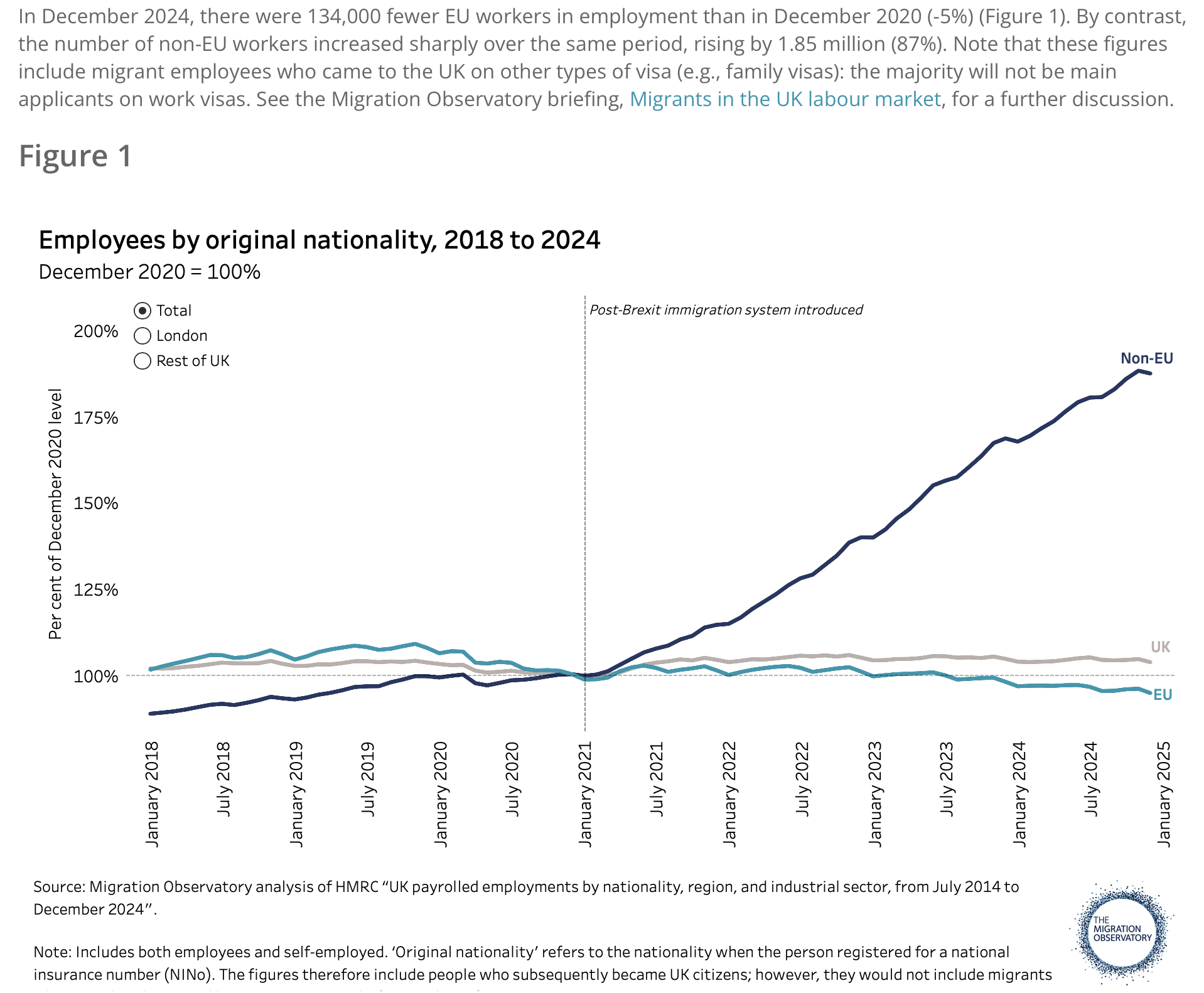
Aside, my favourite ‘whoops’ chart, (given Brexit was mostly a vote on migration):

1 Like

We will have great “AI” just no water left to drink…which one is essential… but maybe if AI can design a way to feed its thirst that is not at our expense that might be a good use of the tech…Otherwise we might all be using the Dune suits some day… :slight_smile:

Creatives won’t stop making art, we’ll just get paid even less.

2 Likes