I’ve been using darktable for a few years, but I have a newbie question.
When using D&S, it is possible to select sharpening for Anti-Aliasing or No Anti-Aliasing. I have always just tried both and selected the one I like best for each given image. But it finally dawned on me that what this really means is to select one if the camera has AA filtering or select the other if it does not.
So, is there any quick way to tell by examining the image info, or would I have to actually look up each camera body and look up its specs, building a personal database along the way (of bodies and whether or not they have AA filters)?
Hi Tim, most cameras have an AA filter. I would suggest that if you own a camera without an AA filter you bought it for that reason. The only difference is that AA filter is a stronger sharpening effect than the non-aa filter. The AA filter softens the image a bit and needs more aggressive sharpening. BTW, I have in DT 5.3 replaced the use of the DorS AA filter sharpening with the capture sharpening now available in the demosaic module as my initial sharpening step. It will be available in DT 5.4 next month. I wonder if this capture sharpening already takes into account the presence or absence of an AA filter in the camera. I don’t know enough about this new capture sharpening to understand how it determines its settings.
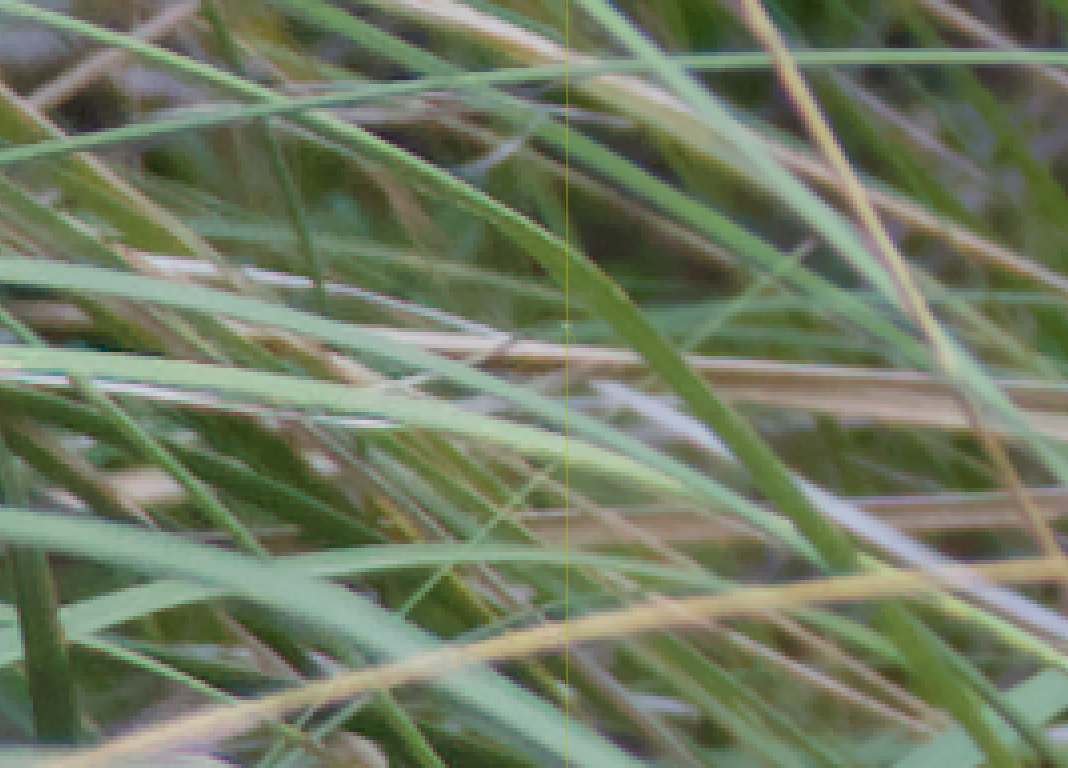
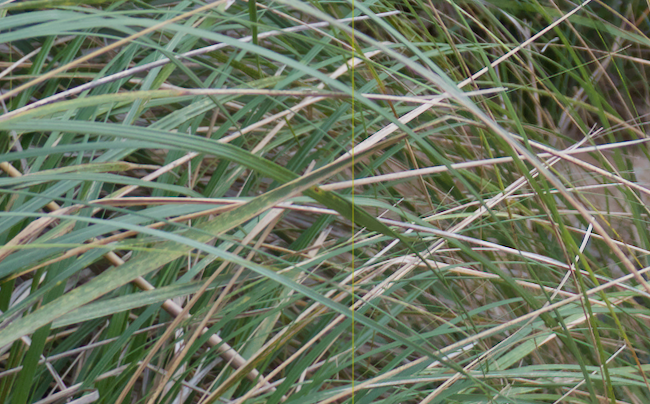
Like @Terry, I almost entirely switched to capture sharpening. My understanding is that the algorithm is self-tuning, I rarely touch the parameters, it is amazingly good, and much faster than D&S. See the screenshot below (400%, left: CS, right: no CS):
Not necessarily. I find the D&S presets rather ad-hoc, more like a starting point to experiment than a ready-made solution. Those presets worked well for someone on a particular sensor, but this does not mean they are universal.
I’ve found this to be very brand-specific. None of my Lumix cameras have an AA filter, and that includes a very small and inexpensive GX85 from 9 years ago.
It doesn’t help that many cameras have underpowered AA filters which reduce, but don’t eliminate moire patterns, so you couldn’t just have an on off flag. There are even some cameras with virtual AA filters implemented using the vibration reduction motors which can be switched on and off.
Personally I’m annoyed that so many cameras skip or under power the filters. You can always make up for them though sharpening if they are in place, but you can never properly correct for moire.
(right is CS on this time, sorry). But there are plenty of comparisons in the relevant topic. It is quite subtle, but very nice. I consider this the ideal level of sharpening.
Opposite opinion, I’m afraid. The times I’ve had an issue with moire are exceedingly rare, but an impact to sharpness will affect each and every photo taken. I’d rather have less to correct in the first place.
Before we had physically correct sharpening I might have agreed with you, but with it, there’s no downside to the filter. It can be programmatically adjusted for. I have had moire in shots and it’s a nightmare. The same artefact is also there on every sharp capture, even when it’s not as obvious as it can be on repeating patterns.
I think only Canon kept them. A while ago there was some crusade against AA filters, as part of the Quest for Ultimate Pixel Peeping Sharpness. AFAIK all other manufacturers caved in.
You can recover some sharpness, but not all. But I agree that it is a not a practical concern, and reducing moire is more important.
Ironically, companies like Kolari are now willing to add an AA filter to your sensor, for a serious amount of money of course. We have come full circle.
follow-up: I read up about AA filters in recent cameras and found that many brands actually kept them, at least a “weak” version (as there are different strengths) but are not telling you. You will find people on forums arguing whether camera X has an actual OLPF, as brands are simply not telling you. This is the funniest one I found.
My hypothesis is that after the initial enthusiasm, many brands backpedaled are they ran into moire issues. But not having an AA filter leading to magical sharpness seems to be an item of faith among users, so they did not advertise this widely.
It is difficult to tell experimentally with high resolution sensors, as you need high frequency patterns to make moire, and the camera processor may already correct for it in the “raw” file.
Kudos to Canon as at least they are playing a clean game.
Going back to the original post Tim was wondering about using the aa or no aa preset in DoS. The only difference is the number of iterations applied. So really it is a matter of how much sharpness we personally like. I guess the AA setting is stronger and I tend to prefer that on most images regardless of an AA filter being present or not.
Nikon continues to use AA filters on lower resolution cameras (less than approximately 35 MP). They do not use AA filters on high resolution cameras - D810/D850/Z7/Z8/Z9.
I can’t imagine any other field of signal processing where correct input filtering would be skipped like this. I guess perceptual sharpness sells better than accuracy.
You can recover some sharpness, but not all.
The sensor can only sample up to its Nyquist frequency. AA filters tend to be a little weak if anything, so you’re not going to lose significant detail below this level. I think much of the sharpness people see with no AA filter is high frequency noise, not legitimate signal. It may look sharper, but it’s not the original scene.
The only advantage to removing the filter is if you are shooting with a soft lens the lens acts as a low pass filter and in that case, the AA filter is redundant.
Has moire been a problem for people and I just haven’t seen it talked about? I don’t necessarily mean the general public, but people here who have use of darktable and alternative demosaic algorithms? Maybe I’ve been naive.