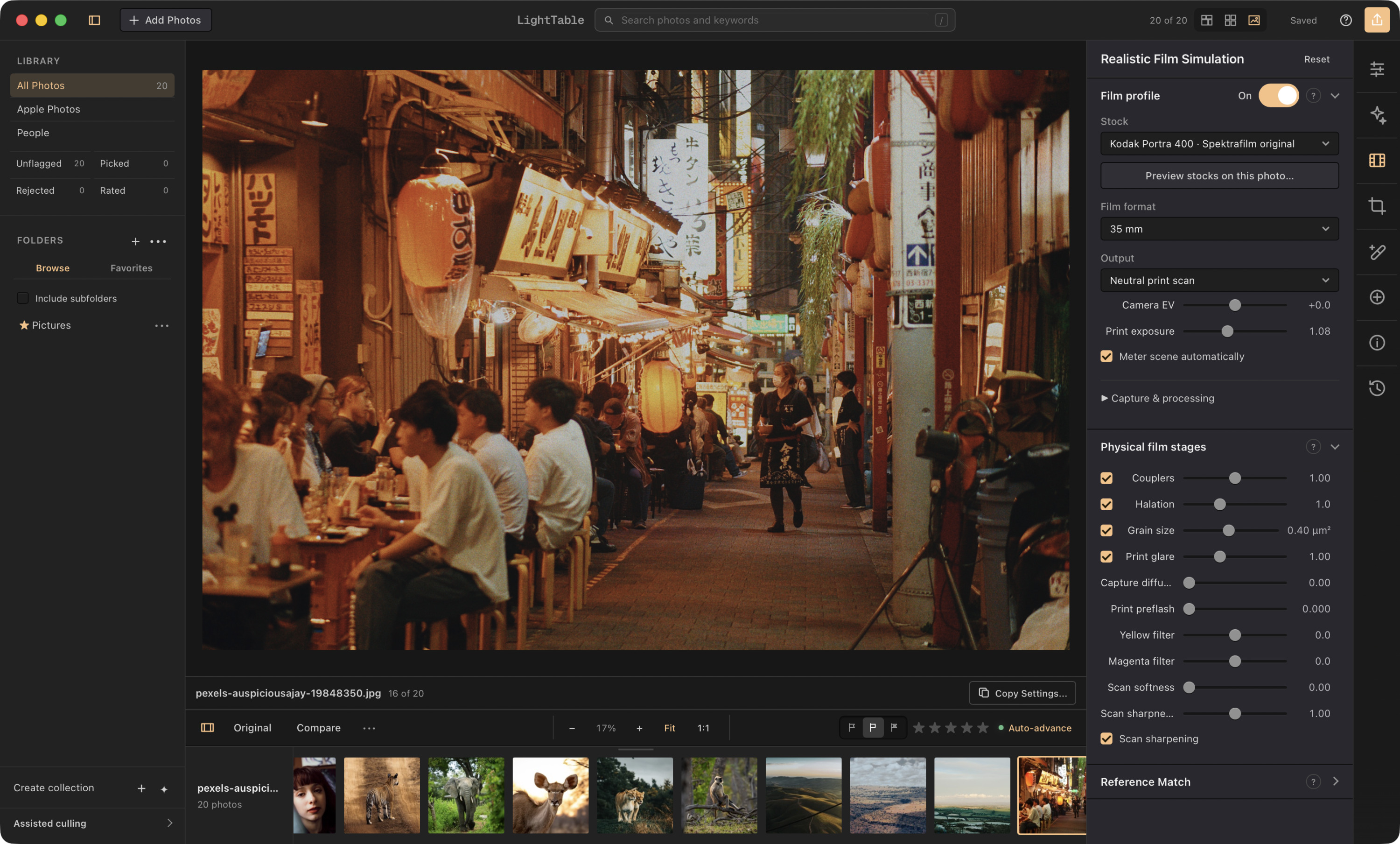
LightTable: digital darkroom

Hi everyone, I wanted to tell you about LightTable a new high-performance digital darkroom app that I’ve just published in beta. I’d love thoughts and feedback and I’m looking for help running the project going forward. Also, I’m still waiting for Apple signing cert and getting it onto Mac and Windows stores, so it requires a little bit of self-install at the moment.

Here it is: https://lighttable.app/

This project started with two seeming contradictions.

First, I’m a very casual, occasional photographer, so I don’t do enough photo editing to really justify having a subscription to something like Lightroom. I was hoping to cancel my subscription and so I started looking around for an open-source alternative. The ones that I found didn’t quite do what I wanted, but I was using one of them and was reasonably happy with it.

Then I had been thinking about how much I missed the look of real film photography. I decided to buy a film camera on eBay (Elan 7) with a decent lens (Canon EF 50mm f/1.8) for about $300 together and ordered a bunch of film. While I was waiting a few days for it to arrive, I started thinking more about why Lightroom wasn’t able to make the photographs I was taking with my digital camera (x100vi) look more like real film. I started looking into this question and found spektrafilm, which seemed like exactly what I wanted.

This became the second contradiction: right at the moment when I was ready to start making real film photographs again, I became interested in how to achieve the same look digitally. And I haven’t even got to the first contradiction, which is that my desire to cancel a $10 subscription to Lightroom, because I didn’t use it enough, eventually led me to spending bunch of time building an open-source Lightroom alternative, with a beautiful UI and spektrafilm built-in.

None of this would be possible if I didn’t a) have experience running software teams for the past 20 years and b) now have the incredible abilities of Claude Code and Codex.

So that’s how LightTable came to be. It’s fast, has a nice UI, and has covered most of the bases. It even has optional local private AI tools for search and face matching.

I think the spektrafilm effects are truly beautiful, and I would love to have everyone try it and let me know what you think.

But there is one problem: I’m still just an occasional photographer, and I am actually not at all an expert in digital photo workflows. I’m really not at all the right person to make the subtle and important ongoing decisions about how it should change and grow. And while I’ve built Windows and Linux support, I’m a mac person. So I’m looking for more mantainers to join me who care a lot about design and UX.

I would love to find someone who has really excellent design taste and cares deeply about photography and beauty and photo workflows, and would like to become one of the primary maintainers of this project over the long term. We may also want people who want to be the maintainer for specific platforms and specific Linux distros.

If you have some experience with software and products, and you are good at using AI coding tools, and you feel excited about this project, please get in touch! If you try out LightTable and have suggestions please get in touch or submit PRs.
6 Likes

Welcome, it looks like a nice set of tools…If I can find some time I will check it out… thanks for sharing…

Hi,

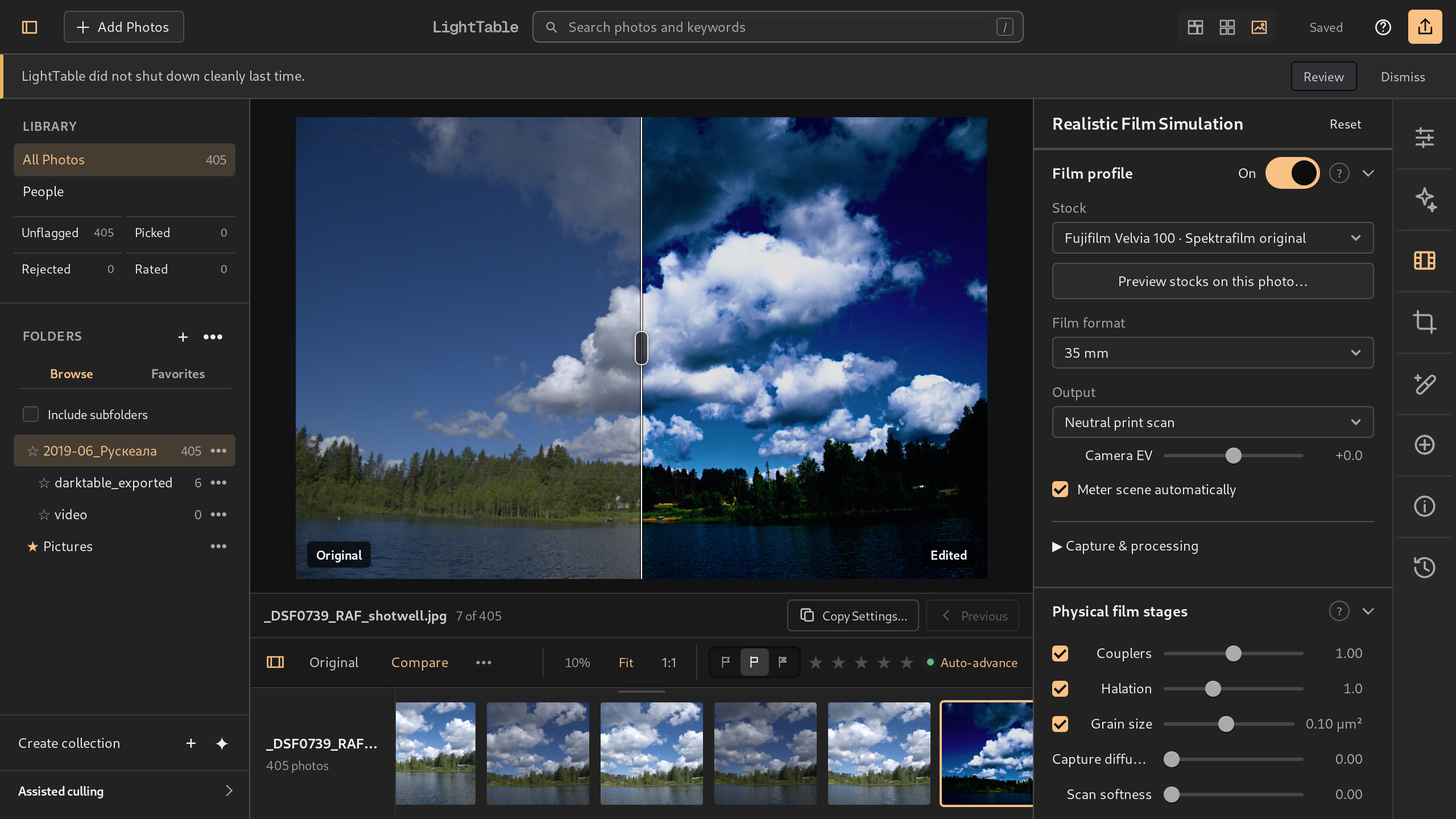
I have zero familiarity with spektrofilm, I just loaded a 8-bit/channel JPEG I had around (since your software doesn’t support raw files), selected a couple of presets, didn’t tweak anything, and the rendering always looks something like this.

From the website -

Spektrafilm is (or includes) a tone-mapping operation, but jpegs are already tone-mapped - therefore you get that overly contrasty and saturated result.
You need to apply it to raw files.

1 Like

Interesting why raw files didn’t show up the first time, but okay, point taken, thanks!

This is no more nor less about this program than any other (and my comment isn’t pointed at any of them) but I’ve personally never understood why there’s a desire to specifically look like film. Film doesn’t necessarily look realistic, if realism is the goal. Or if the goal is to look like film, why not just use film? Or if it’s to be abstracted, why be limited to only film looks?

Again not a criticism, I’ve just never really connected with the desire to look like film, but not be film.

:person_shrugging:

1 Like

I think the reason For Me, is that I like the way film looks for most subject matter, but want more control over the final result, without the hassle of getting into a whole other hobby that is also expensive.

Yeah, theres just too many variables that can go wrong with film. I love the colors, the textures, I sometimes miss the feeling of suprise when a roll comes out flawless, but I am too old for mistakes :smile: I am happy that were finally getting useful good looking in-depth tools that arent just slap-on LUTs.

1 Like

Realism is not necessarily a goal, if you treat photography as an artistic endavour; and it may not even be a well-defined goal, because what’s physically correct is not necessarily also correct perceptually - I know that some darktable modules strive to consider specific effects of the human visual system, but still …
On the other hand, film has been developed and fine-tuned for many decades, so it delivers pleasing results (considering appropriate film choice for the particular application like portraits, landscape, … ) out of the box.

This is why I experience that spektrafilm gives superior results compared to the other tonemappers, and with the least effort of pulling sliders.

Why not use film? Well, the digital workflow is much more convenient than to the traditional, analog darkroom process - although the latter would make for a nice and largely different hobby, but the effort and cost …

2 Likes

My feeling is that the motivation actually has two components:

  1. Just to explore new styles of editing
  2. People are getting disenchanted by straight-up photography because technology has made sharing photography superficial and vacuous to some degree (increasingly every day) and instead of trying to face the problem, people just like to lose themselves in new technology, which is also a series of immediate distractions that hides the fact that long-term self-improvement is being devalued

I have nothing against film emulations of course. But I do think #2 is a large reason why people constantly like trying out new modules and software more than seems reasonable to me. Of course, new tools can help promote art, but seeking new tools (in my opinion) is becoming an activity unto itself because we’ve been conditioned by technology to do it.

And again, I’m not saying that there’s no artistic value in it. There can be for sure. But there’s a significant component, I believe, in exploring all these new tools as a hobby unto itself now.

1 Like

Another point on why film:

Kodak and Fujifilm spent millions, perhaps billions of dollars perfecting their color science and making it look very good. They had top of the line color scientists, working on it, who did surveys and studies on color preferences in the general population, etc.

Digital sort of throws out all of that color theory and gives it to the hand of the common person. While digital gives you the freedom to do your own color grading and working an image how you like it best, you are still disconnected from that color science research/history, and we certainly are not as skilled as Kodak or Fuji color scientists.

Just yesterday I was watching The Wire (for the first time) and I kept thinking “Damn this looks so good”, better than most modern series shot on digital, which then have a ton of color grading work but end up looking like crap as well. Of course more goes into it, the show is very well lit and so on.

I completely disagree. People have wanted their photos to look like film ever since digital photography started becoming popular… It’s not a new phenomenon

3 Likes

Never said it was otherwise. Never said it was new. I just think there’s an increase it this sort of thing, a kind of increased desire for it. That’s why I said ‘component’, not the sole explanation. Like it’s always been there but the increase due to tech alienation probably increases it by 5-15%.

1 Like

Sorry, I misunderstood you, I agree on the tech alienation bit, even if I don’t agree that it’s driven by abundance of software but other causes.

I also did not say it was driven by an abundance of software. I said that people seeking out new tools is a symptom of it (just one symptom).

When I said “technology” is the cause, I didn’t specify it in the post but I meant that it was due to increasingly advanced communications technologies that replace traditional communities, AI, algorithmic manipulation, much of our purpose being mainly mostly useless innovation, being forced to use technology against our will (i.e. 2fa for banks on phones, etc), etc.

1 Like

I understand that, and I love film, but I have the feeling that the interest in film simulations is much bigger than it is to be expected. It’s just one way for artistic expression. Digital photography has endless creative possibilities for that. There must something special about these emulations. Maybe a nostalgic feeling?

And again, I’m not passing judgement nor criticizing the film look. It’s just the pursuit of it has never connected with me personally. In fact I’ve never really studied the various film looks enough to even be conversant.

I tend to think simply in terms of “look”, not necessarily that it does or doesn’t return me of film (nor anything else, for that matter). After all is said and done I may be reminded of some similarity here or there, but so far it’s not been a motivation for me.

A result? Maybe. A goal or intent? So far, no.

(apologies for the thread mini-hijack)

1 Like

I don’t think it’s nostalgic feeling, at least not for me personally.

The endless creative possibilities of digital that you correctly point out might be overwhelming for many, and creating a satisfying, natural and harmonic look is not easy at all.
In that situation, leveraging the decades of research and billions of investments of the film industry seems to be an attractive alternative.

1 Like

Personally, I don’t understand the endless film vs digital squabble. One of my recent finds, Ben Adams, shoots both film (Kodak Portra 400 / Gold) and digital (Fujifilm xt30). You’d have to squint to tell them apart.


Yeah, the photos James shows here, well… (theres a bit in the sponsor section, 13:10ish)

2 Likes