Hi,
I’m figuring out a method to measure the sky quality (SQM) at my location with my Fuji X-E2 and darktable.
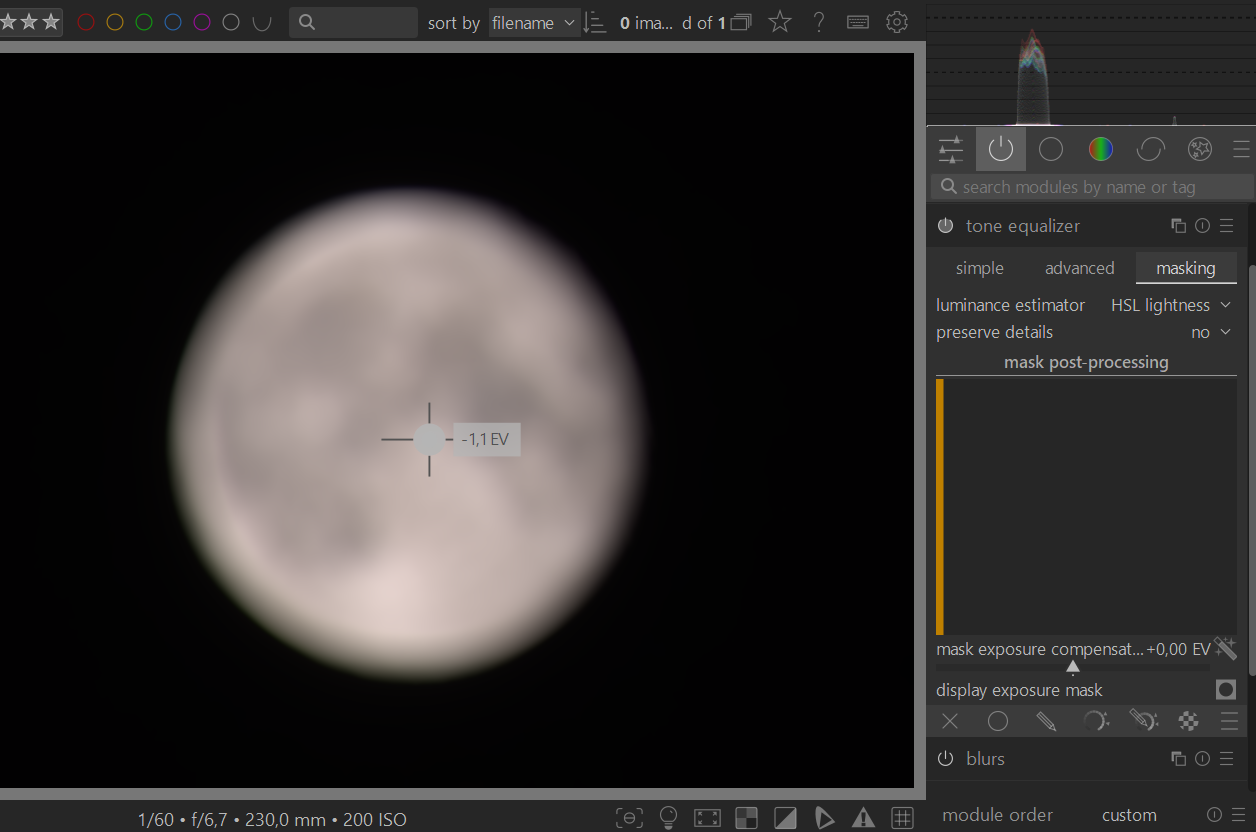
My idea is to compare the luminance of a shoot of the full moon with a photo of the sky in the zenit. Moon is taken with 1/60 sec and the sky with 30 sec. Other settings are the same of course (230mm, f6.7, 200 ISO).
Using stellarium I know that the moon was -12.0 mag at that day.
To measure the luminance in darktable I use the tone equalizer.
So first question: What is the difference between 1/60 and 30 sec?
Mathematically it’s 10.814 EV, but google-gemini says 11 EV.
This is because of the rounding of the EV values to pretty numbers.
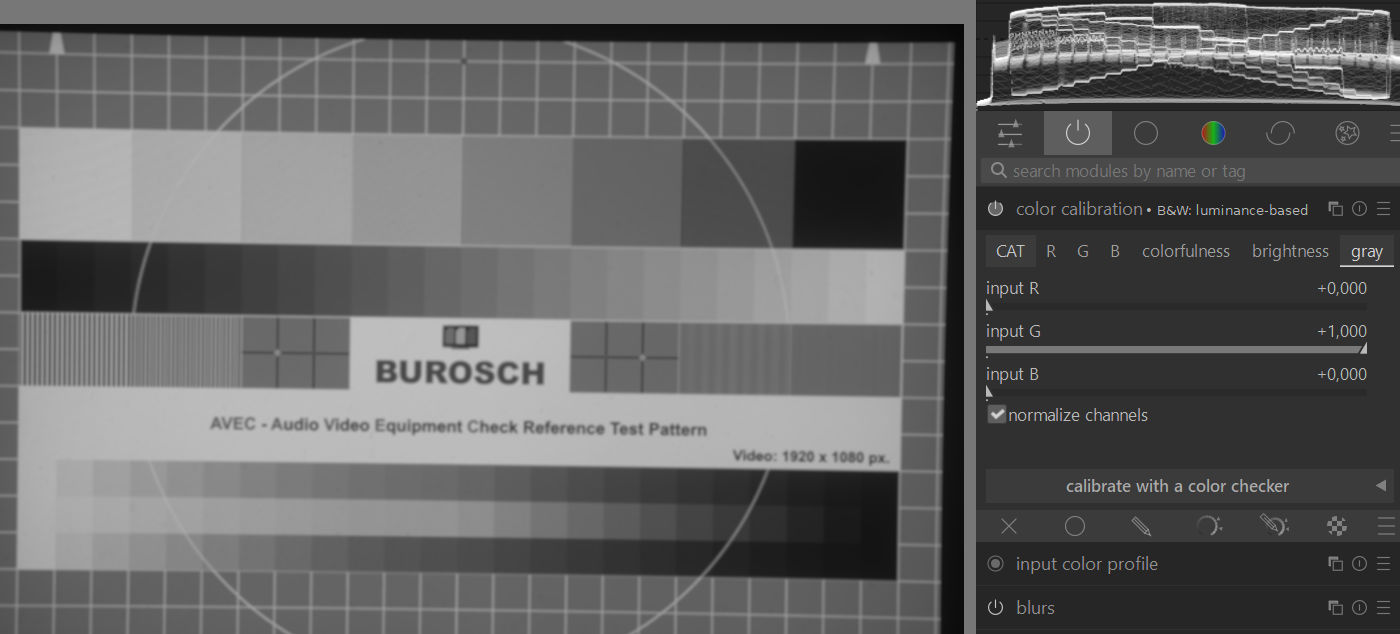
Noise reduction (denoise profiled, preset chroma only) seems to increase the brightness of dark images. So, better omit it for photometric measurements?
EDIT: I reduced the strength-setting to 0.2 and so there is now no influence on the EV read-out.
I’m not so sure this will work but it is certainly a nice en devour.
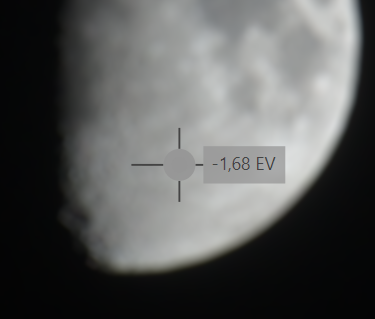
Why I’m doubtful is because the Moon is not equally bright over it’s surface. So which part of it are you going to compare with the sky. Second the Full Moon is far from even in its brightness because of the eccentricity of its orbit around Earth. Third you’ll make - at least in my understanding - the sky picture on another day as the Moon picture. Thus you’ll end up with two variable sky qualities in both measures.
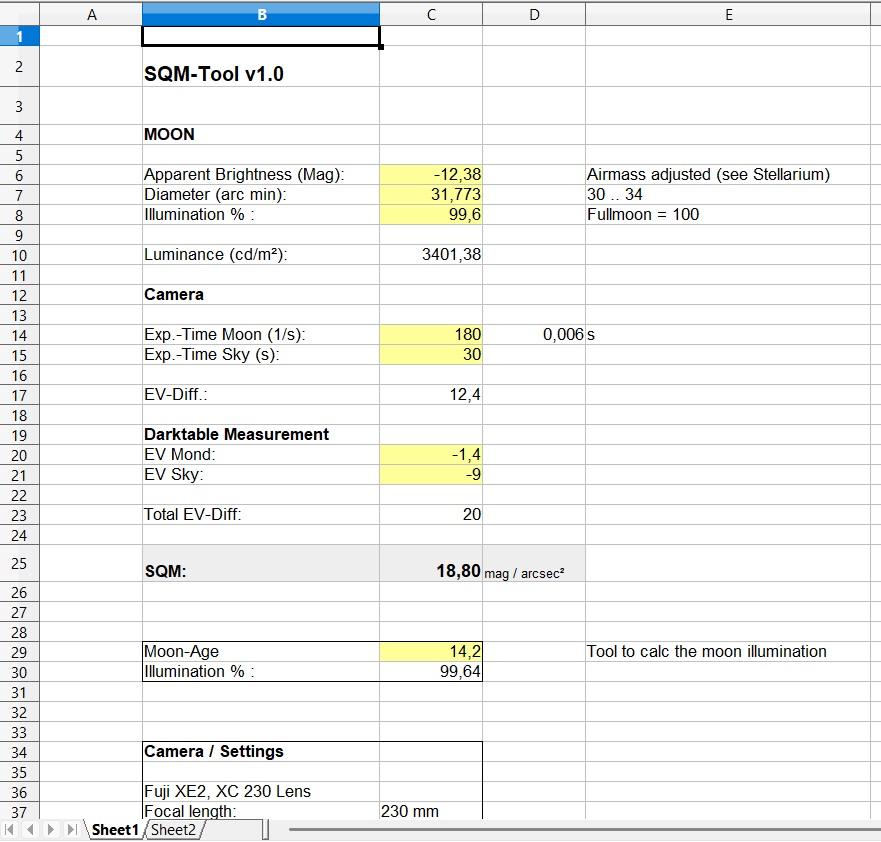
I didn’t figure out yet, how to get the moon surface brightness in cd/m² from the -12 mag and diameter of 1884 arcsec, but assuming 2000 cd/m², I get this first result:
Seems like a point source would be better suited for this, problem is finding one near the zenith. Vega would probably do in the summer time at my latitude. I do like the ingenuity here as the stand alone SQM meters are kind of expensive.
IMO, the issue with these sorts of measurements it they only tell half the story in that you really need to measurements at different points. My east and north horizons are solid Bortle 3s but I’ve got encroaching light domes to the south and west that have been getting pretty bad the last 5 years. In the summer I can watch the Milky Way fade heading in that direction.
Over on Cloudy Nights Tony Flanders had proposed another idea for doing something similar but for a whole sky setup. I saw it a couple of years ago and filed it under “to-do” but never really got back to it, maybe I should soon.