I was hoping to be able to do a scripted plate solve as part of my automated workflow, but it seems siril needs a guess at the origin.
If I invoke astronometry (locally) with a guess it solves within seconds, and it’s more like a minute without a guess (but I give a range for my pixel scale). I could live with that, at least for the focal lengths I am interested in. Is there any way, or any chance siril could be opened up in the future, I can get plate solving working from siril without a location guess?
I’m wanting fully blind position and focal length. That way I can script it without needing to input any details about the scope. I’m ok if that takes minutes instead of seconds, as I’ll be off having my lunch or something while it works. Same script, different setups.
does not work?
Because I use that a lot when users send us pictures that Siril can’t solve but they did not get the resolution right.
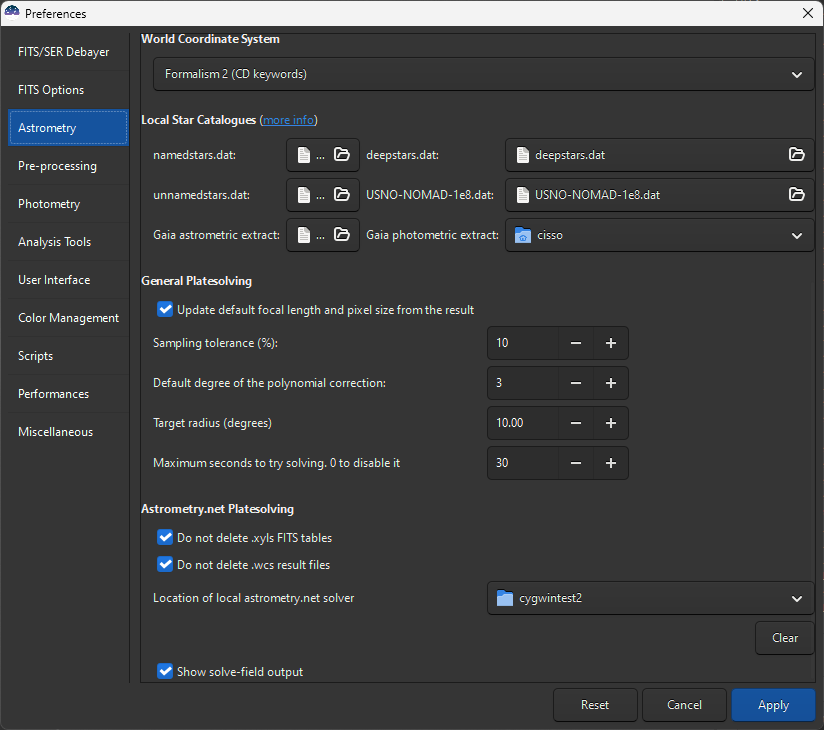
The log where it fails would be great as well. Pls enable the output of astrometry.net to be captured in the Console. This is done in the Preferences tab. Tick the show solve-filed output at the bottom.
You know, I haven’t actually tried! I have been taking the docs at their word for it and because the combination wasn’t documented I assumed it was unsupported. I will try again, but the very fact you do it regularly tells me it should work.
The options are documented here: Commands — Siril 1.4.0-beta4 documentation
and using the combination -blindpos/-blindres is addressed in the last section Astrometry.net solver options:
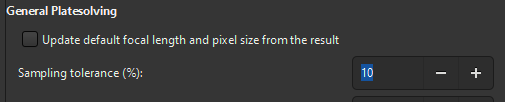
Regarding focal length, it’s actually used together with the pixel size to calculate a sampling. You can increase the tolerance to sampling in the Preferences:
up to 50%. So you could specify the focal length that gives the mean sampling of the range to explore and play with the pref to investigate the full range.
I should explain: my reading and processing machines are physically separate so I wasn’t able to experiment to try combinations that weren’t explicitly documentated, I should really have had a few trials anyway. In any case, I think I am misunderstanding the documentation as I still read this
in your first post, you were mentioning the command platesolve. Now you are referring to seqplatesolve documentation. The first is for solving a single image, the latter for a sequence. Obviously, the second needs a sequence name. Apart from that, both can accept -blindpos and -blindres. So you have to use the right command depending on what you are trying to solve.
Those additional options to -localasnet were not available in 1.2.6
Ah, I’ve checked our tooltip, indeed in platesolve documentation, there’s a wrong sequencename added, I’ll fix the docs. The confusion came from the fact you were showing the seqplatesolve command.