FYI Modern versions of Windows have Powershell, which is its own thing. But it reminds me a little of the Linux terminal. As I recall even a few GNU-Linux commands work here.
But it’s been a few years; my network runs Linux. 
FYI Modern versions of Windows have Powershell, which is its own thing. But it reminds me a little of the Linux terminal. As I recall even a few GNU-Linux commands work here.
But it’s been a few years; my network runs Linux.
Yes and yes. I did exactly this for 6 months and I can only confirm my disbelief that us uneducated, largely untrained ‘engineers’ were booked to resolve all kinds of problems that we had no knowledge of how to properly diagnose.
Tight KPI rules meant we were penalized for escalating a problem to those more qualified or spending longer than 25minutes at a job.
This meant massive temptation to bodge, lie to the client and generally do really bad work, all factors leading to my burnout last year.
I find it incredible sometimes that this society functions at all.
Does it really, though? 
I’ve been tech support rep for CompuServe (remember those?), and we got real training before we started on that job, we did troubleshooting down to the modem chipset (remember those?) if need be. Yes, we had KPI’s, some sometimes you’d be grumbled at a little if you were unlucky enough to land all the tough cases, but in general people knew what they were doing.
I also did tech support for another, smaller, Dutch ISP, and training consisted of an afternoon of someone droning on a bit, here’s a phone, glhf. Yeah, that was a different type of company, and yes, you’d be encouraged to throw network operators under the bus if we had some outage, it was all a shitshow.
Heck, I had a tech install FTTH at some point not that long ago, and the guy didn’t replace the fiber-to-ethernet thingy, nooooo, he just stuck another one on top of it (different brand). When that came down because his doublesided tape was shitty, he affixed it with some packing tape going over the box. This was, he proclaimed, a better solution than what we had before. The little box was supposedly “better” than the big thing we had before. At translating two different media types.
Oh well.
Kinda sad, as the command line interface is quite powerful and expedient. I’ve been writing tools for scale modeling, and I’ve settled on a command-line framework that just lets me write the essential logic, not have to mess with widgets and bindings. Anybody need to make a scale model of a stone wall??
https://github.com/butcherg/stonewall
Anyway, did spend a bit of time a few months ago messing with network tools, e.g. vkdt, blender. You can do networks without a GUI, text files that define the nodes and connectors, but editing THAT is a tedious pain, so GUI. I found a coherent noise library (aptly named ‘libnoise’) that requires actually coding the network in C++, started to write a GUI program for that, lost focus when travel and other things inserted themselves into my agenda. There’s a neat network library for Qt that absorbs a lot of the graphic tedium, but it takes some thinking to come up with the actual mechanism for the intended application.
So there. Coffee-fueled ruminations…
You have me intrigued: what are you building :-)?
I just came out in cold sweats and had nightmarish flashbacks…
I have been working for myself for almost 20 years now, but I used to work in tech support for a major IT outsourcing firm. We had very little training, yet loads of responsibility where certain retailers could be losing thousands of dollars every minute if we couldn’t get their systems back up quickly. And the amount of internal metrics and bean counting was utter bs. I hated it. I was offered a promotion to become manager, and I turned it down, choosing to go to New Zealand instead to snowboard.
In retrospect, it was a terrible decision for my finances, but I kept some of my sanity. Sadly, I may be now forced back into this kind of environment.
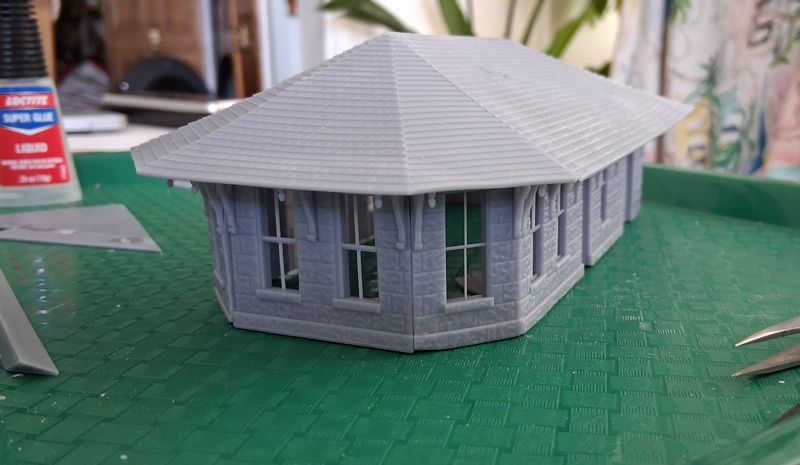
HO and N scale structures. My first project was a steam locomotive, now I’m working on parts and complete station models. Here’s the test-fit print of my current project, the railroad station at Antonito, Colorado, USA:
I’m now using my cell phone for these photos, has a macro mode and is just too easy… 
Neat! Are you sharing more of your work somewhere?
Toward the end of my Air Force career in the '90s, metrics became the thing. One day, we got a HQ email, asking us to collect time we spent collecting metrics. Metrics about metrics… 
I think it was some staffer trying to make a point to the brass.
Oh, snowboarding in NZ… I wouldn’t be into snowboarding, I would be into the f^*&-it. 
Yes. Posted the entire locomotive project on github, OpenSCAD scripts:
https://github.com/butcherg/DRG_168
Also, for structures I’ve started a collection of parts, available in a github repo as well as a website with pages to configure parts the way you need:
I’ve just started learning about color management in video editing. Hopefully I will develop a better understanding and appreciation of modules in dt such as AgX as I go.
Here is a video about color space transformations/ LUTs that I find interesting.
I was in IT at a major corporation in the mid-90s. They were forcing us to charge all of our time to this or that project. I was livid that we could NOT charge any of our time to all the time we had to spend figuring out how to allot our time. My manager was a pretty sane man, but he just said, “That’s the way it is.”
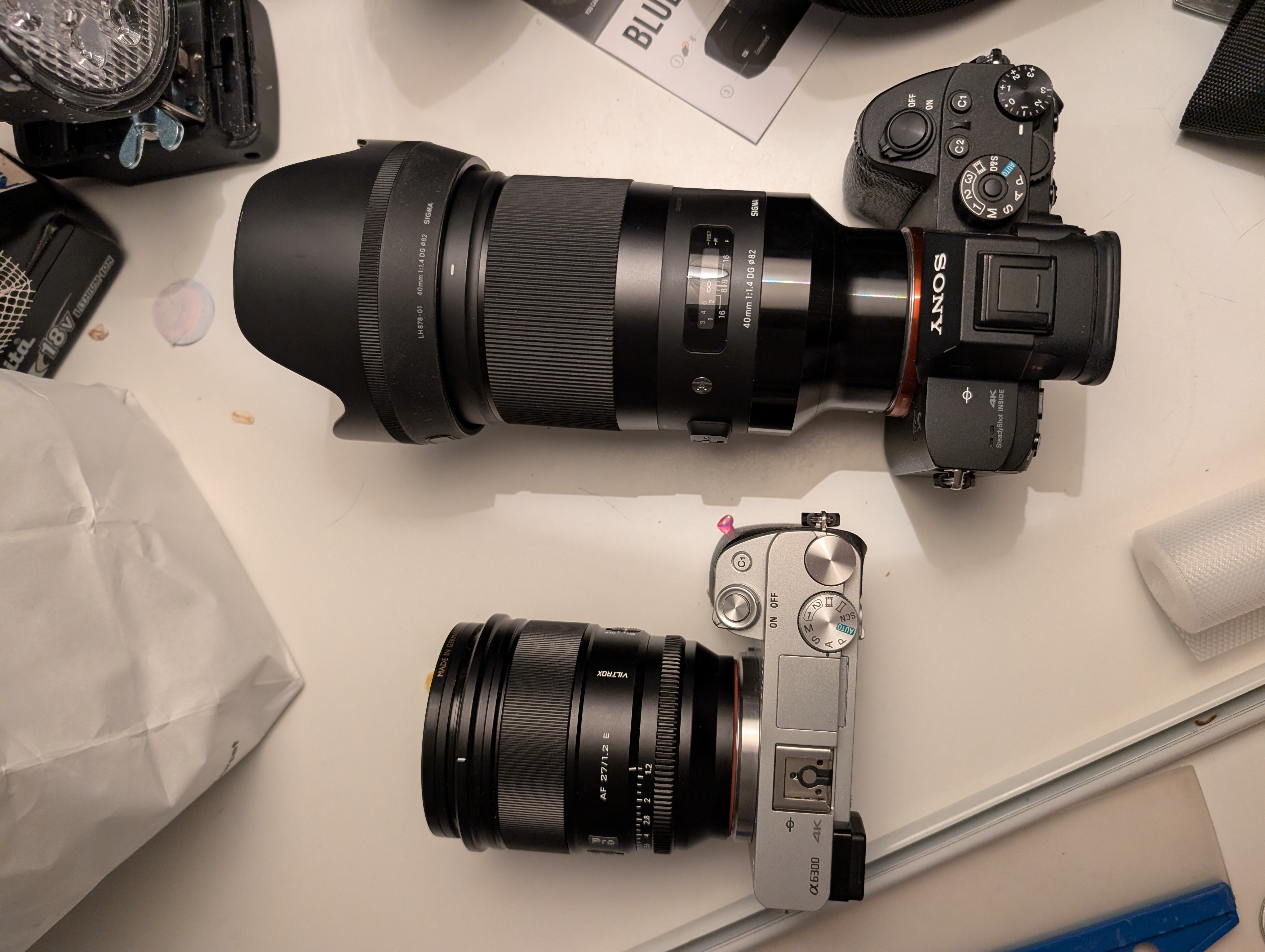
On that note, I finally found a very affordable nex5r in excellent condition for that purpose, to pair with the SG image 25mm f1.8 pancake. I don’t think it gets much more pocketable than that for an aps-c
In short, times are great for photographers looking at the second hand market, especially when you have adult money on your hands.
We’d love to welcome you to the church of Ricoh GR my friend.
Yep. And it fosters a “never want to ever touch that again” reaction, so there’s ironically little to no interest in learning what could be useful. For example, when the only time one touches a major production server is when there’s an issue at 3 AM, one does not fiddle with it unnecessarily. It becomes a sleeping bear so there’s no desire to poke it with a sharp stick. And the pattern repeats…
For me personally, when in the middle of a problem situation, there was little room for learning. It was just “get it fixed now” so once it was fixed you didn’t mess with it anymore. Learning requires the freedom to fail. That doesn’t exist when you’re the person on-call. Or, for that matter, when you had no test environment(s) in which to try things.
Edit; Interchangeable lens mirrorless camera with fast autofocus prime lens*! 
Nevertheless, the IT staff has the perfect excuse: “But we didn’t to anything that caused this problem!”
Very few people in management realize that not doing anything is the cause. Technical debt is an esoteric concept for most people.
I was offered that path two years ago as well, but took it. I’ve been doubting my career choices ever since. Snowboarding looks like a better choice from where I’m at right now. But you can never know unless you try…