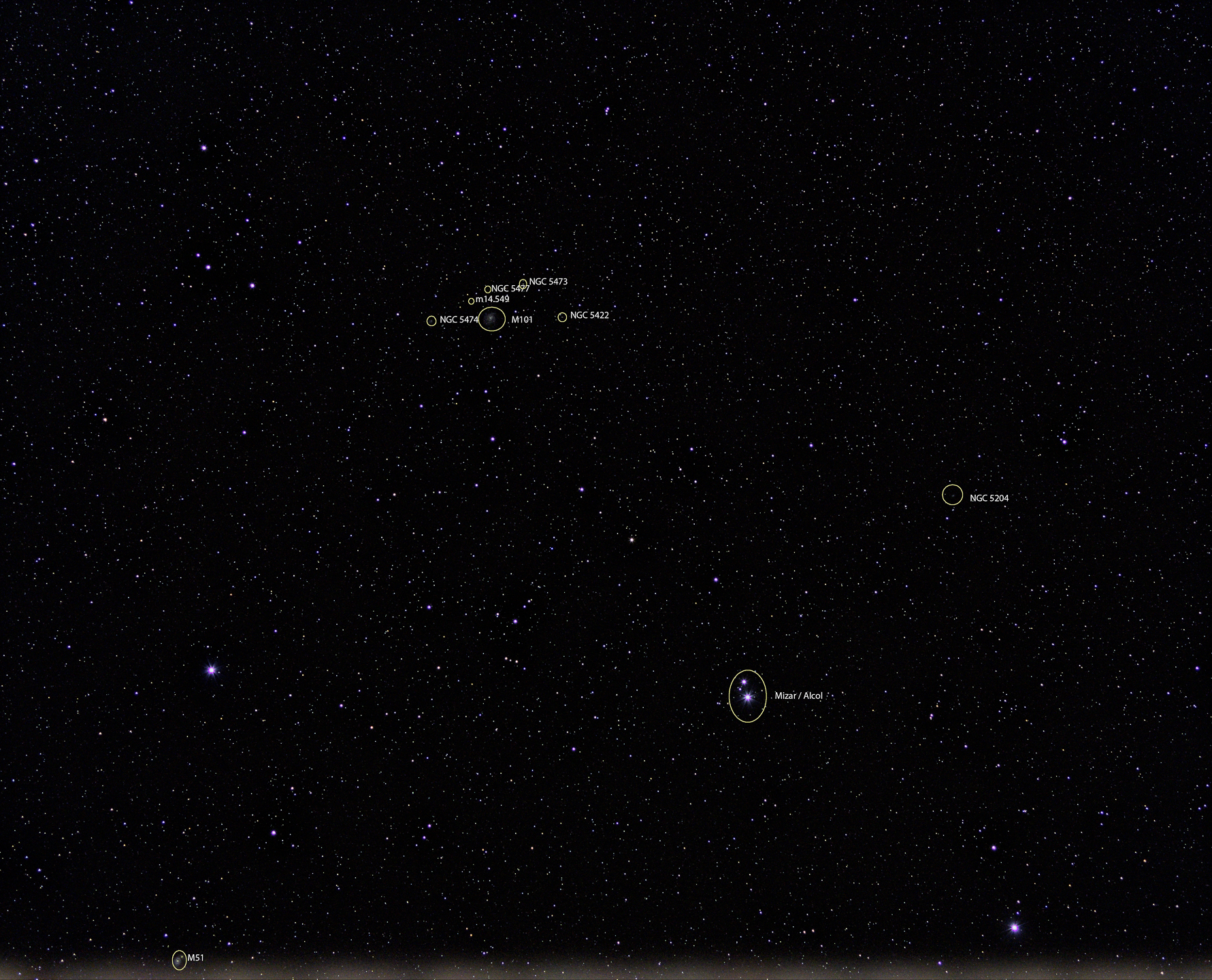
Hi Jetze. I take your point. However, according to the general suggested methods of dividing a certain number such as 500 for full frame, 400 for APC and 300 for 4/3 by the focal length of the lens used the 13 second exposure should not have been a problem. I wonder if what your pixel peaking reveals is not in fact lens defects such as coma or astigmatism. I don’t know for sure. But I would suggest the @Luca_Tion try various shutter speeds to determine at which shutter speeds movement becomes a problem.
But I agree with @Doug-Phoenix comment about using Siril for a shot like this to align multiple exposures.
I do understand you position about pixel peeping. It is a matter of taste however, how someone regards a picture and its technicalities. For me the fact that the star elongation shows up on my screen without zooming in would be a disappointment. No matter how beautiful the picture would be. Not an unbearable disappointment but surely something I would want to improve on. And thus my comments - which maybe were too harsh anyway.
@Terry
Thanks for the welcome and just additions. I would indeed take the rule of thumb about max exposure time with a good grain of salt and revert to the trial you describe. When starting astro-photography not every one is aware that stars around the poles move much slower than around the equator.
Of course it’s a matter of taste. But for me always counts:
Better an imperfect photo than no photo.
If I were hunting always for perfection, I would lose my joy on photography. I just shoot astro from time to time. I don’t want to buy (and carry around) a superfast lens and a tracker just for such cases. On top I dislike the techniques used for professional astro shots. Stacking multiple exposures, making dark frames, making photos of the foreground separately…
Too much hassle too much work, without the ability to see my shots immediately. I need some “THAT WORKED OUT NICE” effect at the time I’m taking the photos. Not hours later on the computer.
Heh, I get the lack of immediacy, thinking back to my darkroom days, but to me there’s something about teasing a general purpose sensor into recording faint light…
I’ve got a tracker, never got around to using it. Actually, a bit more interested in trying the thousands-of-short-exposures-at-high-ISO thing; didn’t someone post such here a few years ago? I went searching couldn’t find it, it was of the Andromeda galaxy, IIRC tens-of-thousands of 1sec exposures, so no streaking, but what kind of workflow???
I had that as well for quite a time. I bought my first SLR when I was 14. A Ricoh XR-X. I shot on transparancy film. And after holydaysI always nervously waited until the photo lab was ready with the processing. Hoping, my shots were successful.
That’s very personal, for others it’s just the opposite
Understand, I had good luck with a 100mm F2.8 macro on a Pentax K1 on a tripod, getting not too bad stars because of the inbuilt tracking mechanism of the sensor. Did do stacking but no darks, bias etc. No separate foreground. Forgot about the details, it’s from the Lightroom/Photoshop period.