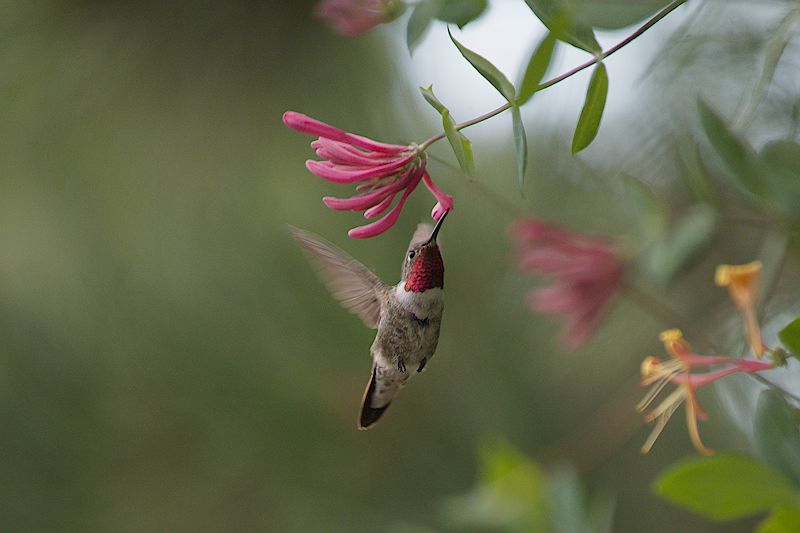
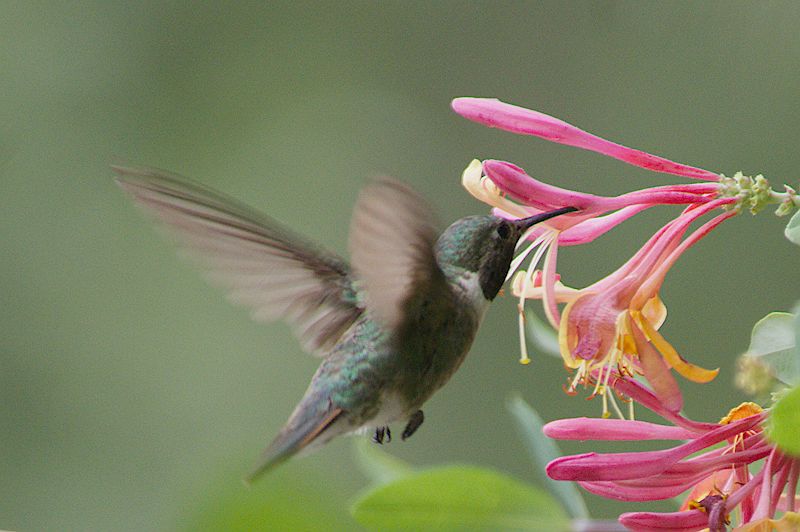
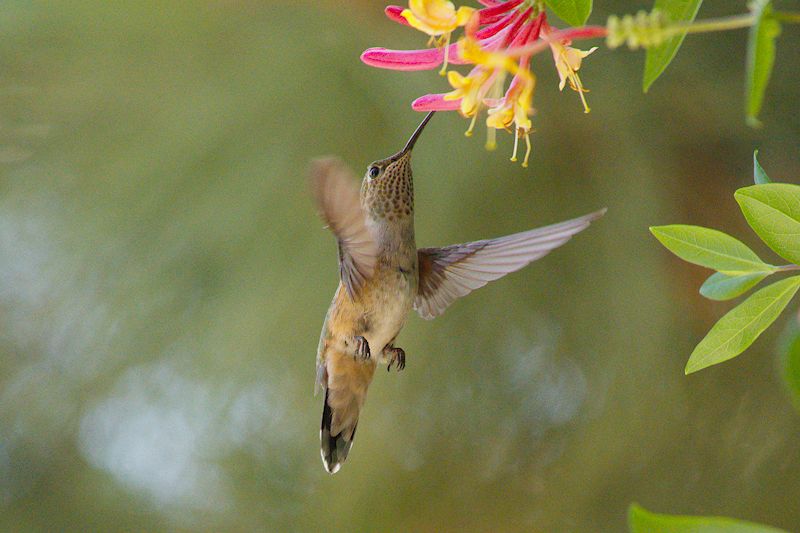
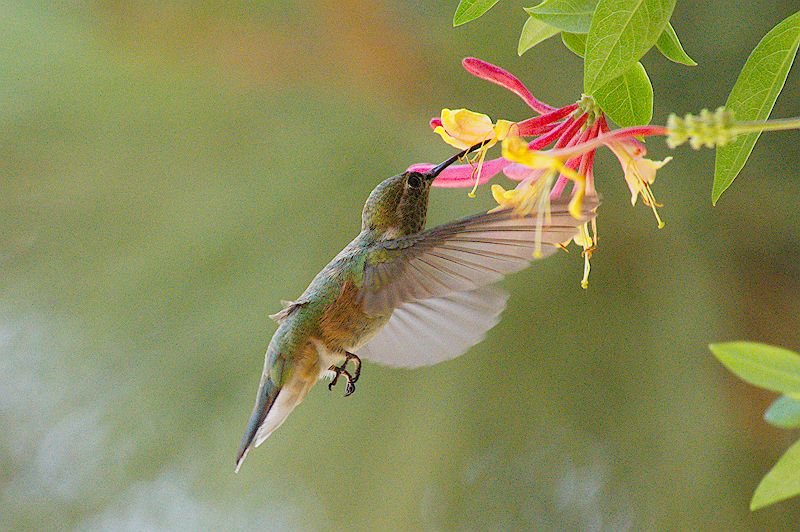
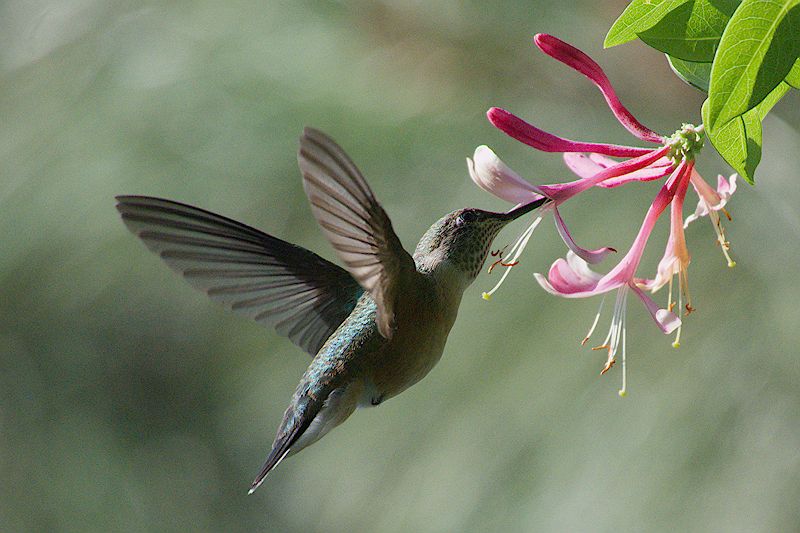
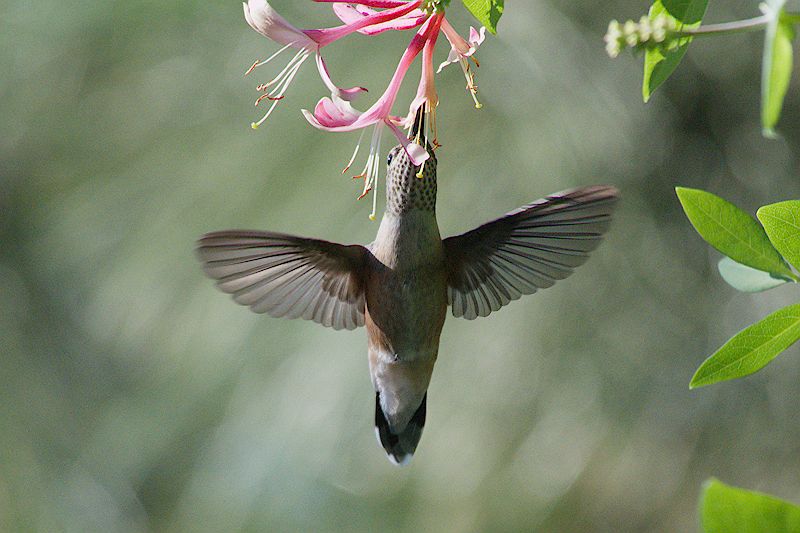
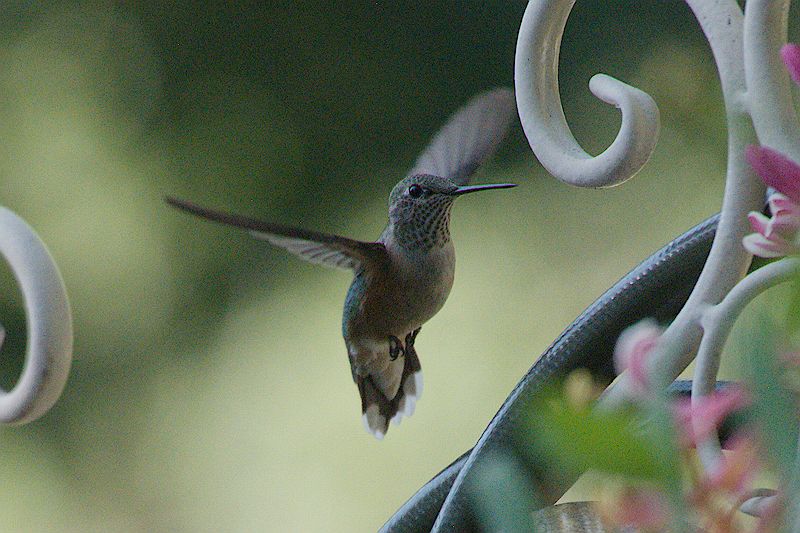
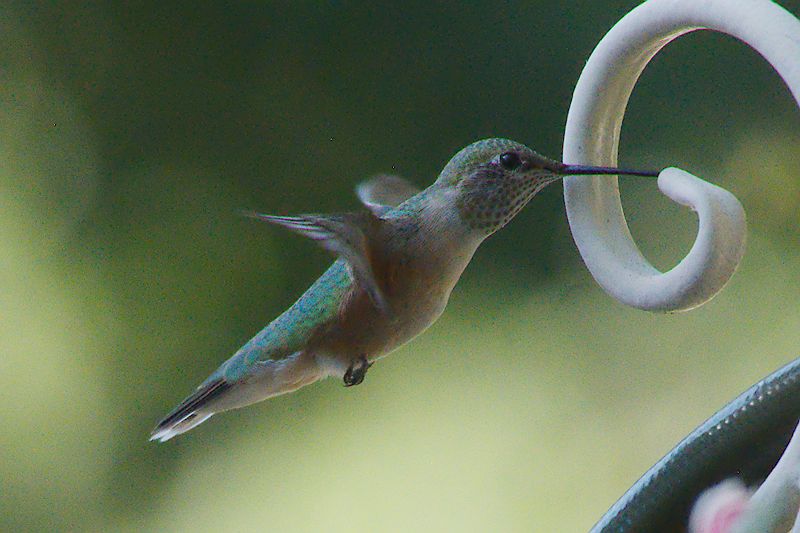
First couple the first day a bit blurred; later in the day learned to set Manual mode, at least 1/2000sec (later I used 1/4000sec), f8. and auto ISO. Exposure mode was highlight-weighted matrix, which I use for just about everything. All of these were taken from a chair on my porch, about six feet from the honeysuckle vine. All are heavily cropped, even with a 300mm lens on a FF camera.
What a nice set. Hummers here in Virginia are “filling up” for their winter migration, so there’s a frenzy around my plants and feeders as they’re chasing each other off.
They’re a fun subject. I need very high speeds to freeze motion, but they like to hover so I can get good shots at 1/400” if I don’t mind the motion blur in their wings. And even then I can get a nice clean shot at that speed if their wings happen to be fully spread out.
I actually like a bit of blur, gives the sense of motion.
It really for me was a ‘grab-bag’, I’d sit there with my elbows against my chest, holding the camera and lens generally pointed in the direction of the vine, focus preset to the general distance. Wait, wait, wait… when a blur showed up, point in that direction and start shooting. They’d usually pause at one flower, so I could center them in the frame, but the angles I got were a function of where I sat…
Lovely collection.
We don’t have many where I live, but one tends to visit every day or two. It’s quite hard to tell how often it comes actually. Maybe it’s coming multiple times a day and I just don’t see it/them.
Anyway, I hope one day to have the time to just sit there and wait with my camera. It usually comes when I’m eating and don’t have my camera with me.
These are some lovely shots! Thanks for including the shop talk about how you adjusted your settings over time. Since I rarely shoot wildlife, it was kind of surprising how high the shutter had to go! Its rare my shutter ever goes north of 1/500th
Funny, at first I thought my max shutter speed was 1/2000sec, as it wouldn’t dial higher. Reading the manual later, recalled I’d set it to Electronic Front Curtain Shutter (EFCS), which limits the shutter speed. Switched back to full mechanical shutter, and now I can dial up to 1/8000sec.
The freaky one is auto ISO. Between birds, I’d wave the camera around and watch the ISO change, going as high as 11400. And the noise in such low-light photos is minimal.
I’m usually set up with my tripod for that very reason. I planted a bunch of hummingbird friendly flowers on my patio so I just wait for them with my morning coffee.
We have a male and at least two others that come every 15-20 minutes. You can tell who are the encroachers because the dart around nervously and don’t stay very long, while “Big Mama” will take her time and sample everything.
Thank you so much. We have different birdlike here down under, so I’ve never seen, let alone tried to capture a hummingbird. They are very elegant in appearance in my opinion, and the reverse-flight superpower, plus the very rapid wing movement is part of the fascination factor for me. I agree that motion blur is helpful in conveying this, but I also appreciate the superquick exposure that allows me to see what these birds actually look like.
Thank you once again.
I haven’t really paid attention to my hot pixels. Spent more time on dust spots, even put a spot tool in rawproc. Now, you’ve got me wondering…
Thanks to the marvelous wonder that is AI, we have this answer on blinking:
" Yes, hummingbirds do blink, although it appears they blink very rarely. They possess a nictitating membrane, or “third eyelid,” which sweeps horizontally across the eye to clean and moisturize it while the bird is flying at high speeds, acting like natural flight goggles. High-speed photography can sometimes capture these rapid blinks, making them seem even rarer than they are."
Now, to go find out if this is right… Not sure what that last sentence actually means…
They’re like a fly that’s had a few cups of strong coffee. They’re like a streak on any long, straight trajectory; when the get to where they’re going, they flit about uncannily until they stop, just for a second or two. It’s interesting to watch them service a bush with multiple flowers, darting and hovering.
Nice pics! I never got the opportunity of seeing those birds in person, I think.
Is “Exposure mode” what my Canon camera calls “Metering mode”? Hum I guess so: a web search showed that Nikon has a “Matrix” choice for that. I never fiddled with that setting, but sometimes hesitated to, because the camera sometimes overexposes the face of the figurines I shoot, as if saying “Yo man, look at how nice the background – AKA 99 % of the picture – looks now”, and I’m like “Dude, I don’t care about the background, just stop burning that face!”, but I just adjust the exposure compensation thingy to ask for something darker and go on with my business.
Didn’t spot them until you mentioned it. Strange. RawTherapee’s filter, even at the most peaceful setting, generally makes short work of such occurrences.
Yeah, ‘metering mode’ is the more appropriate term. Most metering modes measure a place or region in the scene to determine a middle-gray value; ‘highlight-weighted’ instead means the exposure is adjusted to keep the higher values under-saturation, which pushes the rest of the image darker. I use this mode almost exclusively, with the realization I’m going to have to manually lift shadows in post.
Re: hot pixels, I’m using software I wrote, just haven’t felt compelled to write a hot-pixel mitigator…
Thanks. Sounds cool indeed. I’ll need to get a closer look at the Canon modes, but I’m not sure they have something like that. They all sounded like variations on how important the subject is with respect to the rest of the image.
I wish I could say it was one of the features I bought the camera for, but I didn’t discover it until I spent some time reading the manual. That, and IBIS, didn’t know I needed that until I used it…

 Not sure what that last sentence actually means…


 So hardcore.