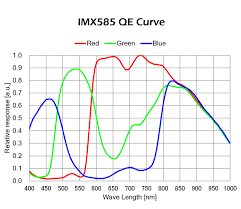
which matches almost exactly with a Sloan z filter (~ 825nm+) and should, in theory, turn an RGB into a mono camera at this frequency range.
I have an imx585 colour and I’m planning to do this experiment when my backorder for a Baader z-s filter arrives, and the skies allow.
I hope to be able to use a regular mono processing pipeline, but I also suspect that the actual transmissions will need a small “colour correction”, owing to the small region 825-850 where the channels have slightly different transmission rates (and they don’t track exactly perfectly either, blue is ever so slightly stronger than green).
Is there any way to apply a “colour correction” of this nature in Siril in this way, without debayering the image? Manual pixel math could work, if I know the bayer pattern… I’d even be happy manually creating / eyeballing the correction parameters.
I feel like I could write a little python script to do this, but I really want to keep everything inside of Siril! And, what a hack, this could be great for RGB folk to dip their toes into a full mono workflow!
NOTE: this is very specific to the imx585 sensor. This will not work for anything else that I’ve seen. Sloan z is very interesting as it has a lot of the Paschen Hydrogen lines (as well as the CaII triplet, some S and some O), but they are more likely to pass through dust. Arguably Sloan i is more interesting, but the rgb-mono hack doesn’t work there so it only works with the mono imx585.
I theory, only in theory. You always will see the bayer pattern.
I have this camera: Caméra ZWO ASI 224 MC Color and I already tried with IR filters. I had the Bayer pattern.
Color correction only work on debayerd images though.
Ah well. I will write a little python script then. My plan is effectively to scale the B and R pixels (very close to 1.0) so that they look like they continue the G data. I could find it automatically by doing PSF fits or something.
Interesting that you did this with the imx224, it does seem like it has a very similar response curve to the imx585 in the NIR. Did you try doing any tweaks like I am planning or did you just look at it and reject the idea when you seen the banding?
Well damnit, I already ordered the filter … I’m guessing we’d need to find the correction factor and apply it to the subs, so that stacking would work correctly. And that does sound tricky.
We can at least use the green channel, and throw away R and B.
Just a thought though, if I treat it as a regular RGB image it might be easier to eyeball the color correction parameters, and then use that at the sub level. Although I’d be introducing rounding errors early in the process, and well, I’m clasping at straws now.
did you ever try one of the zwo 850nm ir pass filters? That cuts a bit more than the sloan z but it’s a lot cheaper (20 euro on aliexpress) and even ZWO claim it should give a mono style response.

 … I’m guessing we’d need to find the correction factor and apply it to the subs, so that stacking would work correctly. And that does sound tricky.