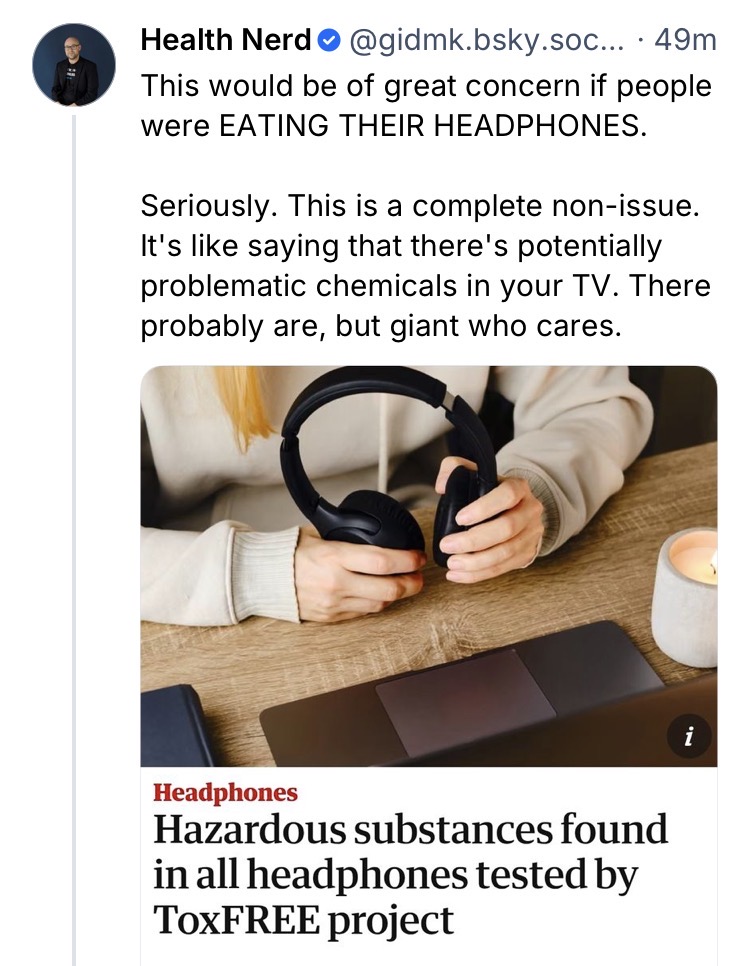
Note that with sophisticated analytical techniques, every single element or molecule known to mankind is “found” everywhere, even in concentrations that are absolutely no cause for concern. The concern is the level, which the article does not talk about.
4 Likes
“These chemicals are not just additives; they may be migrating from the headphones into our body,” said Karolína Brabcová, chemical expert at Arnika, part of the ToxFree LIFE for All project, a partnership of central European civil society groups that carried out the research.
“Daily use – especially during exercise when heat and sweat are present – accelerates this migration directly to the skin.
I am curious on how plastics that are not in direct contact with skin can migrate their chemicals into our bodies. I get that in ears will make contact with your skin, but regular over ear headphones do not make contact with the skin, only the pads do, which usually do not contain any plastic.
1 Like
Surely the pads are plastic or coated?
Right, big logic flaw on my part, the foam used in the pads is obviously plastic foam  I tried to find materials used for Sennheiser and Beyerdynamic pads but don’t find them anywhere.
Maybe it’s time to demand an “ingredient” list for products, like we do for food items.
That would spoil the Guardian’s daily “we’re all doomed” metrics.
2 Likes
This from the Austrian consumer association, which was involved with the testing has some more details and links to the original report with some kind of traffic light system of chemicals. Mentions some specific models that tested worse.
Auto translation:
“This is not a pleasing result,” summarizes Birgit Schiller. “But you don’t have to be afraid to death. In individual products, the amount of harmful substances is often not immediately questionable. The decisive factor is the sum of all loads. However, in everyday life we often come into contact with many stressed objects, such as toys, drinking bottles or clothing. The more often this happens, the greater the total burden - and thus also the risk to our health. That is why it makes sense to make sure that we - and especially children - come into contact with hazardous substances as little as possible.”
2 Likes
A bit of an off topic but I believe more emphasis needs to be done on education as well. Clothing is a good example.
We all know that polyester clothing is probably the leading cause of microplastics worldwide due to excessive washing releasing tons of micro plastics into the water system. We also know that it increases acne when in direct contact with skin, makes you stink like hell when you sweat, etc. Why isn’t this taught in school at all?
We could limit these fabric uses to jackets, fleeces, etc, which rarely need to be washed, and stick to natural fibers for base layers and so on.
I have started using a 75% merino wool and 25% poly blend for my base layers both at home and outside, and if I rotate these shirts, they barely get stinky and can be used for 2 or 3 weeks before washing.
I had to learn this from the internet because neither schooling, nor national TV, nor my parents, knew about this. It’s a bit strange that school focuses so much on topics we will eventually forget almost all the details like geography while ignoring “life” skills that would make everyone’s lives better. Am I too naive?
4 Likes
I think one problem is schools wouldn’t want to introduce divisions between richer and poorer kids. Also, an anecdote, our hippy geography teacher told us all about the dangers of clingfilm (sarin wrap) and we all just thought she was nuts.
2 Likes
Probably because it would be torpedoed by clothes manufacturers using the fabrics that are not recommended. At least in the US.
It is strange that I only figured a lot I know about clothing in my 40s. For example, that “breathable & rainproof” technical fabrics require a lot of maintenance with chemicals I don’t want near my skin to provide a negligible breathability and so-so rainproofness.
3 Likes
Or that “breathable waterproof” is a contradiction. Vapors can only travel along a humidity gradient. If it’s raining, breathing stops. (If it’s not raining, you can just open your jacket to “breathe”)
Also, I recently learned about cast iron pans, and now I wonder what other useful, simple technologies we have lost in the name of “progress”.
And to get back on topic, at least tangentially, I learned about headphones, impedance, and the utter subjectiveness of sound. There’s some objectivity in loudspeakers, but headphones are just entirely subjective. No wonder audiophilia is so closely correlated with lunacy.
2 Likes
Well, I’m waiting for transport so I’ve done a bunch of screenshots of the headphones in the survey with the green, yellow, red ratings, fwiw.













2 Likes
Most people don’t want to know about this. Instead they want fast fashion made by slave or near slave labour that will only last a couple of washes, but is so cheap they can have a new outfit every week.
It isn’t just the G. though, is it. How many reporters have anything but an arts background?
It seems to be perfectly acceptable to say that one is innumerate, but being illiterate is another matter.
1 Like
I guess many of them are English majors (or local equivalent  ). To quote Dave Barry (I’ll mature when I’m dead),
The American newspaper industry isn’t run by people who know anything about business. It’s run mostly by English majors, or people who majored in some other academic sector of the gigantic bullshit festival known as “the liberal arts.” We spent our college careers discussing and writing papers about large important books such as Crime and Punishment that often we were unable to physically read more than about 30 percent of because we were busy being college students. Our chief marketable skill, coming out of college, is the ability to write authoritatively about things we don’t necessarily understand.
The newspaper business is a perfect fit for us, because it doesn’t require the firm grasp on factual reality demanded by businesses such as, for example, plumbing. When a plumber installs a bathroom, he has to understand and obey the laws of plumbing physics, and he has to have all of the plumbing parts he needs, or the bathroom is not going to work, and he is not going to get paid. Whereas we journalists, using our English-major skills, are able to routinely assemble authoritative-sounding stories even though we have only a few tiny shreds of second- or third-hand information and only the vaguest understanding of what actually happened. We produce stories that, if they were bathrooms, would have water spurting from the electrical outlets and bolts of electricity shooting out of the toilet.
2 Likes
Fair, though for a general newspaper, I think incentives are probably more important. Let’s face it, if the headline said “a report came out but, actually, don’t worry about it”, would I have read it or posted it…?
I take the (somewhat cynical) view that the only literary device that journalists know about is hyperbole. This isn’t helped by the 24-hour rolling news cycle, the resultant short attention span and the need for clicks.
Can one imagine a headline like this one, from the Times in 1929
“An earthquake was felt yesterday between Illapel, to the north, and Talca, to the south, in Chile. No damage was done.”
1 Like
As an ex wire hack, I used to send these kind of headlines all day long… I do get your point, though I would add that it’s not a coincidence that whenever an authoritarian executive tries to take over the state, the first thing they do is seek to control and/or discredit the media.
Ah yes, “the arts” what have they really given us? Nothing! Your degree is worthless!!
1 Like
You regard getting a degree as a purely economic?
In the past few weeks, we have been to lectures on a whole variety of topics. On Wednesday, we went to a talk on women’s funerary rituals in medieval Europe, surely economically useless, but fascinating nevertheless.
STEM is certainly important for generating wealth, but one shouldn’t ignore the contribution not just to the economy but to the overall wellbeing of people.