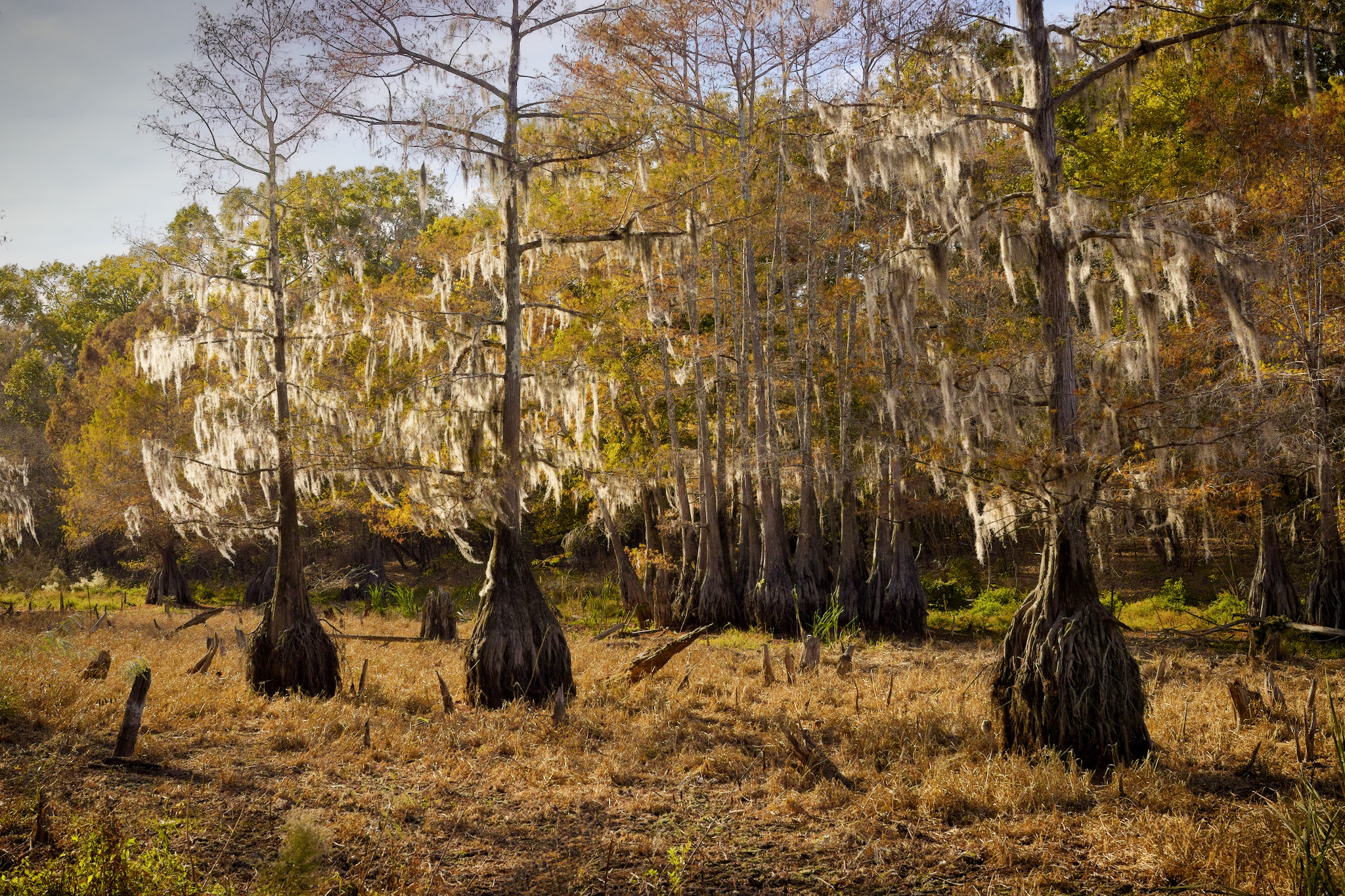
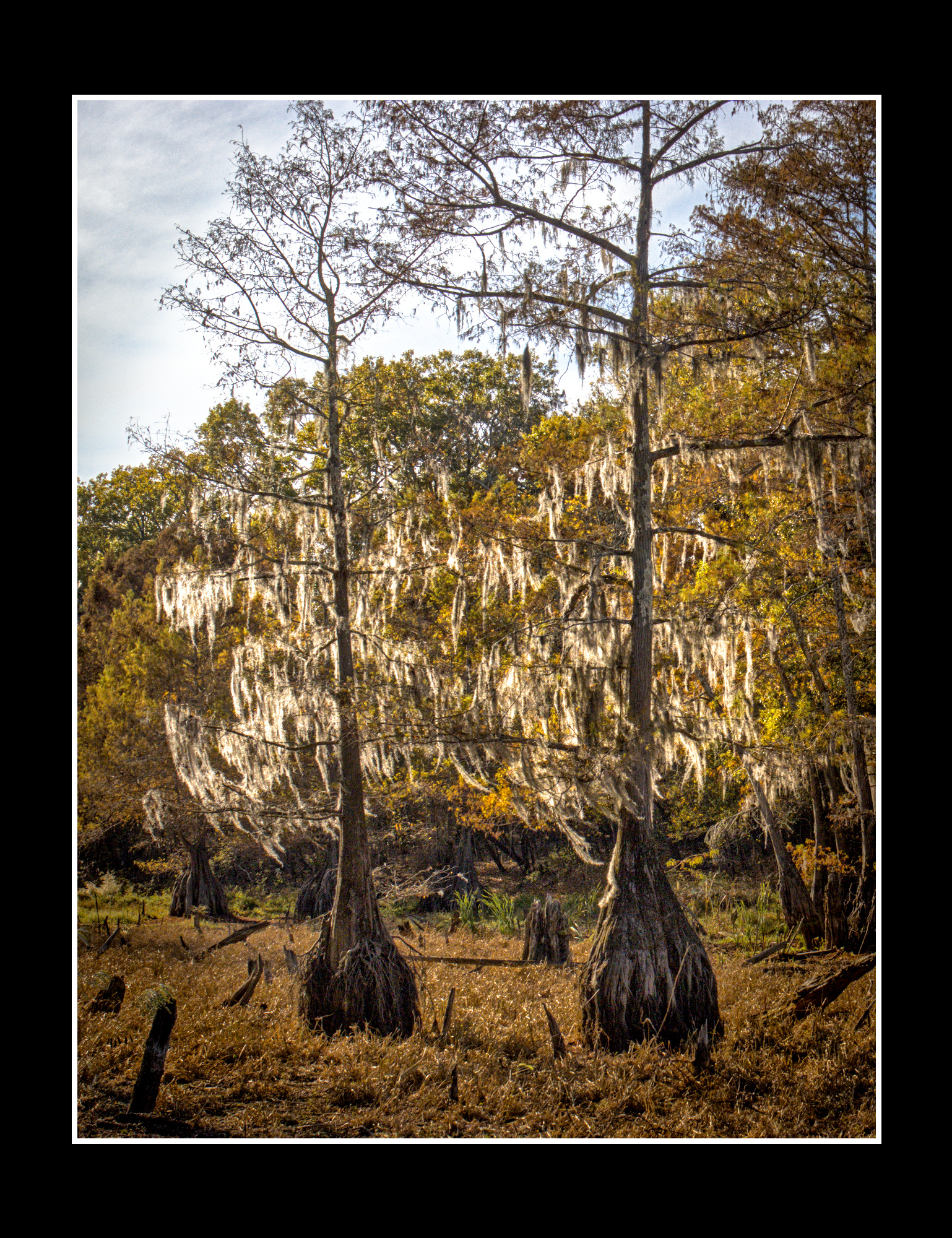
I was at the Catahoula National Wildlife Refuge this afternoon and it’s striking just how low – or non-existant – the water levels are out there. We’re well below our average rain this year and it shows everywhere.
These bald cypress trees reminded me of some kind of Beast from the Black Lagoon or something. The base of the trunks are like a huge many-fingered hand reaching down into the (dry) bayou bed. The wisps of foliage and Spanish moss hanging from them were nicely backlit by the mid afternoon sun and really glowed.
Trouble is, it was an exceedingly difficult image to process. Maybe it could be shot better, technically. But it’s very busy and trying to get some foreground / background separation took a lot of effort. I thought about a little Orton (or similar) effect on the wisps, but I think that would make it worse.
I’m still not too impressed with my results. Maybe that means it wasn’t all that good of a shot to start with? Or maybe I’m just not fluent yet with Greycard (definitely).
Question for @darix (or maybe @patdavid ?) … not sure, but – Can we get *.gcd added to the list of allowed files for uploading / attaching here? They’re the sidecars created by Greycard. Thanks.
Weather-wise – Just for comparison, from Google for my area (edited):
Annual Rainfall Totals (2020–2025)
Year
Total Rainfall (in)
Total Rainfall (mm)
Active Days Recorded
2020
67.04
1,702.89
361
2021
49.83
1,265.70
364
2022
59.70
1,516.44
364
2023
28.95
735.28
362
2024
81.66
2,074.14
366
2025
47.29
1,201.08
339*
*Note: Station logs for 2025 reflect 339 recorded days rather than a full 365-day year.
Key Takeaways & Extremes
25-Year Average (2000–2024): Across complete calendar years, annual rainfall averaged 54.31 inches.
Wettest Years: 2024 was the wettest year on record during this span at 81.66 inches, followed by 2004 (70.96 inches) and 2020 (67.04 inches).
Driest Years: Back-to-back extremes occurred between 2023 and 2024, with 2023 registering severe drought conditions at just 28.95 inches—well below the second-driest year of 2010 (34.93 inches).
Ironically we had the best autumn color I can recall in 2023 following that very hot, dry and long summer. Just a little rain in October fired it off, and the color continued into January in places. This year? Not quite as bad as 2024 / 2025 but still not much. Calendar-wise we should be just at or a little past peak color. But it looks crunchy, dry and past-peak, what little color there is.
IRL the background color was vibrant in small little patches, but there was a lot of dull as well. I found it very difficult (nigh impossible) to reproduce that in processing. The more I worked on it, the more cluttered it got. I guess it’s partially a matter of my brain picking out what to focus on when I was there, but that didn’t work as well on the computer.
Typically Spanish moss hangs from these type trees (and I think that’s what it is, albeit just a remnant). But they also have very small leaves, more like a short needled version of a cedar, maybe. I didn’t walk out and examine them closely.