This is also the point I was making - they all have, to some extent, good features that would be great to include in other projects.
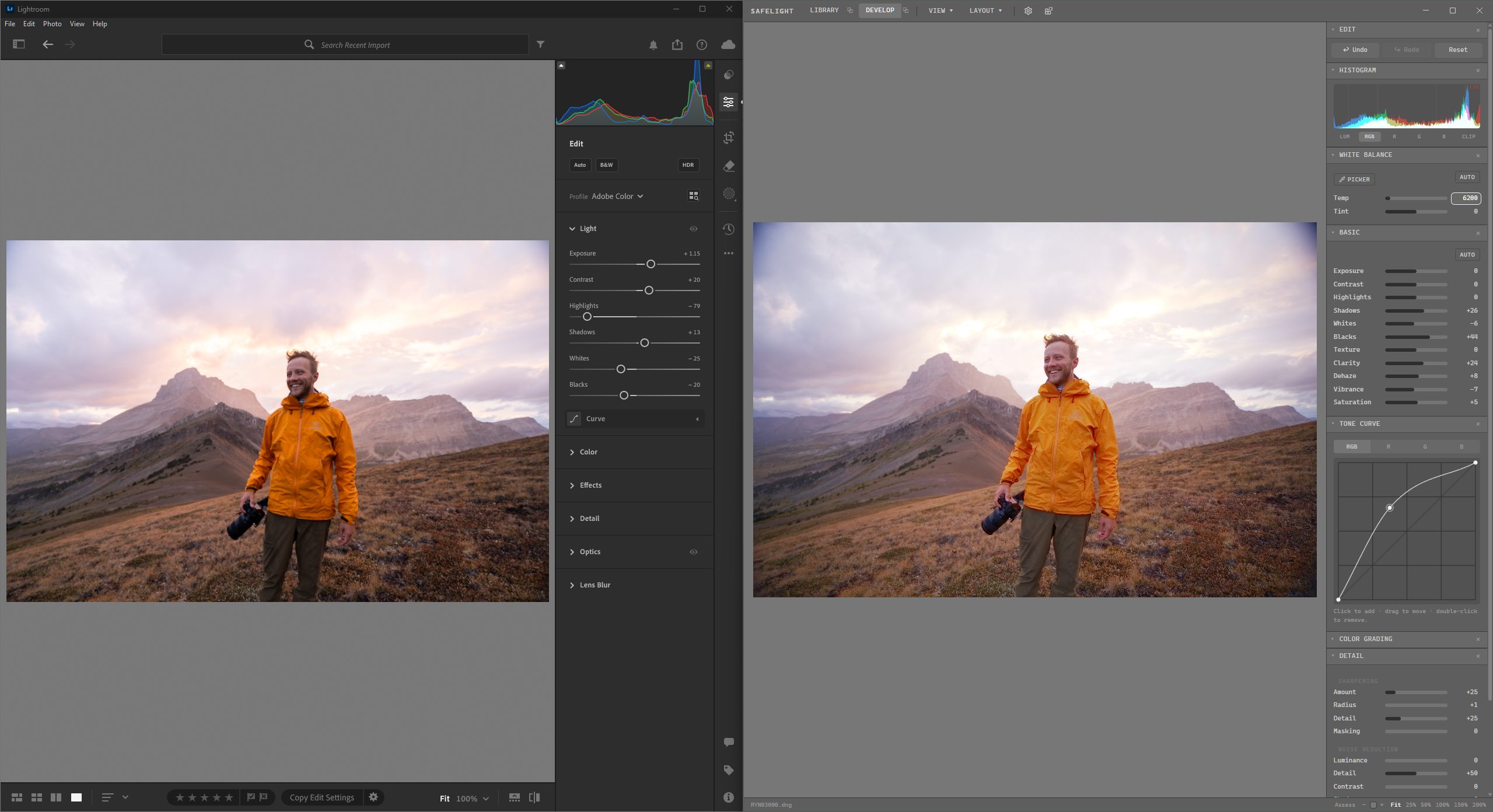
My favourite one in this regard is Safelight, to the point where I’ve been using it more than RT (my editor of choice), because its UI/UX concept is excellent and so usable and logical that it makes the process an absolute joy.
And the shame is that, as @luator pointed out, these projects all have a high chance of living a short life. And in their going, their great ideas that could help shape the future of other projects, would go along.
That is only true if you would 1) assume you need the most powerfull AI to do the job and 2) not pay attention to what happening in open source LLM ai, new models with more power are released their too, and they are not miles behind…
Yes, you “only” need 5k of hardware to run usable models properly, and if you want competitive performance you need to shed out even more, if it is even available at all. Who knows if the plebs will even have hardware available to purchase in a few years, perhaps it’ll be restricted due to “national security” measures. Did you know you can’t take an RTX5090 out of the US or they’ll put you in prison and fine you? Perhaps nothing will happen, but resting on the assurance that we’ll have open models or affordable/available hardware does not feel that great.
It’s not a complaint. It’s an observation. But there definitely is such a thing as too many, I’m just not the person to make that call. This thread is merely posing that question.
At any rate - my point was to debate on the subject of whether it is good or not that all these projects are happening and how they’re happening, not so much about the whole ‘AI bad’ situation. There’s other threads to discuss that subject I think.
Especially since not all of them are vibe coded, and not all of them are AI assisted.
Seeing this thread, and especially @thumper’s side-by-side breakdown, hits a really personal nerve for me.
I’ve never hidden that I use modern tools and AI assistance to help research algorithms or speed up boilerplate. But there is a night-and-day difference between using tooling to build something you genuinely care about and spinning up an autonomous agent farm to flood GitHub with hollow, surface-level clones like the ArtCraft suite.
What makes it so frustrating is watching the internet fall for it hook, line, and sinker. It gets posted all over Reddit with thousands of upvotes, goes viral on X, and even tech blogs and journalists start breathlessly writing headlines like “Someone just rebuilt the entire Adobe Suite in Rust in a week!” Almost nobody sharing or writing about it actually downloads the builds, looks at a RAW file, or checks the output. They just see a slick marketing page, a massive list of repos, and immediately amplify the hype.
It feels almost disrespectful to anyone who actually puts in the grueling, unglamorous work.
A photo editor isn’t just a UI with sliders that hook up to a basic multiplier. It requires actual taste, domain knowledge, and thousands of hours of real photographic testing. You can vibe-code an interface and a viral press release in an afternoon, but you can’t prompt your way into actual image quality without understanding the underlying math.
It’s easy to feel discouraged when pure hype and vaporware dominate the conversation everywhere online. Seeing people in this community actually look past the marketing noise, run tests, and spot the difference in real image output reminds me why building things with care and genuine passion still matters.
Public opinion is a vapor in the wind, especially when it is based on marketing and not the product’s actual result. In my quick test, your product easily won out against LightCraft. In my opinion, neither are anywhere close to darktable, but they have different fundamental purposes/philosophies, and that is fine.
The most interesting thing to see with all of these new softwares, is whether “refined” UIs actually matter much to the FOSS community, or if agentic coding can give rise to additional long-term projects that actually can gain community support.
Yes, I’ve noticed the same thing. A lot of these projects seem to use almost the same technology stack, and many of them are basically trying to recreate one of the big existing applications rather than bringing much of their own personality or ideas to it.
From the screenshots and feature lists they can look surprisingly complete, but once you actually install them and try to do real work, that’s often where the cracks start to show. Things are unfinished, workflows don’t quite connect, and bugs appear pretty quickly.
As someone who has been developing software for a long time, it’s honestly a little unsettling to see how quickly something can now be put together and presented as a finished product, even when the actual quality underneath is still very rough.
Building a convincing UI and a long feature list is the easy part. Making everything work together reliably and making the application actually pleasant to use is where the real work is.
Not even the first time. Remember the kickstarter for Abode? They raised like $300,000 USD to built a few Adobe app clones. The internet was hyped. All that money is gone now. This was pre-AI, so not even close to enough money to pay someone to get close to even one adobe app.
They’re not going to beat millions of dollars in development, and three decades of refinement and development, sorry.
Funny, I have a draft for the OP’s post that’s almost the same sentiment. There’s been a huge slew of new tools lately, and most of them developed by single developers with LLM assistance.
On a surface level, I don’t see anything wrong with that. Heck, I’ve extruded more than a handful such bespoke tools myself. Open sourced a few of them, too.
What irritates me a bit is that some of these tools seem to have a popular intent: they seem to not just be personal projects, but explicitly built for others. Now that they have become so numerous, that way lays burnout. I think the days of “build it and they will come” are over. That’s a bit uncomfortable, since “build it and they will come” has been a core mechanism of FOSS.
But still, I don’t see this as a problem in and of itself. FOSS used to operate as a sort of “proof of work”: the fact that someone invested the required time and energy to build a FOSS tool without a profit motive, gave it an innate value. But no longer. “Work” has been marginalized. I think we will transition to a “proof of care” model. What will count is that an author shows up every day, and keeps on keeping on. If they do that, I see no reason why LLM-assisted software can’t be just as good as organically coded.
And frankly, several of the cited software packages seem to be full of care. Of this, I wholeheartedly approve!
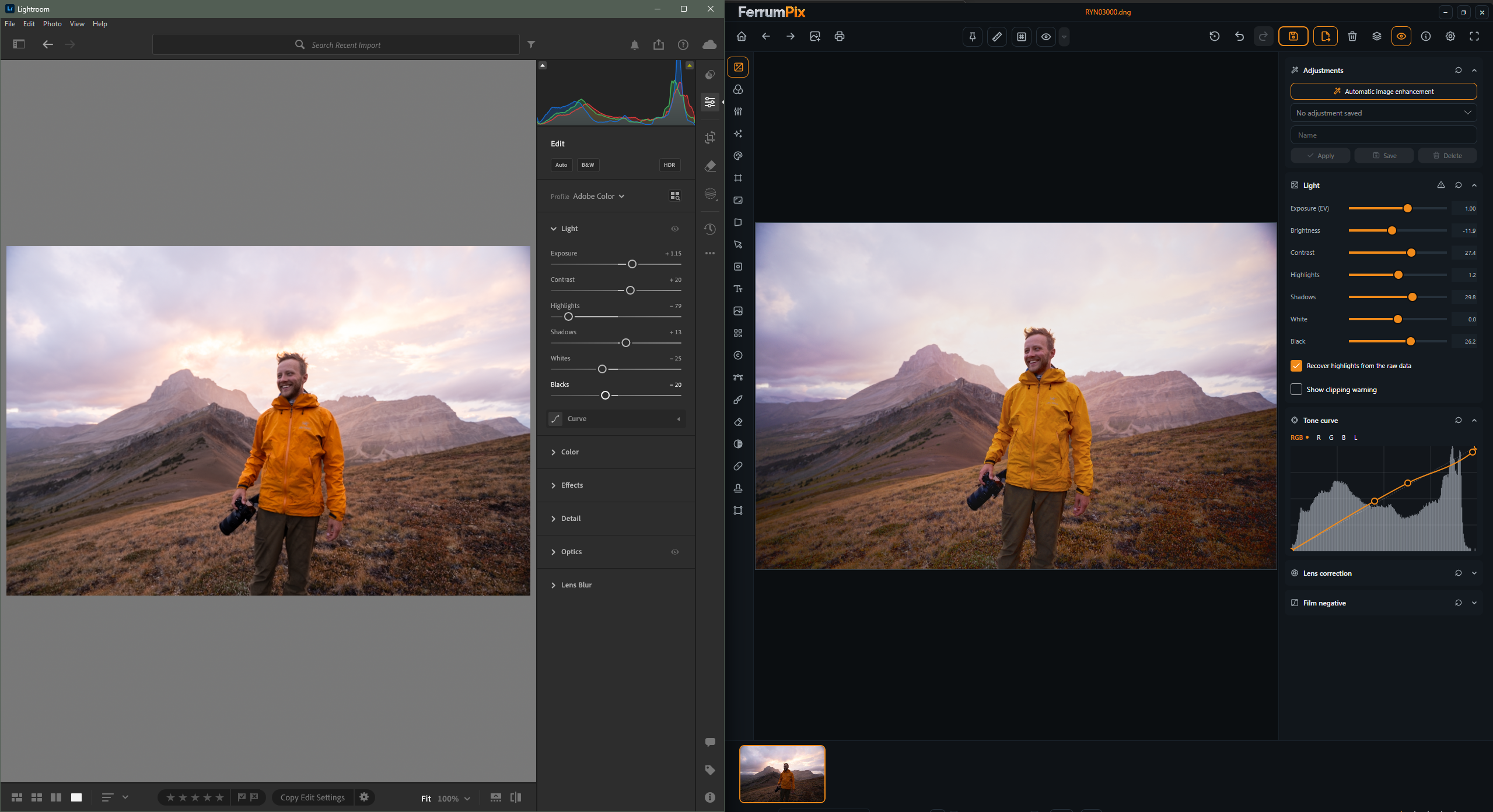
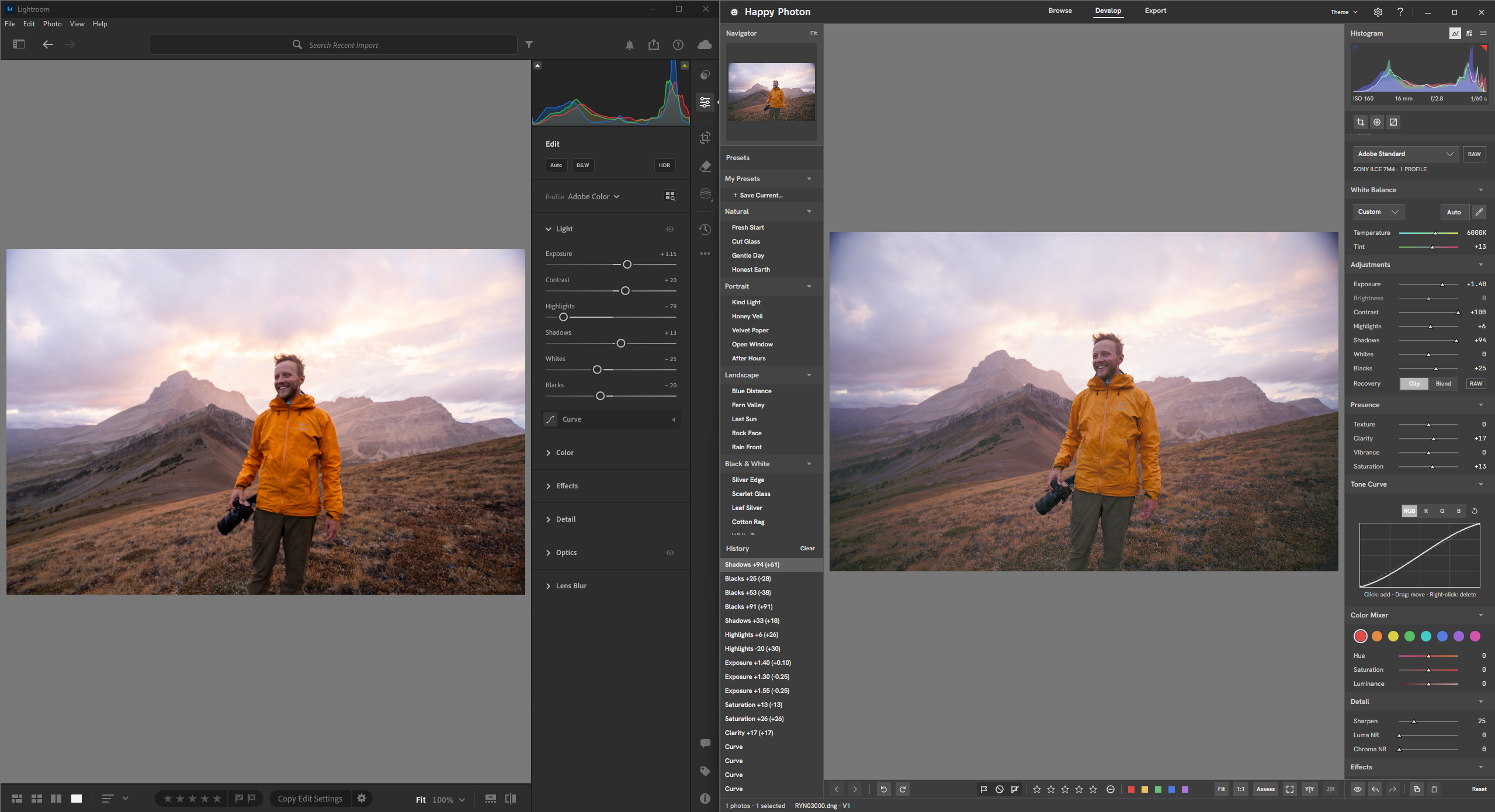
For the sake of “completeness”, for whatever my own feeble attempts are worth: I also downloaded Ferrumpix, Safelight, and Happy Photon and tried out the same test (attempt to roughly get a similar level of contrast, saturation, and tone control as a rushed lightroom edit):
The functionality of Highlights, Shadows, and White/Black felt very strange. they seems to desaturate things very quickly if pushed too much and invert the natural tone gradients.
Similar to RapidRAW, the management of clipped highlights or just the ability to retain highlight details felt difficult, though I think RapidRAW performed better.
Still better than paying adobe, and quite comprehensive at first glance (Lens corrections tools, etc., etc., etc.)
At first I was about to give up, because as soon as I tried to increase exposure, the highlights inverted and became very ugly, but after some playing around a while I finally decided to increase brightness using the tone curve, which worked really well and I was able to increase the overall brightness while not completely destroying the highlight detail.
I really like the direction the UI is trying to go, but there are a few issues I see: sliders are too small, and adding duplicate modules doesn’t seem supported? or at least not in an obvious way.
Again Rapid raw beats it in terms of how similar the controls are to their Lightroom analogs, if that is worth anything.
This feels like the best underlying editing engine. Highlights always felt like they were being handled beautifully, no matter how bright or dark the sky was.
I like the UI generally, but it is not as “polished” as some of the other contenders, which is fine. Like it feels that standard buttons are used for too many interactions.
There is a weird thing where if the window is collapsed to narrowly, the editing panel shifts to the bottom, which I understand, but I want to be able to keep it on the right hand side if I want to.
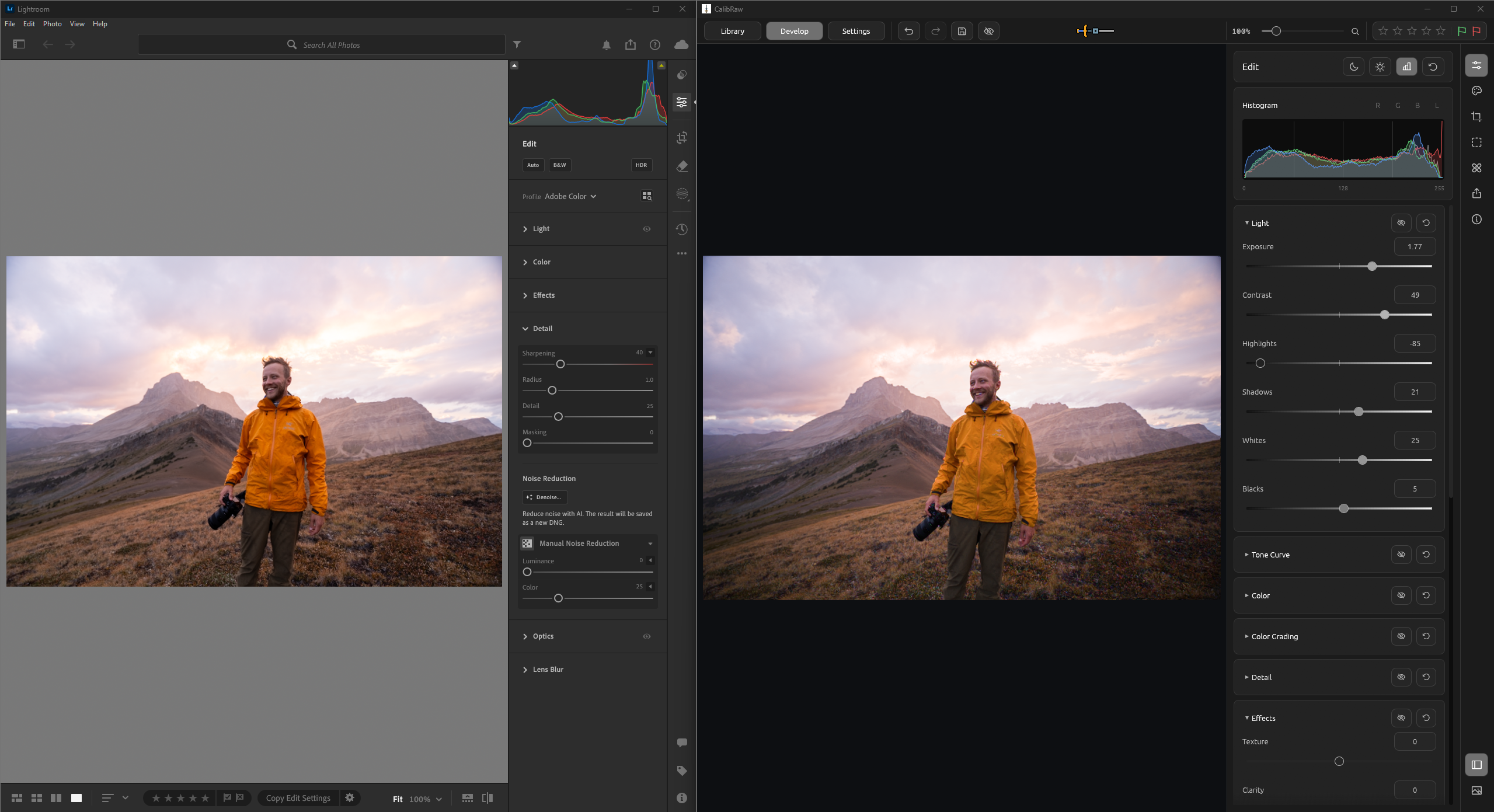
I am shocked at how well this compares in functionality to Lightroom. It feels like someone actually uses it for editing photos, and somehow they know what algorithms adobe uses…
Obviously I have barely tested it, but I hope this project continues for sure.
Overall I think my final rankings of the new contenders after a far-too-brief exposure to them:
CalibRAW
RapidRAW
Happy Photon
Safelight
FerrumPix
Don’t take this to mean anything. It shouldn’t.
EDIT: I also tried Happy Photon and have added my initial thoughts.
EDIT: I also tried CalibRAW and have added my initial thoughts.
Edit: After testing some other images, I have changed my rankings. RapidRAW now clearly beats out Happy Photon, simply based on better UI and better highlight recovery, though both still lag behind CalibRAW in my opinion.
For an application that isn’t really trying to be a dedicated RAW developer in the first place, I’ll happily take third place.
That said, your comments about Highlights/Shadows/Whites/Blacks are useful, especially the desaturation and tonal inversion you noticed when pushing them hard. The same goes for highlight recovery. FerrumPix has improved there quite a bit recently, but it’s still an area I’m actively tuning.
Yeah, I am not well-versed in the technicals of image processing, but maybe the final inversions is because of some kind of guided filter issues or the lack of one… I don’t know. RapidRAW probably has the smoothest looking transition handling I have seen, in case you want to look at that code.
Thanks, your guess actually helped more than you’d think! It gave me the right idea of where to look, and I found what was causing those inversions. It’s fixed now, and pushing Highlights and Shadows hard should look a lot more natural. Colours also hold up better when you push them.
Improved highlight recovery is still on my list, that one needs a bit more time.
Thanks again for trying it out and sharing your impressions!
When I had to decide between FOSS raw editors a few years ago the two main contenders I had to decide between were Rawtherapee and darktable. I found the interface of rawtherapee easier to grasp as a newbie but the masking capabilities of darktable won me over and I have become a darktable devotee and watched that program just develop at an amazing pace.
Now there are new raw editors coming at me every couple of weeks. The truth is that I have little interest in trying every new editor that is offered. They need to offer something that darktable doesn’t have but I want to get me interested. They are generally not doing this. They often come on with the statement I don’t like the current editors so I created my own. Well I do like my current editor so I am not interested in trying a new one for the sake of being new.
However, I appreciate the willingness of people to share their new editor with the spirit of being FOSS. Maybe some outstanding ones will emerge that I will try one day.