The whole host of photo editors that have just landed

I’m confused and shocked at the same time.
This year (or thereabouts) there’s been a massive influx of all-new photo editors.

Not limited to:

  • RapidRAW
  • Safelight
  • ArtCraft suite
  • CalibRaw
  • FerrumPix
  • Happy Photon
  • Photo Rebel
    …to name a few.

I’m fairly confident that there has never been such an amount of RAW editors before, let alone released over the span of just 8-10 months.

Some projects are promising (I won’t go into that, it’s outside the scope), some are dubious, some are clearly outright AI slop.
Some stand out to me, such as the ArtCraft suite, which has amassed a few thousand stars on GitHub over a week of life, with its founder seemingly running an AI agent farm (they’ve pushed over 3500 commits in just over a week and opened over 360 pull requests in the same span of time…). For the sake of argument, here’s a discussion on Bluesky on it:

My observation (question?) is - I understand that not necessarily everyone wants to use (or likes to use) the existing tools. I’m one of these people. But how many is too many?

Are we getting to a point where there’s so much noise that not enough attention is given (or is even available) to any interesting features they might have, hindering the possibility that some serious contenders may emerge?

Please note that in no way I mean to criticise the listed software, I’m just using them as an example to illustrate the situation.

5 Likes

The ArtCraft suite is ridiculous though :smiley:

1 Like

What all of it has in common is that its all coded by AI. I was listening to a podcast, and one of the people said “we are in the age of bespoke software.” What I find worrying is that it seems to imply people not working together anymore.

12 Likes

Even though I’m anti-AI, I would never argue that these new programs are terrible, because some of them are decent.

But I don’t think this surge of tools created by LLM-assisted programming is a good thing. Yes, there are some advantages for mature codebases, especially at the beginning, but I don’t think that’s worth the overall results.

Indeed, for one, a lot of these programs have gotten to the point that they do MOST things decently. But what about the last 5% of a program that really gives it polish? The kind of polish that only results from a huge userbase testing it? How will any of these programs find a huge userbase when one can be developed as a little hobby in a week? And that will only get exacerbated with time.

Secondly, even for existing software, it makes it “too easy” for anyone just to introduce new functionality that sometimes doesn’t really make sense. Yes, again there are exceptional cases, like some of the darktable modules, but already we’re seeing some cases where endless new functionality is just being introduced that may not make much sense photographically (I’d argue that the color harmonizer module is a borderline case here, but that’s a different discussion.)

But even if some developers are careful about their software and their features, the very existence of endless options is just a bad thing. It encourages superficiality almost to the absurdly humorous point where photographers are taking time away from figuring out how to take better photos (which ultimately results in more joy for them) and putting that time into testing Raw editors. Now just testing new tools seems to be the hobby.

No one wants to say it, but while some choice is good, too much choice is a bad thing. It’s like when you go on Amazon, search “frying pan” and get a thousand throaway brand versions that all suck. There are so many options that one can’t even put enough time to understand which ones are good and which reviews are good, etc.

Abundance might be good, but too much abundance is a bad thing. And I think everyone who has put their time into using AI to code a new Raw developer is ultimately doing a disservice to the software world and to photography. Same with any other kind of software.

People only can’t see this downside because one new Raw developer might be interesting and useful, maybe the second one too, but the hundredth over time starts to contribute to this degeneration.

So, I think this proliferation of Raw editors is ultimately a bad thing, even though in isolation one can actually be helpful. It’s our ultimately failing that we just don’t have the instinct to recognize this “ultimately bad, proximately good, net negative” scenario and avoid it. But I think human beings are very foolish for blindly encouraging these things.

4 Likes

I think that’s one of the key downsides here. In the past, a developer of a software program would become known by it and appreciated. That exchange of appreciation in the world is one of the nice and beautiful things about the world.

It’s the same with research. When I was a researcher, people would sometimes email me with questions or ask me questions at a conference and they’d appreciate my answers. I’ve even developed friendships this way.

With AI, that changes. Yes, some of the developers of the above-listed software might still be appreciated by some. But as time goes on and AI coding becomes even more advanced, they will be less-appreciated. And even now, do people have the same appreciation for new features that they would have had if the features had been developed by hand? Nope. Yes, the features are enjoyed but let’s say the developer quits. Who cares? Another one can just go in and prompt the solution away. And that will only get easier.

To be honest, if any developers of the above programs stopped AI-orchestrating their programs, I don’t think it would be a great loss. Another ten photo apps will just appear tomorrow. Who cares?

But if someone sticks to writing code by hand, at least they’re doing something different. At least I can write “hey this program is really useful, thank you for putting in so much time to make it” and have it actually mean something.

Yes, AI-assisted programmers still put in lots of time into their programs, like the developer of RapidRAW. But will anyone really value him or remember him in a year when, if he quits, someone else can point an AI at it and just continue the work? And soon, it’s quite likely that even less time will be required to make this stuff, and no one will care about making the program the best it can be. Just good enough to impress with the first click.

It’s all very disgusting.

6 Likes

It’s all slop and depressing. As a developer, what has been happening is horrible. The breadth of F/OSS software “stolen” to train those models, and then using the people who used those tools (me included at work) who trained the models from average to very good, just so they can sell back all those enhanced capabilities. Plus the social, political and environmental repercussions we are seeing. I will leave the rest of the AI rant for the other dedicated thread.

On those raw developers (and most vibed software), most of them seem full of features but once you dig deep the cracks start to show instantly. You need users and developers over a long period of time to really let software marinate and become good, and most importantly, you need good taste, which most vibed software doesn’t really have.

I personally won’t touch any of those developers or image viewers. For developing I use darktable which is well maintained and for viewing images I just use my own (hand developed) image viewer.

7 Likes

I won’t repeat all the excellent points already made in this thread, but I agree with them.

Every RAW processor has some gaps, deficiencies and workflow quirks, and I think people jump on the the latest hot software that promises to fix these gaps in the hope that it will finally give them everything they need. But of course this new software just comes with its own gaps, deficiencies and workflow quirks, especially as more people adopt it and make requests for it to serve their needs.

What I love about Darktable (one example of many) is its community and that it is the work of contributions from multiple people. I really hope that doesn’t change. I’m immediately doubtful when new software comes out which is developed and maintained by one person because that doesn’t feel sustainable. Even though I do most of my work on my own, I still know that the best work comes from collaboration.

4 Likes

That’s true. Of course, even if you DID code a Raw editor on your own without any AI help, it would likely take a very long time, so you’d really have to be invested into making it. And you probably would only do it if you really had a good idea on how to do something different. And by the time it was released, it would be proof that you would have found a way to make it sustainable, too.

I think darktable was something really special. I know it’s not for everyone but I’ve watched it evolve from the 1.x days and the way people put effort into it…I doubt that could happen today with this AI-assisted workflow.

People will say the same about other stuff that’s been automated. Like clothing, maybe. But then again, we have a huge problem now in the world with waste from clothes, cheap clothes that just rip easily from questionable manufacturers like Shein, strange materials used in them that are putting microplastics into our environment, the wealthy buying way more than they need.

Did it make the world better? I don’t really think so. Isn’t there some line to be drawn? Shouldn’t we save our intellectual work from the same fate?

3 Likes

Funnily enough the other day I was reading the old archived mailing list (dunno why) and found your name there, in some chats a couple of years ago :smiley:

1 Like

One has to ask, whether the purveyors of all these packages have checked the correctness and quality of the code.

The other question, which the above implies, is how much of the code is “write only” and is never checked?

3 Likes

Yep. I didn’t follow all these new tools closely but my impression so far is, that these are (almost?) all hobby projects by some individuals. So I think the risk of them being abandoned is quite high. I wouldn’t depend too much on any of these new processors until they survived at least a year or so and are still actively maintained.

1 Like

We seem to be on anothet AI bad bender. Anything good we can take away from the raft of new editors?

1 Like

I can’t say of the new ones, but some good points about what is happening in darktable in relation to AI:

  • spektrafilm port
  • even veteran developers are benefiting from LLM code review
  • previous developers can iterate on their ideas faster (contrast & texture), as the time doing boiler plate UI code is eliminated
  • gtk4 implementation is accelerated
  • there is now a PR for wayland color management support
  • bug discovery is accelerated, particularly kofa has done a lot of work around this and a ton of pre-llm bugs got discovered and were either fixed or in the process of being fixed

This is just what I can muster at the top of my head as a user and semi-regular github pr/issue reader

5 Likes

Some of these will fall out over time, I’m sure. Vibed or not, that’s a big reason why I’m not getting invested in any of them. I’m not jumping into using a tool for this purpose that I don’t trust has a long term plan in place, or knowing that the dev/maintainer is actually invested in the long-term and won’t bail once the initial dopamine hit subsides. There’s also something about seeing an initial release that looks like a fully fledged product that raises alarms in my head.

I am generally suspicious by default about LLM use for these types of projects, but I can at least acknowledge that the tools are useful. I really just don’t like having development be dependent on paying some American AI company or relying on expensive hardware and running Chinese models locally.

The cool thing about a lot of FOSS is that you can replace money with time, effort, and knowledge. Now we’re regressing back to replacing time, effort, and knowledge with money.

8 Likes

Just quickly, a few precisions: Photo Rebel is 100% AI Free, fully hand coded. And contributions are welcome. Photo Rebel is (so far) the only newcomer that dares to “Play Raw”.

10 Likes

:saluting_face:

2 Likes

I have no desire to join the fishing trip in the South Drama Sea, so I will skip to questions in the original post:

How many paper makers is too many? How many neighborhood book sharing spots is too many? How many hobbyists are too many hobbyists?

To what/whom?

I am unclear about what your complaint is.

1 Like

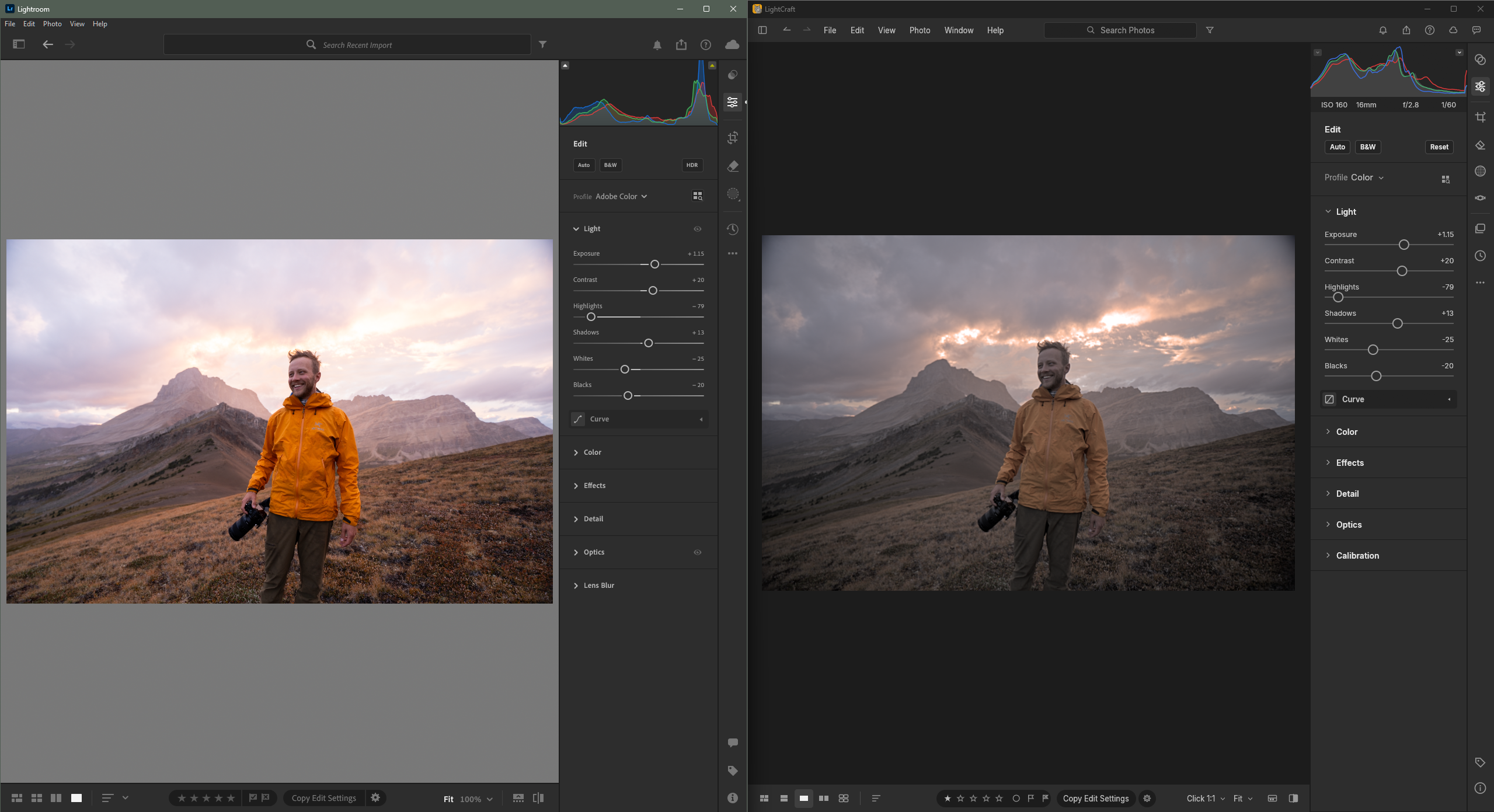
I checked out LightCraft, their Lightroom clone, and I actually think this might just be a money grab, to funnel people into the subscription. While the UI’s are nearly identical, with the controls and their ranges replicated, the actual editing capabilities are really bad IMO. This is either a money-grab to get people pulled into the subscription ArtCraft offers, or just really vibecoded without any care for actual editing quality.

Simple edit using the Light controls, with the “same” image profile, white balance, etc. across both apps.

If you don’t care about ensuring the output, it is very easy to create all sorts of things, very fast and impressive-looking.

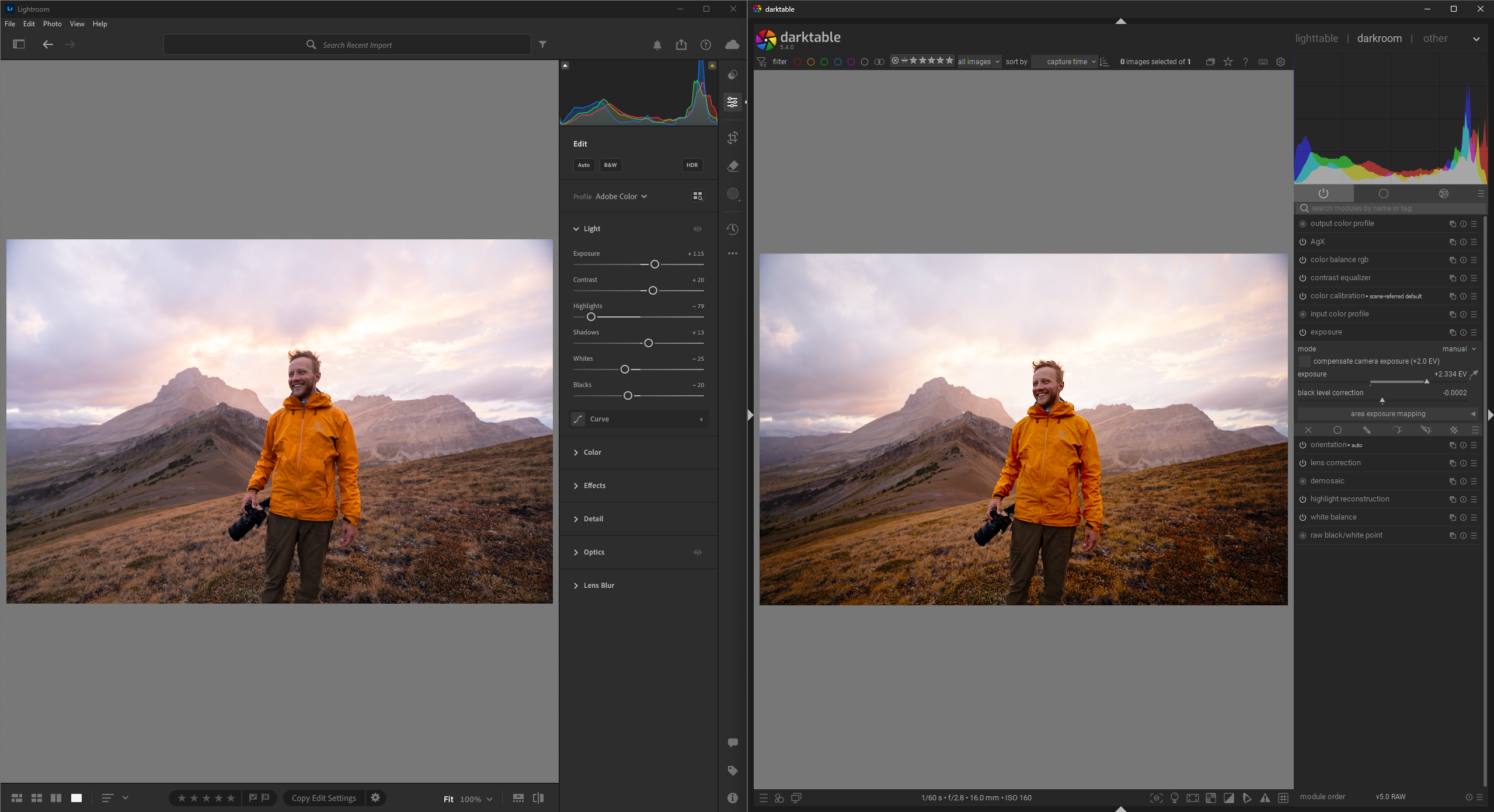
For for testing purposes, I tried getting to a roughly similar starting point with darktable 5.4.0. For this test, I wasn’t worried about which controls I touched. I was just seeing how hard it was to reach a similar balance of saturation, contrast, sharpening:

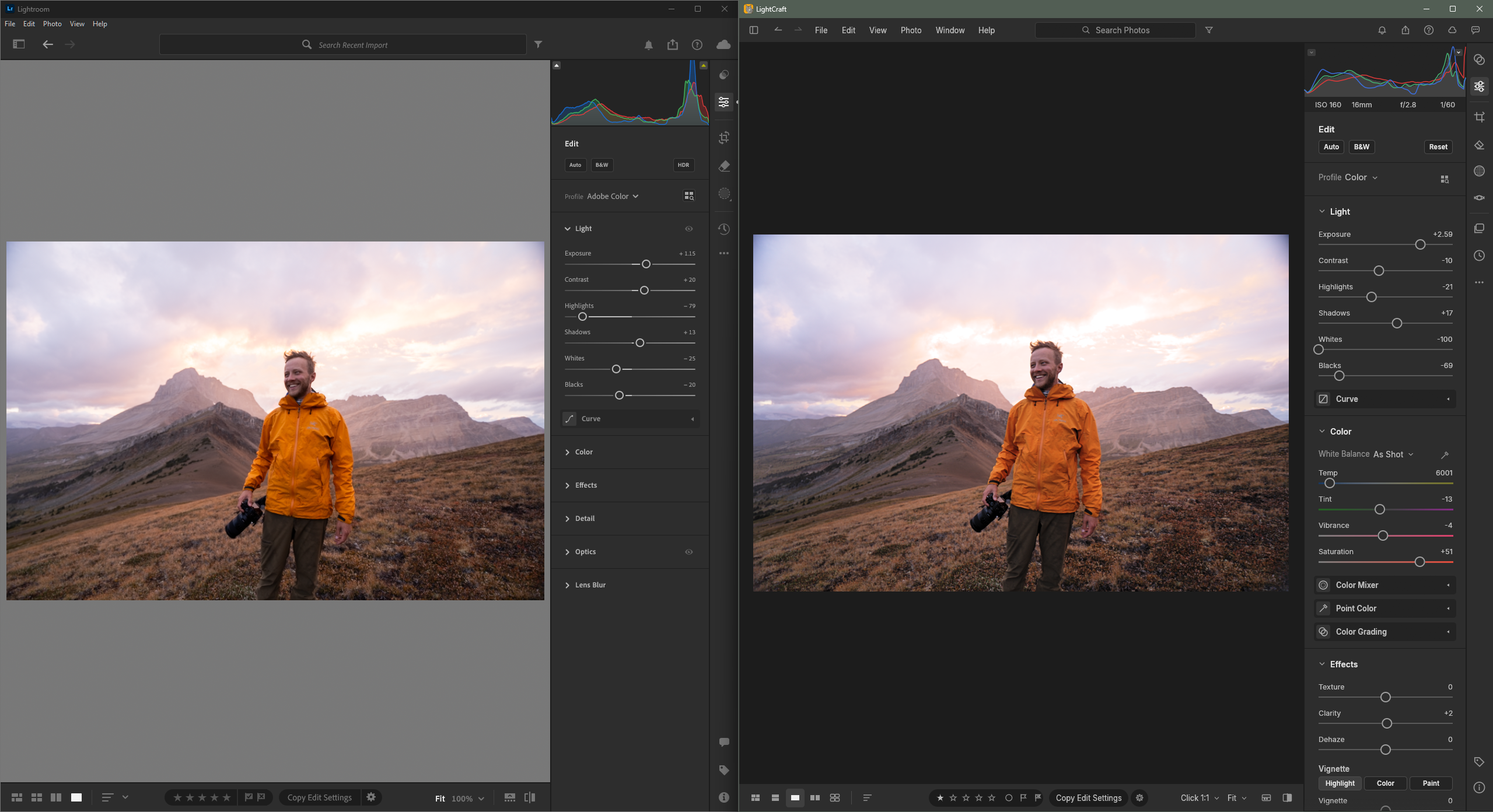
I also attempted the same thing: getting a similar level of saturation, contrast, and sharpening in LightCraft:

Obviously I am very familiar with editing photos in darktable (and previously used Lightroom extensively). In my opinion, Lighcraft is not at all similar to either. Because of this, it was quite challenging to figure out how to get to a similar level of edit with LightCraft. The primary challenge I found was how to get enough contrast in the image while trying to mitigate the clipped highlights.

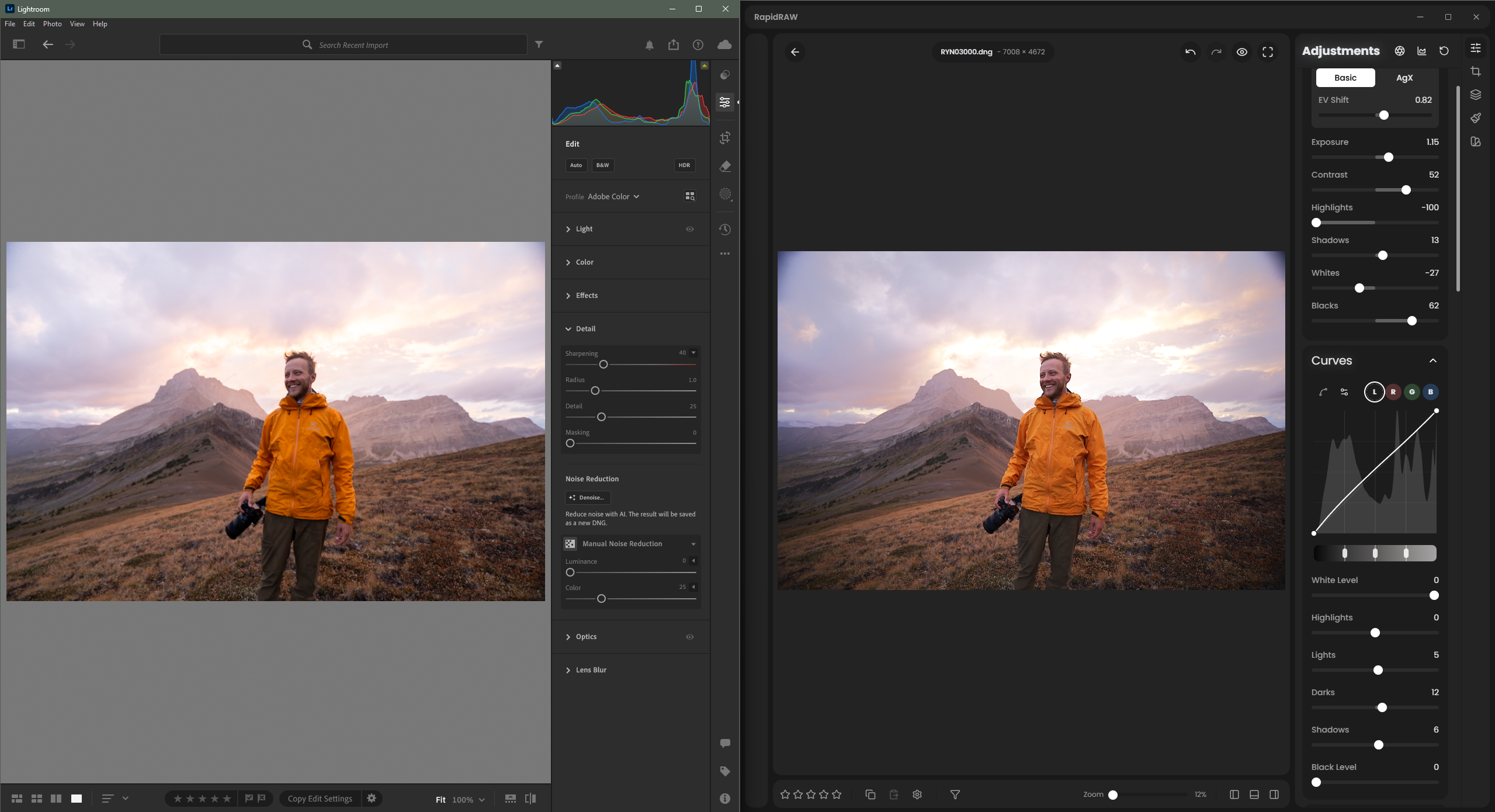
Here is Lightroom beside RapidRAW (a slightly old version):

I’ll say this: RapidRAW is much more similar to Lightroom in how well the various controls work. I was able to start with the same control values as in lightroom and then just adjust from their a little. My attempt in LightCraft took a lot longer and many control changes felt very bad in comparison. It feels like RapidRAW went through a lot more QA than LightCraft.

Summary

LightCraft is definitely not an actual clone of Lightroom. Many of the interface elements are similar, but the controls are actually significantly different in how they work or don’t actually exist as they are presented. For example, the tone curve only allows the movement of preset points in the curve, rather than Lightroom’s/Darktable’s/RapidRAW’s free-form curve.

LightCraft feels very much vibe-coded, and seems to lack QA in my opinion (I could be wrong, and I apologize to the person behind it if I am mischaracterizing them). I think other projects, even if they are “vibe-coded” technically, have a better chance if they are actually true passion-projects.

9 Likes

Just thinking here, the core of FOSS is freedom over the tools you use , and sharing knowledge is the mechanism that makes that freedom real.

With LLMs that freedom over the tools you use, is bigger than ever before. And projects like ArtCraft prove that. Everyone, with a bit of time and money now can build whatever they want.

But all those new Raw Editors don’t add much in the sense of knowledge to the FOSS community as a whole. Hardly any new algorithms, no new real ideas (with a few exceptions). Mostly rehashing in a different GUI.

So in that sense, all those new tools dilute the FOSS community. More code, same knowledge.

But, this means for the existing established tools, that maybe more curation is needed. Not only code, but much more discussion on planning on features. Much FOSS software has grown naturally / organically because before all these LLMs, contributing was costly in time and required software developing knowledge. This acted as a gatekeeper to not have the application explode and become a tool capable of doing anything but being useful in nothing.

But that has now changed. So maybe the gatekeeping function must change as well? So maybe there must be much more discussion as community what we want and only create it, rather then someone thinking he has a good idea and then push it to the maintainer?

2 Likes

I was wondering what impact the new coding tools would have on proprietary software.

For work I use a lot of expensive proprietary tools and have been hoping for open source variants for 25 years. As someone who has also taught at university the situation with licensing etc for students has always been shit. Luckily piracy is a thing. Adobe for instance is expensive but required in my line of business. There are also other proprietary file formats etc that you need to spend enormous amounts of money to use.

These proprietary software have never been particularly good. Often with glaring issues or anti-features left to fester for ages. Also enormous legacy behaviours and workflows that bog everything down.

AI decompiling must make these software giants tremble? Even without decompiling new ai coded open source software has popped up and is already way closer that traditional open source ever was.

So whilst I agree about the problem with hyperproduction I imagine we will eventually develop ways to distill quality. And the only way to distill quality will be lots of human intervention.

I think this is wrong, the most powerfull AI will most certainly not be free. The whole system of power, control and money just got hella more centralised. It’s just that AI might currently be eating big softwares lunch. This was always the case, there was always competing factions with opposite interests in the capitalist class.

Edit: forgot to mention that eventually those investors will come looking for a return… Well see enshittification on a new grand scale.

4 Likes