Progress report #9:
-
To cut a long story short: I’m done, with implementing all the stuffs I had in mind, for the new G’MIC unified viewer. It took me roughly 3 weeks and just under 2000 lines of code. I’m a little tired, but also very proud of the result. I’m sure that this viewer will be a decisive feature that I’ll be able to use to promote G’MIC (in addition to its very practical aspect for scripting of course
 ).
). -
These last days, I’ve focused on 3D mesh visualization and animation (so to replace the “old” command
display3d). The same code allows to visualize regular 3D meshs, as the one below.
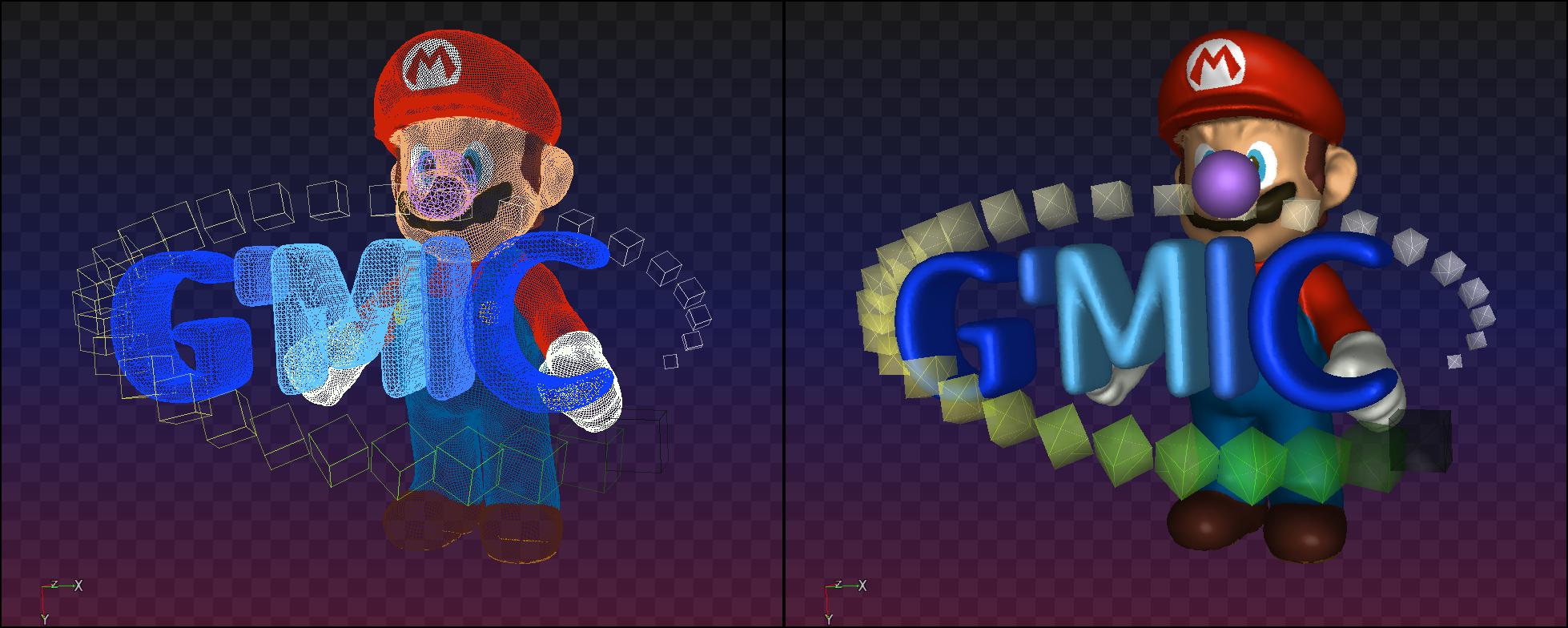
But it is also used to display a 3D representation of volumetric images (you know, those with voxels rather than pixels! ).
-
There is now also a ‘frame recording’ feature that you can use to record
.mp4videos (when G’MIC is compiled withopencvsupport), or.jpgframes (whenopencvhas not been used). That’s what I’ve done for the video above. -
To sum up, G’MIC 3.3 will have an integrated image viewer able to display:
- 2D images, with an arbitrary number of channels, and up to float-valued pixels.
- 3D volumetric images, also with an arbitrary number of channels, and up to float-valued pixels
- 3D meshes.
And all these images can be imported and displayed with a single call to the viewer, thanks to the top navigation bar, like you can see in the example below:

The thumbnail bar makes it indeed easy to switch between the different images.
- I’m pretty sure this new image viewer could attract new users of the command-line tool
gmic, just for the purpose of displaying images (for people who don’t want to start programming in the G’MIC language for doing image processing). Just typing:
$ gmic images*.png mesh3d.obj
- Now it’s time for intense testing, before 3.3 release planed next week. I’ve already found and fixed a lot of issues, but there might be some remaining. Feel free to test (with current pre-release binaries numbered
3.3_pre#something), and tell me if you find something strange. Also I’m now open for feature requests. I won’t promise anything though. Basically, as the viewer has been entirely coded in the G’MIC language, it will be easier to improve it or add new features in the future (it won’t need any recompilation).
That’s it for now. That was hopefully the last progress report I wrote on this
Cheers,
David.