Confidence in aesthetic choices in processing

The other day I watched a video on how to process/edit raw images. While adjusting some sliders, the person made an important point which stuck with me. He said that oftentimes, minor adjustments can make or break a photo.

Besides the technical side of things, which imho is an interested but separate topic e.g. with regard to how much in-depth technical understanding is actually required for purposes of making and judging aesthetic choices, I think I’m still often struggling with finding that ephemeral sweet spot of images. The type of edit for a given photo that would give me either of two moments: either an aha-moment of seeing the edit come together, or of determining that the source capture just isn’t that good and no edit will really save it.

Reaching one of these two moments is imho crucial to processing images. To have the confidence to judge the capture and the edit.

For me, this is currently a purely aesthetic problem. I can’t seem to get to the moment of decision quickly or confidently.

I’m convinced that this is not an issue of which software to use. It would be the same regardless of what I use, DT or RT or ART, or any proprietary software out there. I don’t think I’ve ever truly reached the moment where a software I was using couldn’t do what I wanted.

Rather, the problem is one of undershooting and overshooting the sweet spot in a myriad ways and not (yet?) having any real confidence in either my photography or my editing. This isn’t always the case though. I can confidently aesthetically judge edits (my own and others’) when I see them.

I just have a tendency to quickly lose, or never actually gain perspective on editing. How does one gain the confidence of what actually looks good (or “right”) in an image, and the confidence and clarity to see that a given capture may simply not be good enough to turn it into a truly good picture? Asking for a friend.

Right now I feel that the best criterion might be to just go by editing time, so as to prevent myself from getting lost in the possibilities of editing and putting a self-imposed deadline on the process. But that’s difficult when I keep thinking (or fantasizing) that an edit might just be one or two slider adjustments away from making an image look great and satisfying.

12 Likes

It sounds like to me, at least, that you don’t have a clear idea of what you want out of an image when you start editing it, so you pull sliders until you get there. Pulling sliders until you get there is certainly one way to go about it, but the better way, at least as I see it, is to have an idea of what you want to get out of the image before you start editing. Ansel Adams referred to this in part as “previsualization.”

When I open an image to edit it, I usually have a pretty good idea of where I want to go with it. Then I just pull sliders until I get there. Then I step away for a period of time until I sort of forget what exactly I’ve done (this becomes a short and shorter amount of time the older I get :eyes:), then I come back with fresh eyes and try and connect to the feeling or emotion I want to get out of this photo. I then ask myself, “Is it there?” If no, then what else needs to be done to get to that emotion? I work backward in the editor from there.
That seems like a lot, and it is.

To start, can you look at a raw image and visualize what you want out of it? You should be able to describe what you want in plain language. If you can’t do that, then that is the place to start. You start by looking at photographs that have that wow factor that you want and ask yourself “what do I feel by looking at that image?” Once you can answer that, then ask yourself what editing decisions did the photographer make to reinforce those feelings you feel?

Hopefully that is a good starting place.

PS-- these are the kinds of conversations I like having. Thanks for posting!

19 Likes

Confidence comes with practice…I’m fairly certain almost all of us have posted an edit we knew to be less than our expectations, and from those come discussions that we can learn from if we listen.
If I had a dollar for every bad edit I’d done, I’d be a few hundred dollars richer .

4 Likes

It’s common in photographic fora to separate the aesthetic from the technical. Some folks actively decry technical comment while others just ignore it in favor of “how it looks” to the eye.

I would suggest that, like yin-yang, the one has some of the other in it - how much being dependent on both the image content and it’s creator.

7 Likes

I guess every photographer has to learn what a good picture looks like, by looking at lots of good pictures. It takes time. And if the picture isn’t good, it can’t be made better by editing. I think this is what Henri Cartier-Bresson is remarking on in a video made when he was 90; he’s looking at a photograph he had done a fortnight earlier (a rare event, as he didn’t do much photography after 1974). It’s a photograph of the tracks left by skiers in the snow on a mountain side.

HCB: I don’t like deep blacks and dramatic contrast. The drama should be in the picture if there is any. But not in the printing: printing should just respect values, that’s all.

Interviewer: It’s about not distorting too much?

HCB: Ah, yes. I don’t like distortion.

(The remark is at about 34mins into a 50-minute documentary about HCB, called “Pen, Brush & Camera” (1998)
https://youtu.be/WsNnJLv1pkk )

3 Likes

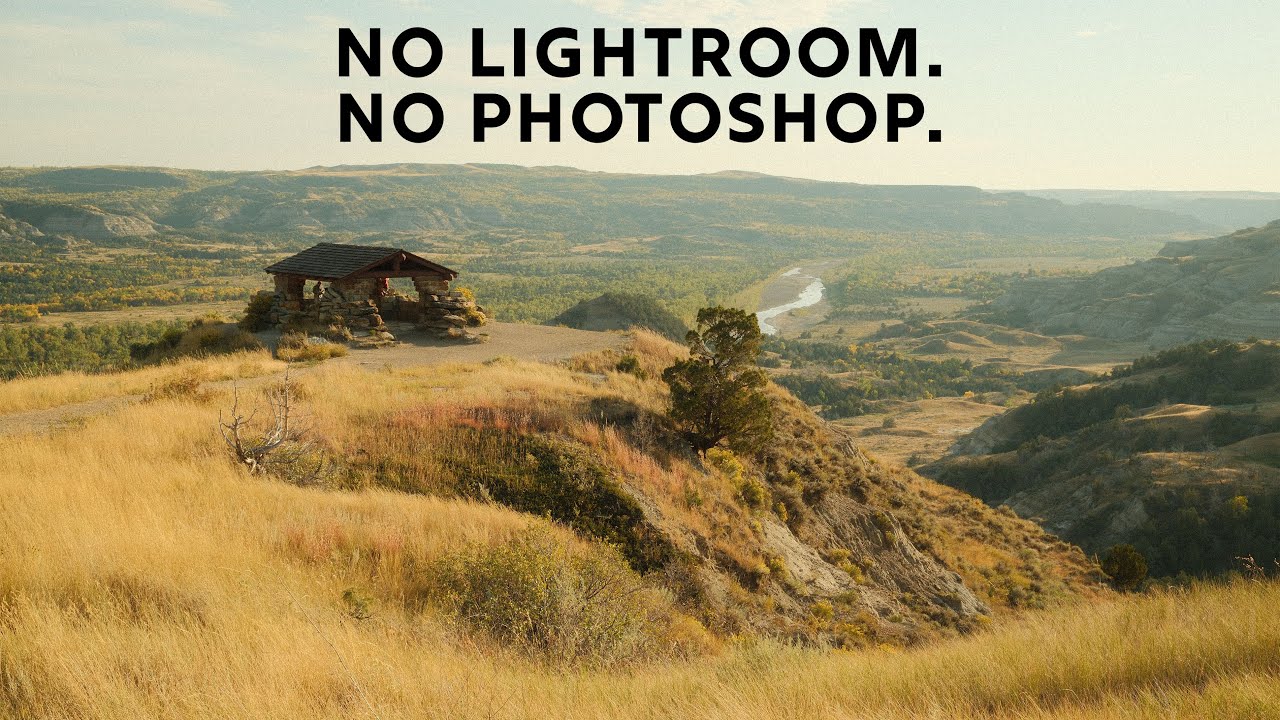
I liked a line in this video about how you can start to use editing as a crutch in your photography…

There is some self promotion in here but beyond that it can make you think about when and how you take pictures even before you edit …or “not edit” :slight_smile:

5 Likes

Fun fact: Some of Ansel Adams’ most iconic photographs went through significant changes between the first print and his later prints.

I cant find it now, but I remember watching a video from Princeton(?) that showed how Monolith, Half Dome is almost unrecognizable between the first print in 1927-ish and 1970-ish.

Here is a link showing (2nd picture) the changes he made to Moonrise

Cartier-Bresson, I guess, would have had disagreed about the quality of those later prints. :no_mouth:. But it does show that even the “greatest” of photographers iterated on photos for years.

7 Likes

For me, the aesthetics start when I view a scene. What interests me? Why would it make a good photo? What do I feel?

If the answer is “that’s a pretty view”, then that’s the wrong answer, it is too shallow, and the photo will be no good. A better answer might be: “the spaces between the objects describe an unexpected relationship between the objects” or “the light is creating shadows that are features in themselves” or “if I move down and left, that splash of colour will beautifully balance the texture over there”.

Mostly I explicitly think about this. Sometimes it works by instinct. Sometimes I don’t explicitly know what interested me in the scene, and I only realise (and can verbalise) when I view it on the computer.

Editing is then simple: ensure the image expresses the intention.

5 Likes

As @archiemac says its important to look at lots of good photos. I think its important to avoid or at least limit exposure to online photographers that don’t have an audience offline. Sometimes/often they aren’t very good and their fame comes from things other than the sophistication of their images. Some will obviously be amazing but it’s helpful to rely on what experts have concluded until you feel confident in judging quality.

I also don’t recommend looking at each image in isolation. Each project or series should have a similar look.

Make sure to let the image “rest” and look at it after a day or two. Your brain recalibrates while editing and you can end up with some pretty bad edits. I’ve done this myself several times, often when trying out new tools.

4 Likes

My way of processing an image is to recreate what I saw at the time of taking the photograph, from all aspects, including the emotion part (as far as possible). Which is why I have difficulty in processing my own images which I took, say, five years back, as memory fades, or process images someone else took, as I find it hard to get the feel of the eye that took it.

For the pictures I have taken, I rather like to process immediately, within a few days of taking the picture.

The keyword for me is to recreate what I saw and not try and make things as an artwork. That happens later when I like to play around with some of the pictures, just for fun

1 Like

Very nicely formulated! :clap:

This had to be highlighted somewhere. :+1:

4 Likes

So many great replies! At least I evidently had the right hunch in writing up this post.

Thank you for your reply! I had heard of previsualization, but it’s not nearly discussed enough online. I’m guessing that many photographers (pros as well as experienced hobbyists) have both talent and practice in previsualization.

I don’t want to veer too far from the topic of photography, but I guess that lack of previsualization is an issue for me personally in more areas than just photography. This is where hobby photography as a meditation-adjacent practice comes into play since it provides an opportunity to practice mindfulness and could hopefully help me get a better handle on how to go from what’s around and in front of me to what I want out of it and where I want to go more generally.

True, but I find that sometimes it’s easy (for myself at least) to fall into certain traps, like training a specific muscle for too long and forgetting about other things, especially the (proverbial and literal) big picture. I guess in a sense my question here was what I should keep in mind, what I could or should focus on while practicing my photography and processing.

Oh for sure but I believe that even with regard to learning more about the technical side, one should know why they’re learning about it, to what end. Purpose comes into play with everything, and I think in a sense I’m looking for purpose.

Very true although I’d say that the ability to connect with a given image has a lot to do with one’s current mental state. Right now, I find the photography of Todd Hido amazing for the mood it evokes, but then I think that has a lot to do with how it reflects my current state of mind.

I had actually watched that video before, and I agree with the core point. This is where a strange limitation of the Sony system comes into play btw, to bring gear into it for a moment. Other systems, like Fujifilm, Leica, Nikon or Canon, have more of a “propietary look” to them, which as far as I can tell is what people appreciate those systems.

Sony on the other hand has a very generic quality to it, which is fantastic if you know where you want to go with an image, but not very good when trying to rely on the manufacturer to deliver a compelling out-of-cam look. As someone who went from Nikon to Sony (mostly for the AF), Sony images demand editing, and thus clear previsualization.

Many YT photographers who are in the Sony system do talk about this difference between Sony and other systems, but mostly not in such clear terms.

Yeah I heard about the history of Ansel Adams’ edits, and it’s good to know that even the greats revisit their edits.

This is a fantastic point which I will keep in mind, thank you! I feel like this kind of approach is also crucially important in most anything in life, not just with regard to photography.

I agree that following online photographers can lead to bad outcomes, not least because it’s a very seductive trap to fall into a habit of vicariously experiencing photography which defeats the entire purpose of owning a camera in the first place.

Yeah that sounds like a good approach. Getting playful later, when there’s a bit of distance between now and then, but first focusing on getting to a goal that is in line with the moment of capture.

1 Like

If you are struggling to find the right aesthetic choices, maybe look at style and intent.

Many artists leave a thumbprint on all of their work, a distinct style that one can pick out. Without referencing any of your images, can you clearly explain what your overall photographic style is? One doesn’t have to have a personal style, but for those who do, that style probably guides most of their photographic choices, from what gear to use, to location, time of shoot, framing the shot, post processing, printing, displaying, etc. Styles don’t have to be rigid, but they can help guide stylistic choices, whether with the camera or post-processing. And for many artists, think Picasso, styles can certainly change over time.

For each image you create and edit there is an intent (reason, message, vision, objective, etc.) whether thought or unthought—something has moved you to lift the camera and take the shot—and that intent, as well as any personal artistic style(s) you may have, most likely drive the choices you make. For any individual shoot, before picking up the camera or walking out the door, can you articulate your intent for the shoot and for each shot?

(The following comes from a similar comment I made on a reddit post a few weeks ago.)

So for each image you are about to capture, you could ask yourself some questions, such as:

  • What is/are my intent/s for creating this image?
  • Does my artistic style come into play
  • Is my intent to recreate the exact scene, to create awe and wonder in the viewer, to remind myself of the event/place, to create a piece of art without the need for an accurate representation of the scene, to impress others, etc.?
  • Will the final image be for myself, others, both?
  • What will be the best way to meet my intent/s? (lighting, position, gear, etc.)
  • Etc.

And for each image you post process, you could ask yourself some questions, such as:

  • Did I actually go on this shoot with intention, or was I just out using my camera? (If I did not go with intent, can this image still encapsulate my overall artistic style?)
  • If I did go with intent, is my intent the same with this image as it was when I captured it, or has it changed?
  • Can what I see in the image fully realize my old (or new) intent/s?
  • Does the image need to be post-processed to fully realize my old (or new) intent/s?
  • What kind of post-processing, and how much of it, do I need to do to fully realize my intent/s?
  • Now that I am finished post-processing, did I succeed in realizing my intent/s?
  • Etc.

The above is a very prescriptive approach, and it certainly doesn’t have to be followed, but hopefully it helps with some additional thinking about aesthetic choices.

I know that when I’m looking at a batch of photos and I can’t articulate my intent, I end up aimlessly fiddling with sliders and knobs, hoping for magic to happen.

5 Likes

To be honest, I can’t say I have ever felt an edit “click” into place. It’s usually a process of continuous improvement that gradually congeals into a pleasant image. But for me, there’s typically no perfect endpoint, but instead just a “good enough” cutoff where I feel I’ve done enough. Perhaps I’m just not much of an artist.

Come to think of it, I don’t see my photos as art, either. I try to document, a place, a scene, a feeling. But photography for me is a spontaneous activity, not a premeditated refinement. As such, I’m typically happy with my renders being “realistic” instead of “artistic”. Perhaps I’m just not much of an artist.

6 Likes

I recently read Steve Simon’s book The Passionate Photographer after seeing one of his B&H lectures on YouTube.

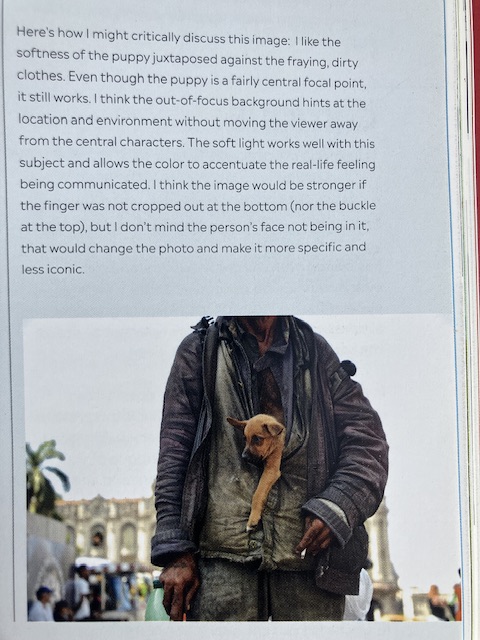
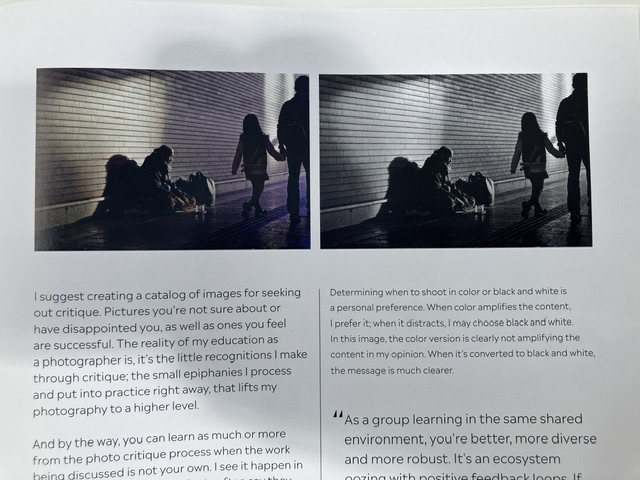
I took snapshots of these small segments at the time as they seemed to illustrate a key point. That the form of an image should serve the meaning and intention. I think there’s only so much processing can do if that’s not there in the picture to start with, though certainly it can emphasise what you wanted to do with the shot or maybe only noticed when you got home.


By chance, I see now he has what was for me the other memorable takeaway from the book linked on his website:

4 Likes

It’s really something that experience will teach you. Remembering what inspired you to take the photograph is the first step, and the editing process should support moving back through the layers of the photographic process towards that impulse. You won’t always get there on the first edit, and it’s a good practice to go back to those images after some time has passed and do another edit.

I had lunch with an old friend last month who is the photography department chair at Chicago’s Colombia College. She told me that she is insisting that her students submit the SOOC jpegs along with their edits for assignments. She said so much of the work submitted has been so heavily color graded that she needed to go back to the jpegs to teach what should have been done while capturing, rather than after. I think she has a valid point for the moment she is in educating her art students. As an old timer, I relish the time I spend editing, and feel it’s a big part of my photography.

3 Likes

Yep, starts with the capture.

Force of habit now, but I can’t help but to think “compositionally” when I stare at any space. The subjects, the lines, the patterns, the textures, and I sometimes find myself walking around, looking for the “good” composition, even if I don’t have a camera with me.

Exposure is an important part of capture, but not one I want to have to think too much about. My camera’s highlight- weighted metering mode pretty much stays on all the time, with the realization I’ll have to mess with tone distribution in post.

Post processing for me is mostly about tone distribution and cropping. A lot of my shooting situations don’t allow choice of where I stand, so I crop a lot and to Hell with what anyone thinks about that. I use ColorChecker-trained matrix and LUT camera profiles, so i don’t spend a lot of time worrying color. Once in a while though, I’ll just start messing with an image, trying various things to make it more interesting. No pre-intended outcome, just idle foolishness…

Anyway, FWIW…

8 Likes

You have many great answers here. My simple but I feel important advice is to consider why you took the picture and what inspired you to take the picture. Then that at least will guide you in what you want to achieve with the editing process.

6 Likes

Lots of posts have touched on the ethos or pathos of different genres, schools, artists, etc. So, instead, maybe a merely pragmatic comment will be helpful as well.

Let the real world constraints of how you are going to display the photo be a guiding hand to your edit. This includes the media type (digital display, paper, glass, etc) and more importantly size of the photo.

As the size decreases, the less you need to worry about a host of elements in the photo. Moreover, the size of the photo can significantly alter the perceived composition (keeping all else constant).

Regarding media: There is no image without a display media, so editing an image already assumes a media type. This is true even at the level of a film negative. As the pool of actual displays your image will live on decreases, the more constraints the real world will impose on your edit-- regardless of stylistic choices.

4 Likes

I once began to notice (at least for me) that when I had a video of the scene and surroundings sprinkled in with my photos say during a vacation that I found myself feeling that I had a more accurate reflection of how I remembered things while watching it that could be applied to my decisions about editing the photos. I felt like I could use that to study the light, the colors, maybe from a perspective of all the other possible cues that trigger our perceptual processing of our surroundings, people trees cars signs etc…

So now if I remember I often shoot a little video. Sometimes it helps…

4 Likes