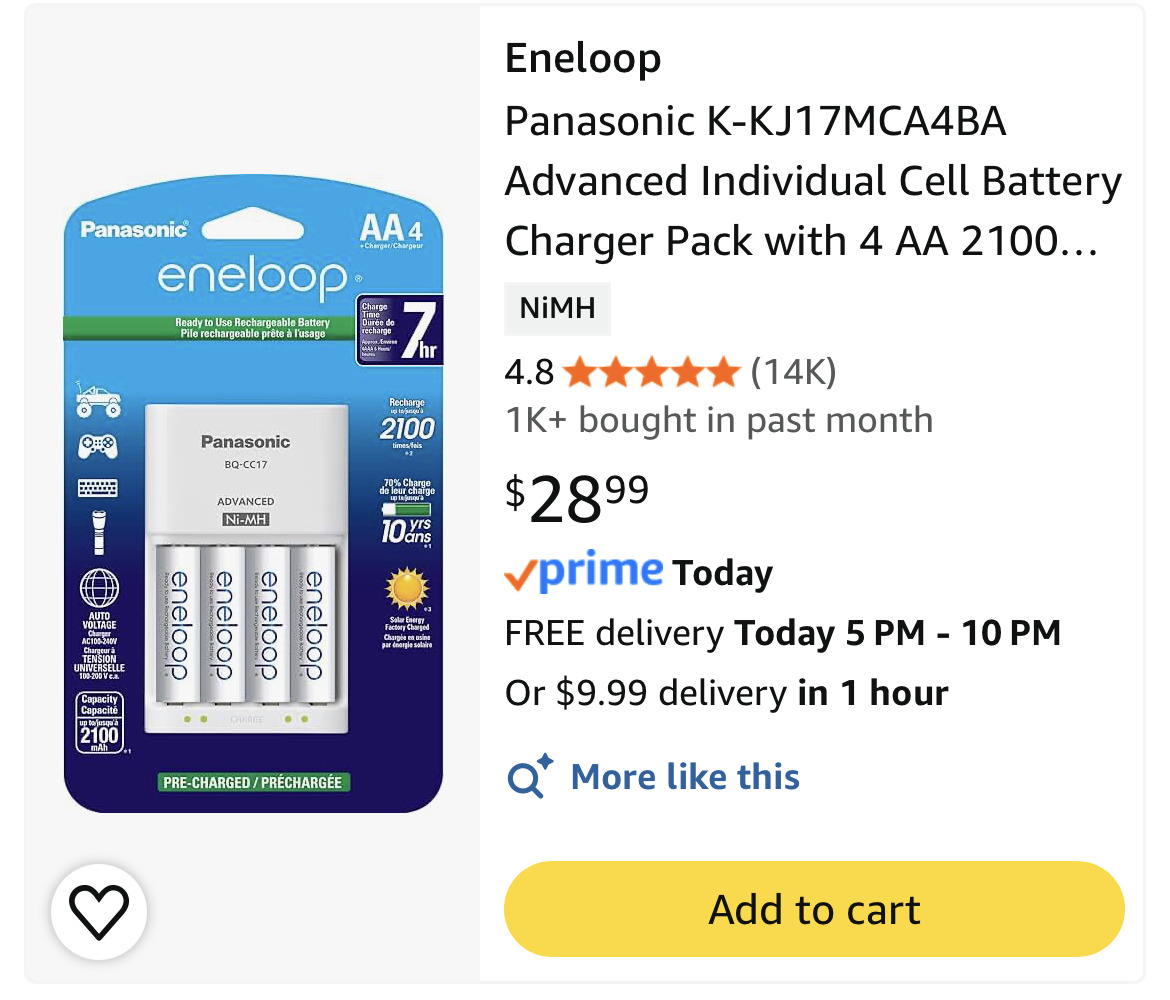
I have a lot ot AA (and some AAA) rechargeable batteries scattered around my household. Maybe 20-ish in total. All of them are in low power devices (think: wireless mice, wall clocks, LED night lights for kids). All of them are Eneloops and last 6m-2y between charges.
My parents asked me for a set of batteries and a charger for their household. I talked to the same store I get all my batteries and now they recommend lithium for AA and AAA, specifically Xtar.
Does that make sense? They way I manage Eneloops is precharge the depleted ones when I insert a new set, so I have a box of them ready to go. I was told that I should just recharge the xtars when I need them, as they don’t hold their charge as well as eneloops, but they charge very quickly so that would be OK, and I would get a constant 1.5V while they last.
Pricewise they are more or less the same, maybe lithium a few euros more.
Probably not useful info as I don’t have a comparison but, like you, I use mostly eneloops in my smart radiator valves throughout the house and when they run low I replace them with ones I’ve precharged, then charge the flat ones immediately to go back in a cardboard box. It’s been a decade and I haven’t had to throw any out yet and I have about 6 spare AAs at any one time.
«Saldo» also tested how much capacity full batteries have left after being stored at room temperature for 60 days. The IKEA batteries lost 12 per cent of their capacity during this time, while the GP batteries lost as much as 15 per cent. The Coast batteries only lost eight per cent, the best value. The advantage for Coast: the models work with lithium technology, while all of the competition tested used nickel-metal hydride.
Depends. Most of my batteries are NiMH, because they’re relatively cheap, and hold their charge fairly long if unused. They are a good default.
However, NiMH is 1.2V, which is not enough for some devices that require closer to 1.5V. In those cases, I use NiZn batteries, which run at 1.6V, but require a different charger. They’re a bit more expensive, and typically hold less charge.
I haven’t used Li-Ion AA batteries yet. On its own, Li-Ion is 3.6V, so each battery must come with additional integrated electronics. The advantage being, that the Li-Ion cells hold their voltage very steadily, and typically include an integrated USB charging circuit. And they seem to hold a lot of charge. That actually sounds intriguing, perhaps I should try them as well.
For speed lights, some old phones the eneloops are okay. Although what they claim on the box that they can last up to 3 years and be at 80% - I have doubts about that - especially if they are in a device - even if the device consumes just a bit.
On the phone specifically - I already discarded about 6 to 10 batteries - they stopped working.
A small device (outdoor thermometer) eats them fast. Every 4-6 months I have to replace them. The odd thing is - when I bought the thing again with same batteries - it used to last 10-12 months. So - either the thermometer started using more power about 1-2 years ago or the batteries lost their strength (less than 10 years old).
Haven’t tried anything else but I think I will continue with what I have until they become unusable.
I bought some lithium rechargeable AA XTAR batteries. I put them in my flash unit and the flash unit got very very hot. I was surprised the flash unit wasn’t damaged. I now use the lithium batteries in a blood pressure monitor where they seem fine. The Eneloop batteries would be the safest idea in my view.
I looked into this a bit, apparently the way it works is that the 3.6V is converted to that steady 1.5V by switching the output on and off really quickly (eg a lot of chips says they do it at 1.5MHz), and then smoothing it out a bit with capacitors etc.
This means that even at very low outputs, this circuitry has to be operated, which eats up battery. So it is explicitly not recommended for low-drain scenarios which would last ages on a NiMH battery.
Yes, I know know that NiMH is 1.2V. But for what I use it, it works fine, well-engineered devices are designed to tolerate it.
Thanks, this is useful information. After reading up on this, my understanding is that all current has to pass through the voltage regulator circuitry, which is not designed for high, sustained drain as it sits in a very small place.
The bottom line is that I am getting Eneloops again, just have to pick a charger (ie resist getting myself a fancy new charger like the ISDT N8 and giving the plain vanilla one to my parents )
Li-ion cells with active buck converters have very limited use cases. The buck converter is always active and tends to have relatively high standby consumption, and it’s only reasonably efficient within a certain power range.
Even then, they can’t provide very high current, often have somewhat odd regulated output, and can introduce noise. You’re also limited in how many you can use in series.
For something like a wall clock, I’d go with alkaline batteries I don’t think Eneloops would be economical there, and Li-ion certainly isn’t.
Wireless mice maybe but I’d still prefer NiMH over Li-ion because of the potentially noisy output and better compatibility with battery level indicators.
I see Li-ion with buck converters being useful in certain devices, like decorative LED lights with low power draw, or maybe wireless game controllers devices that are used regularly and would otherwise drain a battery within about 1–2 days of constant use.
my recommendation uses cheap Ni-Mh and Alkaline for ultra low power devices like Clocks
Do you have a recommendation for a charger for NiMH, specifically Eneloops? All I need is that it charges the batteries with the minimal wear, keeping it slow, the temperature low, and stopping when it needs to. And maybe a “refresh” program. I don’t need capacity analysis etc as that seems to be disproportionally expensive.
A good charger already has everything build in to do the capacity analysis. if it can a a “refresh” program it can messure capacity.
Ni-Mh is way harder to charger properly then Li-ion.
From my experience with a very similar devices i would advice against it.
My devices has miss identified a full ni-mh as empty li-ion and overcharged it…
This mad me paranoid…
But this is just my experience with one device.
For my speedlight I like the Energizer Lithium disposable batteries. Yes they are expensive, but for the amount I use my flash I change them maybe once or twice a year. The weight savings make it worthwhile.
I have not tried the lithium ion AA’s in my flash, but based on the specs, I fear they will struggle with power requirements needed for a fast recycle time.
Regrettably, I own a few devices that don’t. An old godox flash, and an old garmin GPS. But NiZn does work with them. Today I’d probably buy Li-Ion instead.
I used these when I was a wedding photographer in a past life and speed of recharging cycle was critical, but now Eneloops are excellent and using the manufacturers own charger is also sensible.
After looking into this issue again, I decied to go for IKEA’s Stenkol/Ladda NiMH chargers and batteries.
They may or may not be rebranded Eneloops, and if they are, possibly not the latest generation… but for the price, I don’t care.
The chargers have the standard useful features (dV, temperature protection, etc) but nothing fancy (discharge refresh, capacity measurement, etc). Those chargers start at 60 EUR, which would not be prohibitive, but I realized that instead of obsessing over my batteries, I want something plug & play and spend that time & money more productively elsewhere.
 )
)