Channel mixer can work well for darkening the sky because it doesn’t need masking: create a new instance of Colour calibration, apply the basic channel mixer and in the brightness tab pull down the blue channel.
1 Like
I think filmic can be easier to use when you want to preserve the colors in a lower-contrast scene as it gives pretty decent colors out of the box. I often use AgX now but sometimes still resort to filmic. And I think with filmic, it’s also easier to preserve tonal variation in the highlights without manipulating too many sliders. It can be useful for white birds for example when a lot of the important detail is in the highlights.
4 Likes
Tangential but (IMO) relevant suggestion: if you haven’t already, learn to use tabs 2–6 of color calibration, as described in these excellent tutorials (follow the link to the channel and you will find them in the contents):
It is an extremely powerful module and is often the answer to a color manipulation question, and complements filmic rgb very nicely.
Regarding filmic rgb: it really improved with color science v7. If you like how it looks, why not use it?
(Personally, I hate filmic, but that’s just memories from the various “color science” iterations before, say, v6, not anything objective.)
1 Like
Agreed!
Filmic v7 did not introduce new colour science. It uses the same as v6. You get a slider to mix two versions of processing: the ‘no preservation’ and the ‘max’ norm.
I linked some comments from Aurélien here: Filmic and brightness of reconstructed highlights - #6 by kofa
3 Likes
Thanks, I misremembered which iteration fixed issues.
I always seemed to be fighting saturation roll off at the highlights and sunset color issues with Filmic, so I moved on to Sigmoid and now AgX. But I might revisit Filmic now that I know a bit more about these tone mappers
3 Likes
Also, one thing always annoyed me beyond belief – why is “soft” and “hard” (often) reversed in meaning for highlight/shadow contrast? Like… “soft” is clearly the more intense setting based on the graph. Has actually no one noticed it’s wrong?
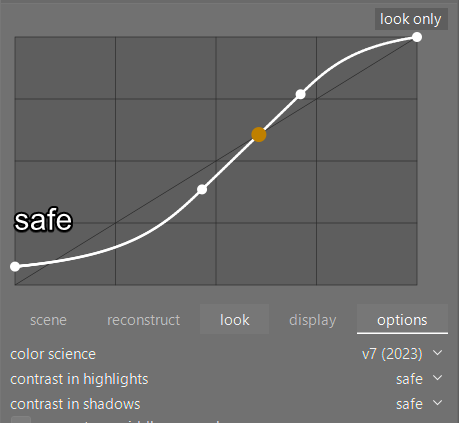
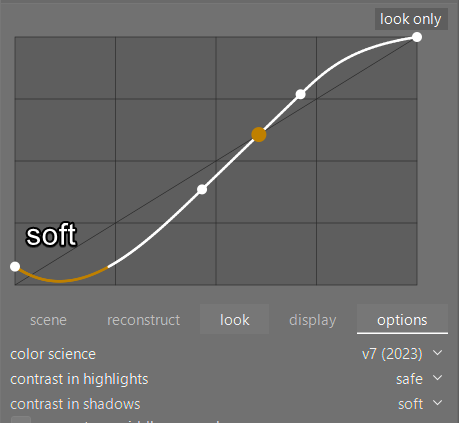
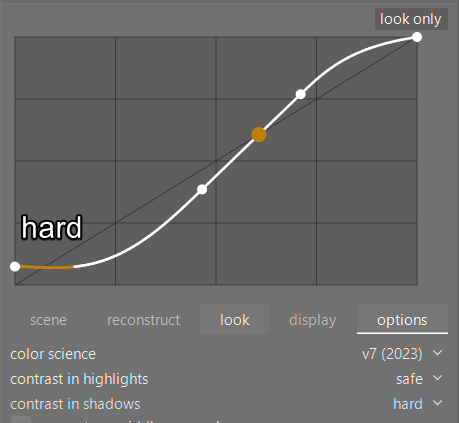
… or am I misunderstanding something? It doesn’t always happen and I don’t know why. It seems to flip at some point, likely related to curve slope
1 Like
If you pull back the dynamic range so that you don’t have the spline error, ie the orange area then I think it works as expected…visually not so when the spline is messed up…
2 Likes
As I recall, Aurélien gave an explanation for why hard seemed to be soft and vice versa, but I am not able to point out where that is.
1 Like
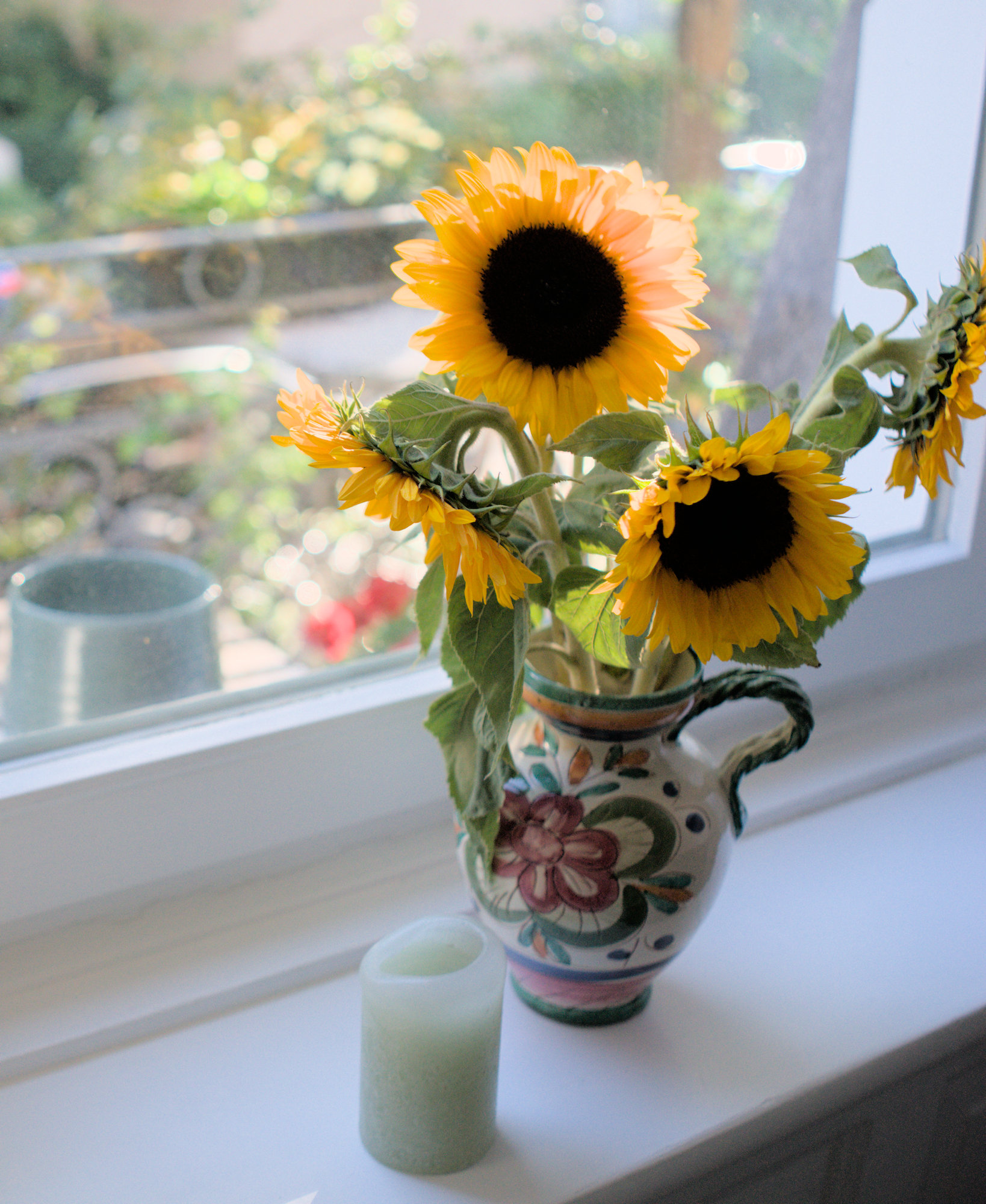
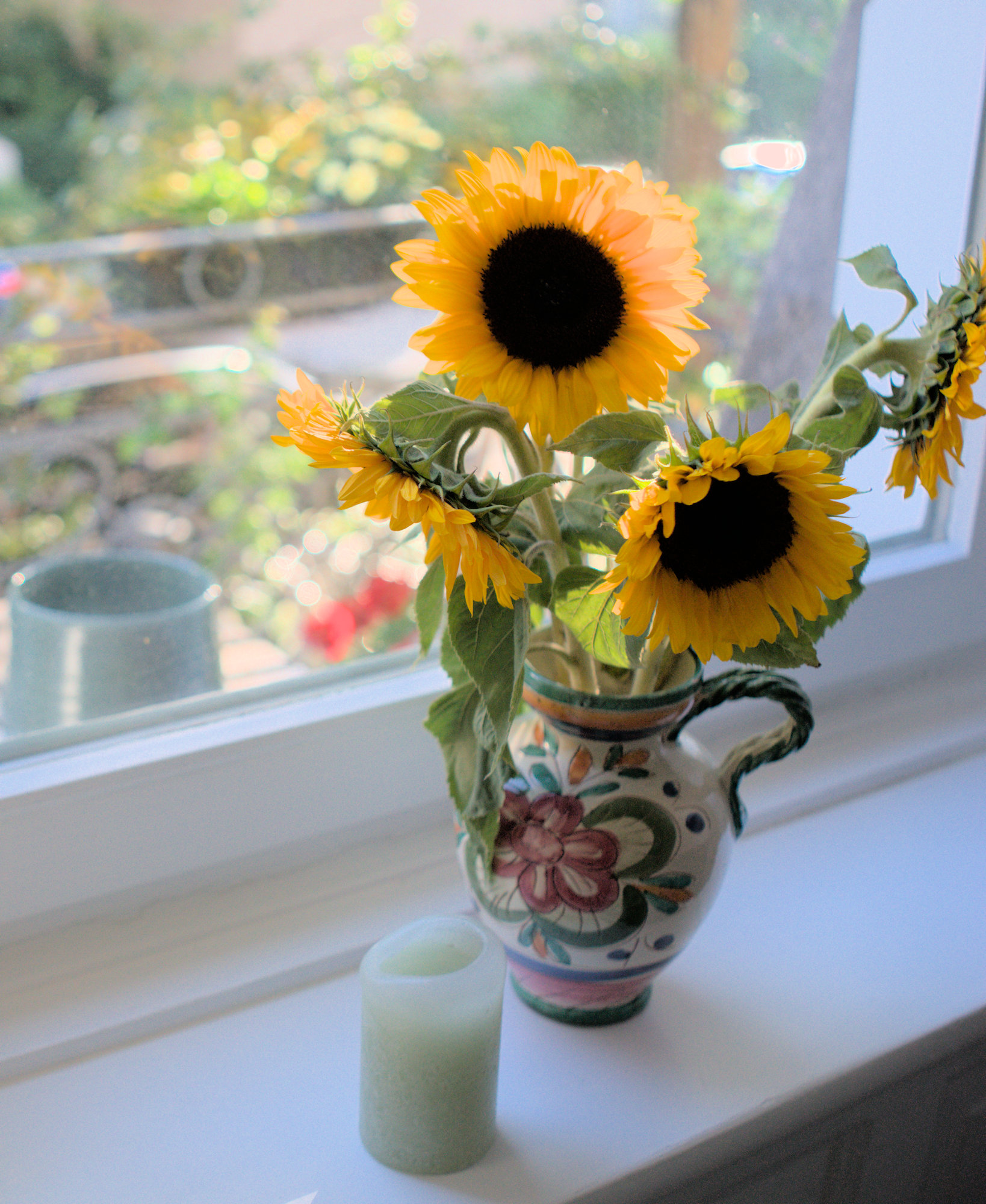
In this context I often recall the popular “sunflowers in jug” picture. Try to compare Filmic, Sigmoid, and AgX for yourself.
Actually, that only happens with certain filmic settings. If the filmic contrast slider is set to a low value (around the default), then the soft and hard settings do indeed make the contrast softer or harder respectively. Only when the filmic contrast is boosted do these toggles “reverse polarity”.
But I think that only happens when you get the crushed shadows or highlights or maybe the orange line in filmic, which still seems to have the same effect because then (at least for highlights) the “soft” actually keeps the highlights blown out whereas the “hard” setting does not (so still, more contrast). So in that case it’s just the curve that’s a bit misleading.
1 Like
3.0 ev added to all…
autopickers only for default images
v7 Filmic default (50%), no color preservation, and maxRGB preservation
v5 No color preservation
Sigmoid default with hue preservation at 0 and at 100%
Agx…only the pickers adjusted from defaults…
So basic starting position for these TM for the most part using 3.0 ev… exposure could be more or less I suppose…





1 Like
Picture 2 (filmicv5nocp) and 4 (signoheupres) seems to have natural colors, at least for my brain.
Picture 1 (agx_01) has slight red cast int the flower, was it like that in real life?
One can either reduce hue preservation or increase red rotation towards green (yellow).
2 Likes
It wasn’t my photo…so nuance on the perceived color at the time I can’t comment on… in each case there are ways to approach what you get with each TM but this was just a quick visual based on @Y69 's comment above… and for a different photo with different hues and gamut maybe it would be different conclusion…
Personally, I will use agx and tweak it, filmic v5 because I like the latitude and midtone saturation controls for some photos and I don’t like the gamut control math in the newer versions, and sometimes sigmoid is just easy if I was in a hurry…but to be honest I also try to edit without them unless the DNR requires the compression…using instances of local contrast, DorS, tone eq, color calibration, color balance, and exposure I can get nice lively versions with natural colors and tone…I have also been experimenting with @Christian-B combination of basecurve and contrast and texture modules with some nice results… as I am just a hobbyist I am constantly just experimenting to see what I can come up with, others might need a more serious, structured approach using a standard workflow to get some “real” work done so in that case its good to define what you like and what tool gives you the look and results that you prefer…
EDIT:
As @kofa mentioned for agx you can tweak the preservation or play with the primaries …
For example I think 60% is the settled upon default that works nicely as a default…but there is a significant visual impact of that slider…
Here instead of default is agx at 0 and 100


That’s why I often caution when people make absolute statements about the result of one tonemapper or another…there are often nuances within each that dramatically will change the result…if the user is unaware or doesnt use them then an impression of the results and limits of one module vs another can be skewed or misleading especially for new users that don’t have context from the historical development and discussions and/or experience with the different modules…
In any case as it is often stated it is nice to have so many options and there really is I think something there for everyone…
I am grateful for all the hours of development and continued discussions and support from all of those that have made such impactful contributions to the software, adding and enhancing the tonemapping and so many other aspects of darktable…both forward facing ones and also the background work to clean-up and optimize the code… Your effort, skill and dedication contantly impresses me…
8 Likes
I have been guilty of this myself in the past. Maybe when comparing tone mappers we can really only compare the starting look that each gives us. Here is an edit by me using AgX. The colors may be too bold but I am just demonstrating that these tone mappers are creative tools and not handcuffs. Which ever tone mapper a person is happiest to use seems fine by me.
DSC09445.ARW.xmp (15.7 KB)

That’s how I’ve always felt about the tonemappers, where I’m looking for controls to roughly “shape” the image at the beginning. I usually shoot for lower contrast and saturation because it’s easier for me to add those qualities rather than back off later.
I also frequently begin with a brighter exposure because I have a habit of darkening my photos as I edit, but that’s a different topic.
What I want to avoid are situations where the tonemapper introduces anomalies that I have to correct elsewhere. That’s been my only hesitation with Filmic. Otherwise it’s a brilliant module
Same here – except editing the documentation. Occasions, on which I want to adjust contrast in conjunction with chroma are very rare. And to me, AgX feels like an attempt to (re-)introduce more detailed controls to Sigmoid’s simplicity-by-design, but actually exceeded the complexity of Filmic’s controls.
I recently started using Filmic again for some pictures. Admittedly, I don’t really have an understanding of which kinds of pictures I prefer one or the other for yet, which feels slightly frustrating.
I’d love to play around with OpenDRT in Darktable one day, just to see how its approach of both using a norm and deliberately introducing cross-talk compares to both AgX and Filmic.