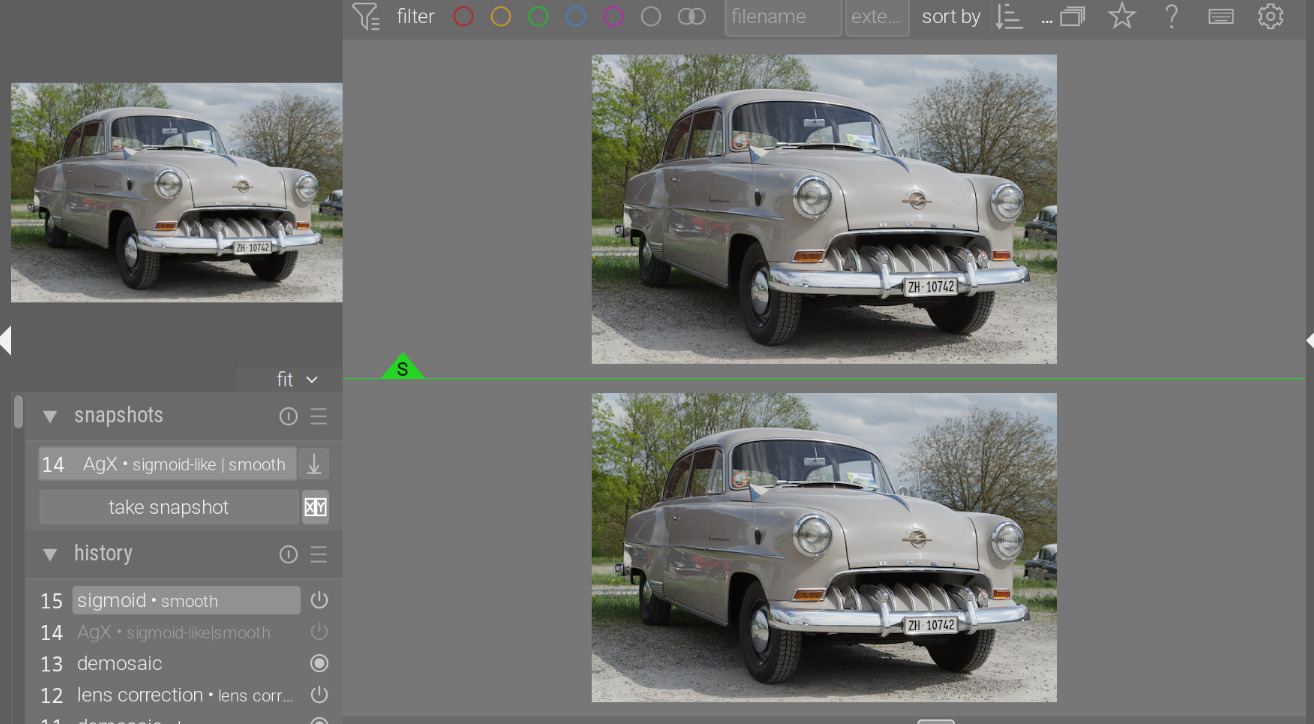
I have had Sigmoid as my default tone mapper for a very long time and the fact that I switched to AgX speaks for itself how much I like it Thanks @kofa and contributors! It is a game changer especially for night time photos.
So I was thinking, what do y’all use by default? I’m not exactly asking what you end up using the most, just what are your settings.
What’s your preferred auto-applied pixel workflow? (The one that you have enabled now)
At the moment I mainly use AgX. But never auto-applied. I always start with looking at the raw with a minimum of modules activated. Then I might apply a style that includes AgX.
A while ago, I read the manual page for Filmic RGB and it said something along the lines of “make your picture look as good as possible before using Filmic,” and I decided that meant I’d start with ‘none’ and work upwards through the pixelpipe…
It took me until after AgX came out to figure out why Sigmoid would flatten my highlights into grey…
That would explain why starting editing with Filmic enabled is so hard. I’d compare the look and feel of such photo to a burnt toast that I try to recover afterwards Like really, the shadows are often really dark and dull.
I have a preset that very slightly increases contrast from default.
A tweak to skew can make a small but important difference.
Sometimes I tweak black to bring a little detail back into black hair.
But often don’t even open it.
AgX… when I have time to put into getting used to it, will probably become my favourite. I’ll use it for my next batch…
They are coming in 5.6, BTW (there are 2: basic and smooth). And the default is now also a lot closer to sigmoid’s tone curve. Blender-like remains as an option.
In the last couple of days I discovered the fujifilm provia AgX preset from @jssfr and it has been a game changer for me. Strangely enough this fujifilm preset actually does a good job replicating my Canon’s R7 JPG. Gives me a great starting point.
I was using Sigmoid as my default for quite a while, and it is pretty straightforward to use. But I often take photos that don’t have such a huge dynamic range that they need squeezing. A little while back, I was editing one such image, and decided to turn Sigmoid off, and BAM! the image came to life. I tried the same thing on some other images, with similar positive results. So now I start without a tone mapper, and deploy one when needed. My first impressions of AgX were quite positive, but I haven’t had much time to edit lately and I am going to have to learn it from the beginning again.
I have done exactly this for sometime and I found the same thing…compressing things with a curve on images that don’t really need it often resulted in a significant loss of detail and even as you say it “life”…
For a while I had sigmoid and filmic with my favourite preset applied by default in the inactive state and then I would just toggle and compare as needed…
Somewhere along the line I reset that and dont have that setup right now but I try to work on tone without tonemapping first and then if its necessary I will now go to AGX as it has pretty much all the control you could ask for… I have also been playing a little bit with @Christian-B 's basecurve module with it now added ODT and gamut compression. He has a couple of other color contrast controls as well that can really produce some nice looking results…I haven’t really looked at the detail issue and usually since I am in his fork I am adding his Contrast and texture module so I haven’t been concerned with that aspect …but it might also be an issue there…
@JasonTheBirder’s Udemy darktable course advocates for None in the configuration, and then evaluating, based on the image, whether to use Filmic (taught first) or Sigmoid (taught second as an advanced topic, with a separate video on the choice between them). The course does not include AgX (yet?).
In my photography with a real camera (not a smartphone), I found no use case for Sigmoid that is not also covered well by Filmic. The course mentions “strong, nearly blown-out highlights”, but I don’t use them.
So, I changed the default to Filmic, but I do try AgX from time to time, only to return to Filmic. Or even more often, just out of pure laziness, especially when on a laptop, I use ART.
I am using AgX, because it’s just so dang flexible. But there is a particular look to Sigmoid that I enjoy a whole lot; that I still miss.
Whenever I compare them directly, they seem very equivalent. But when I look back at rendered photos from the Sigmoid era vs the AgX era, it seems to me that there’s something I’m still missing.
To be clear though, I’m talking very small nuances here. This is not like the big differences between the tone mappers of Lightroom, Capture One, and DxO. Overall, I am very happy with AgX/Sigmoid! I just haven’t dialed in the perfect settings yet.
As a new learner who has started using darktable merely 2 months ago, I diligently follow the most recent manual and suggested best practices. So it’s AgX for me.
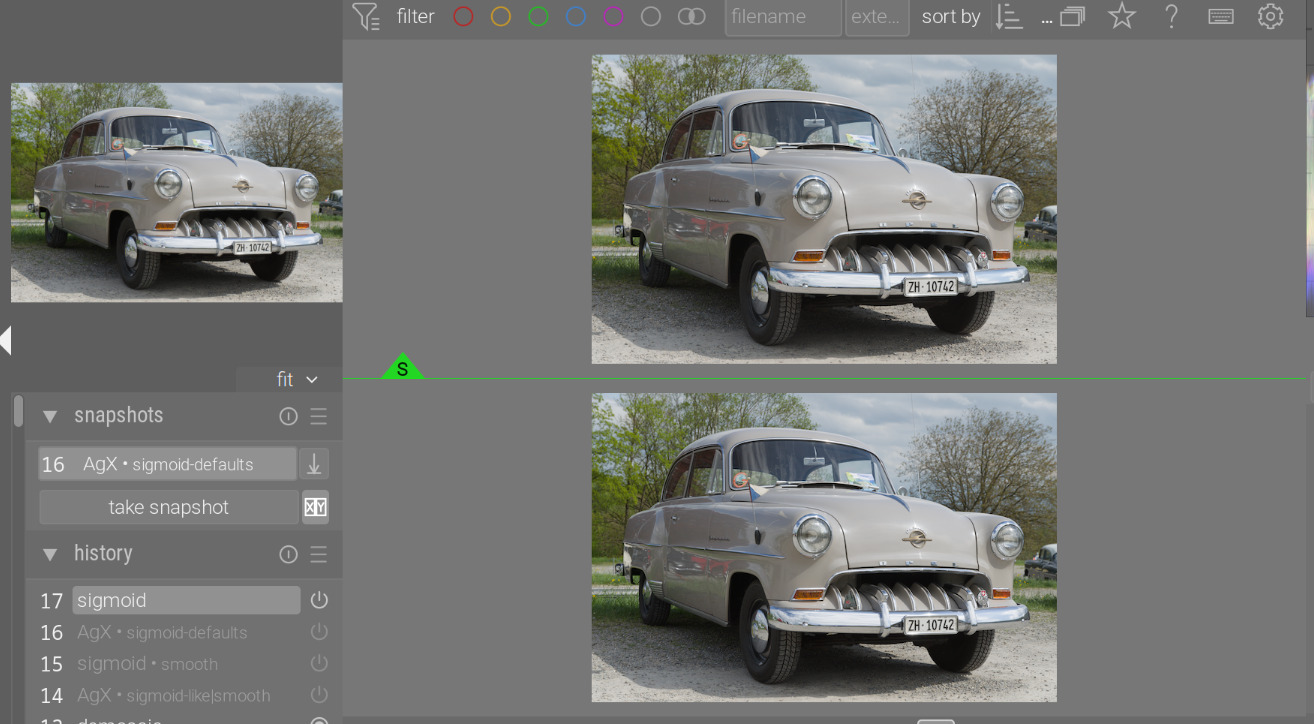
sigmoid-like|default also matches the curve 100%, the difference comes from hue preservation, the algorithms are not the same. If you set hue preservation to 0%, the match is perfect; otherwise, it’s close. This is with 100% (default):
 Thanks @kofa and contributors! It is a game changer especially for night time photos.
 Like really, the shadows are often really dark and dull.
 BAM!
BAM!