Mine is also 2021 actually, but it sounds like it works a bit differently to yours. Mine doesn’t kick in until you are close to crossing the line, then it pushes your steering wheel in the right direction. But if you’re already steering properly and staying within your lane, it keeps out of your way and does nothing.
In fact, it detects if you take both hands off the steering wheel and scolds you for not paying attention 
1 Like
Dang. My 2014 Toyota Prius doesn’t have any of those features. It does a have CD player that can play MP3 disks, bluetooth for calls and audio, a genuine black and white LCD display for the media unit.
It doesn’t even have cruise control.
1 Like
Cruise control? Sure, like it – it helps prevent speeding tickets. Adaptive CC? No way. Lane keeping? Nope – they both interfere too much, which can be dangerous given the context. Rear camera? Sure, if rear vision is compromised. More cameras than that? Unnecessary, IMO.
I would rather continue to exercise my physical and mental driving skills than have them atrophy. Plus, taking an active part in driving helps keep me alert. Just sitting there is boring.
2 Likes
For mine, it is only the case when cruise control has been activated. My rationale for it is that if the driver holds onto the steering wheel:
- It feels the resistance and knows that they still have control; otherwise, it will alert and warn them until they comply.
- It keeps them awake and semi-alert.
However, it is a little annoying and gives my arms a workout that I do not appreciate.
1 Like
Most things are still relatively low tech for the family car. Two annoyances:
- There is no on button for the HVAC system, only an off one! I have to press the temperature up or down button to turn it on.
- Wipers are below the hood. Something about aerodynamics and durability. But I cannot simply manually put them up during the winter, for cleaning or for changing without a strange power on and off while toggling the right stalk kind of combination ritual. Doing that moves them to the upward orientation, but not off of the windshield!
Not sure about other cars, but with mine, I never really get the impression that control has been taken away from me. It isn’t self-driving.
Adaptive CC is really nice in congestion when you are constantly speeding up and slowing down. When you look at those videos that show how congestion happens, it really shows how frustrating and unavoidable the whole process is if just one person suddenly slows down, so it’s nice to have something to give your foot a bit of a break and keep a more constant speed.
But perhaps the best “feature” is the discount I get on my insurance for having these safety features
1 Like
Yeah, mine does that, too.
That’s exactly how I feel about Linux. I don’t use a file manager nor a network manager. I use commands instead of scripts, so I don’t forget how to use the commands.
1 Like
Yeah, I really like working in Linux. I use a combination of tools.
Actually in many ways my favorite file manager of all remains the old MS-DOS Xtree and its later descendants. I have ZTree installed on Windows now:
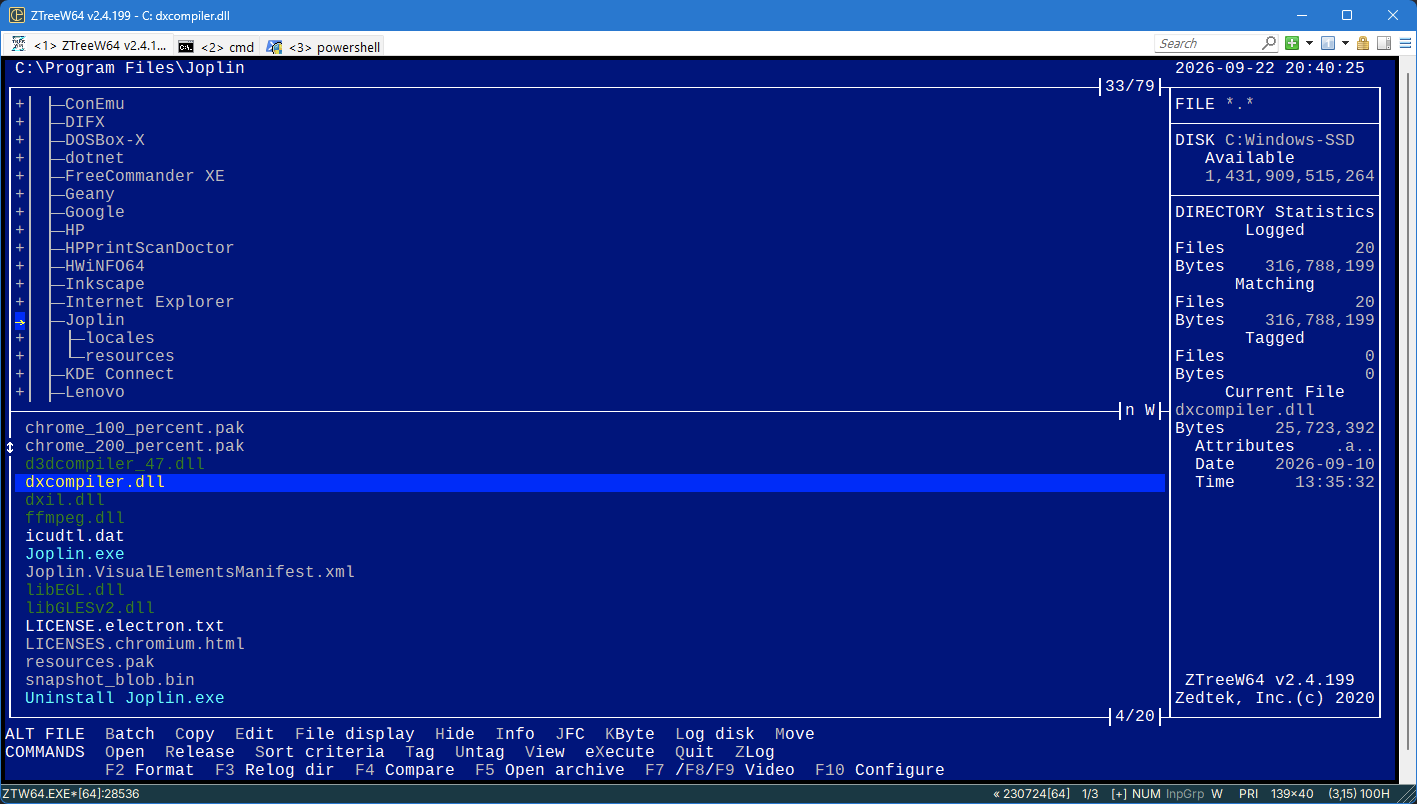
I don’t use it too often, but I found it to be a tool worth learning. Once configured and learned, everything is right under your fingers.
Back in my Solaris days we did EVERYTHING in a terminal, at least at first. The old OpenLook and CDE file managers kinda left something to be desired. And early on we had to use sh, not bash and only rarely ksh. Plus the termcaps were rarely set right – But we weren’t allowed to monkey with them. So, no command recall, spurious characters all over the terminal… you name it. Moving to bash on Linux was a definite usability upgrade.
2 Likes
This sounds really annoying 
The techno-nanny state…
1 Like
These are not hands-free driving systems, just lane holding assist. Personally, I would not use nor own a hands-free steering automobile. That scares the **** out of me.
PS - As stated above, I tried the lane holding assist a few times, but I no longer use it, either.
1 Like
Yeah, what I mean is that sometimes I drive with only one hand, when on familiar roads or going very slow. It would be extremely annoying if it kept beeping because I don’t have two hands on the steering wheel
2 Likes
My former manager at work was trying to move away from a vehicle in another lane that was crossing the stripe and crowding her, but her lane assist kept trying to steer her back toward (into, actually) that vehicle. That’s when she decided to disable it.
3 Likes
I don’t use CC in congested traffic. I just try to maintain a safe space, fore and aft, with surrounding vehicles.
2 Likes
It only scolds you if you take both hands off the steering wheel. One-handed steering is completely fine.
3 Likes
We don’t have a car, which means we rent a lot of cars. The newer ones now have an adaptive cruise control, which reads the speed limit signs on the road, and adjusts its target speed automatically. The best of these systems even auto-stop and auto-start at a traffic light. You can go hours without touching the accelerator or brake pedals!
Except every single one of them still has the odd false positive, where I’ll drive down the highway at highway speeds, and the car suddenly detects a 30 kph sign out of nowhere, and practically stops the car. Very unpleasant, not to say dangerous.
I typically still leave it on, as it’s just so dang convenient. But these braking false positives are unnerving.
1 Like
We’re the same, though often it’s the same car at the end of the street. The latest model, a Renault Austral, handles lane control better. No sudden jolts or the steering wheel going weirdly loose. But then sometimes every display in the dash will suddenly flash red or amber and I’ve no idea why. I think it’s something about my grip on the wheel. Maybe it can’t detect it randomly. But it doesn’t really explain what’s going on. I don’t normally take my hands off the wheel. Not as bad as this, though, which for me is taking open source too far:
1 Like
I do not understand why the regulators are not more restrictive on that matter. This creates dangerous situations. I had once an automated emergency brake on the Autobahn and it really sucks… after that, you need a break… I work in one of the most regulated industries and things like this would be completely unacceptable.
A technology that I like is the automatic headlight beam dimmer and adaptive beams. Works very reliable. However, I have one care with the suitable camera sensor, but an older headlight systems which I unlocked via a 3rd party coding tool. The user experience is rather mediocre… sometimes it’s OK, sometimes I was just too lazy to get the coding tool to remove it…
Expecting my first BEV soon. I am curious…
1 Like
Reminds me of my dad’s Tesla, which every once in a while, would reboot on a left curve. Every display black, no sound, running dark, then reboot. Thankfully, power steering and brakes still work.
A buddy of mine works in automotive programming, and apparently, safety critical car software has to follow very strict safety regulations, with multiple failover systems should the main system fail. Not quite aeronautic grade, but not far off either. (Did you know that aircraft control software always runs in triplicate, on three different processors, programmed by three different teams? This makes sure that any single software or hardware defect still has a majority vote of two working systems that can continue safe operations. Fascinating stuff.)
3 Likes