Indeed, that’s also my impression. These seem a bit easier to work with, but I’ve just started exploring the possibilities so I’m not sure yet.
1 Like
I posted in the other thread, but judging from the films I know these are out of the box colour wise closer to what I expect.
The agx filmsim have halation and grain that are critical to the film look and very close to what I expect.
1 Like
ART has both as well, although I don’t know how convincing as I’ve never really shot film (well I have due to age but I was not into photography at all at the time 
1 Like
I am actually in the same boat. Since I really don’t know the film processing at all I am sort of guessing and playing with all the settings in both projects and just trying to land on something that I like but I really can’t target the adjustments at all at this point. I must say I have created some really nice results that I like the look of I just have no idea if at all its film like or just a pleasing digital image…Thanks for making all these options accessible in ART…
I actually don’t know it it’s the case but from the results I gathered that agx had halation and grain tuned to each film. This was a straight up assumption that I didn’t question, may well be wrong. Whether this is a pro or con depends on the user.
Just out of curiosity, with the Film Grain effects in ART - Do these have any bias towards shadows/highlights? A bias slider could be a nice addition if possible! With Negative film having more pronounced grain in the highlights, and vice-versa with positive film.
Also regarding JanLohse’s spectral film sims - it’s great to see so many supported colourspaces!
The grain is dependent on luminosity, but it’s always applied to the positive image at the end of the pipeline, so the effects you mention won’t be possible. However, the “add noise” mode of the smoothing tool uses the same algorithm as the grain tool, and it allows to control its intensity with any kind of mask, so you could probably approximate what you want with a bit of work.
It’s great if you use the tool directly to generate Luts. If you use it from art, it doesn’t really matter as this is handled automatically for you.
HTH
1 Like
Thanks Alberto for adding this new tool, it was easy to install thanks to your instructions. It seems a little bit more responsive than AGX emulsion, and the sliders feel more intuitive for common users like me who have no experience in film development and printing.
2 Likes
Hi all!
I tried to extract, from the post 88 of this thread on, an “HowTo” to add to the Documentation area of the ART site, if @agriggio thinks it could be useful.
I attached it below as a .zip file containing an .md file and 2 images.
Regards,
Topoldo
SpectralFilmLUT.zip (138.4 KB)
2 Likes
Hi @agriggio,
Thank you for integrating AgX emulsion and Spectral Film LUT!
What settings should I use for the other modules (like the Tone Curves, Tone Equalizer and so on) to match for example the the sample images in the AgX emulsion thread or repository? With default settings many of my images appear very saturated. What modules should be turned off?
Thanks!
Stefan
I think I remember Alberto said that the Tone Curves should be off for AgX.
1 Like
Yes, the film/paper simulations already have some constrast baked in, so the Tone Curve should be disabled. But you still can use any module after wise if you want to adjust contrast/tone to your liking.
1 Like
There’s also a way to apply the film sim after the tone curve, which probably makes more sense in this scenario!
Explained here:
3 Likes
I’m looking forward to trying this out. A few questions:
Step 2 of your original instructions it says:
Download the files agx_emulsion_mklut.py and ART_agx_film.json, and save both in the same directory.
Which directory is that? The directory where uvx installed agc-emulsion? Or the “CLUT directory” you mention in step 5?
Also in step 5 you mention the CLUT directory can be specified in Preferences > Image Processing, but I don’t see that option there:
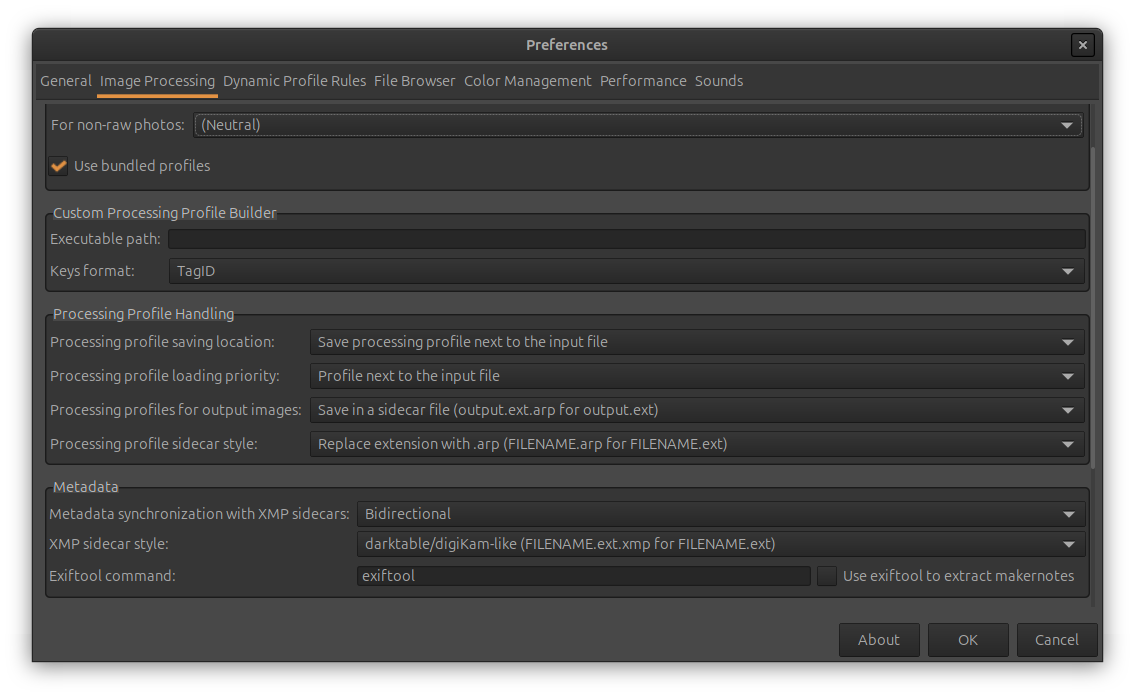
In a message from @sguyader on 23 Feb, he gives the link to the json and py files:
There are 4 files listed there. Do they all need to be saved to the CLUT directory? And how should those json files be edited?
Lastly, when I installed agx-emulsion from the link you provided (GitHub - andreavolpato/agx-emulsion: Spectral simulation of analog photography processes) I got the following error (bold added):
chuck@chuck-ubuntu:~$ uvx --from git+https://github.com/andreavolpato/agx-emulsion.git agx-emulsion
WARNING: Warning: Ignoring XDG_SESSION_TYPE=wayland on Gnome. Use QT_QPA_PLATFORM=wayland to run on Wayland anyway.
/home/chuck/.cache/uv/archive-v0/Z5NlIZrfHxYTAB1oPJv1a/lib/python3.13/site-packages/agx_emulsion/gui/main.py:27: FutureWarning: Public access to Window.qt_viewer is deprecated and will be removed in v0.6.0. It is considered an “implementation detail” of the napari application, not part of the napari viewer model. If your use case requires access to qt_viewer, please open an issue to discuss.
layer_list = viewer.window.qt_viewer.dockLayerList
I’m just sharing that as an FYI. I’ve added it as an issue on andreavolpato’s GitHub page (FutureWarning: Public access to Window.qt_viewer is deprecated · Issue #14 · andreavolpato/agx-emulsion · GitHub).
Thanks for any guidance!
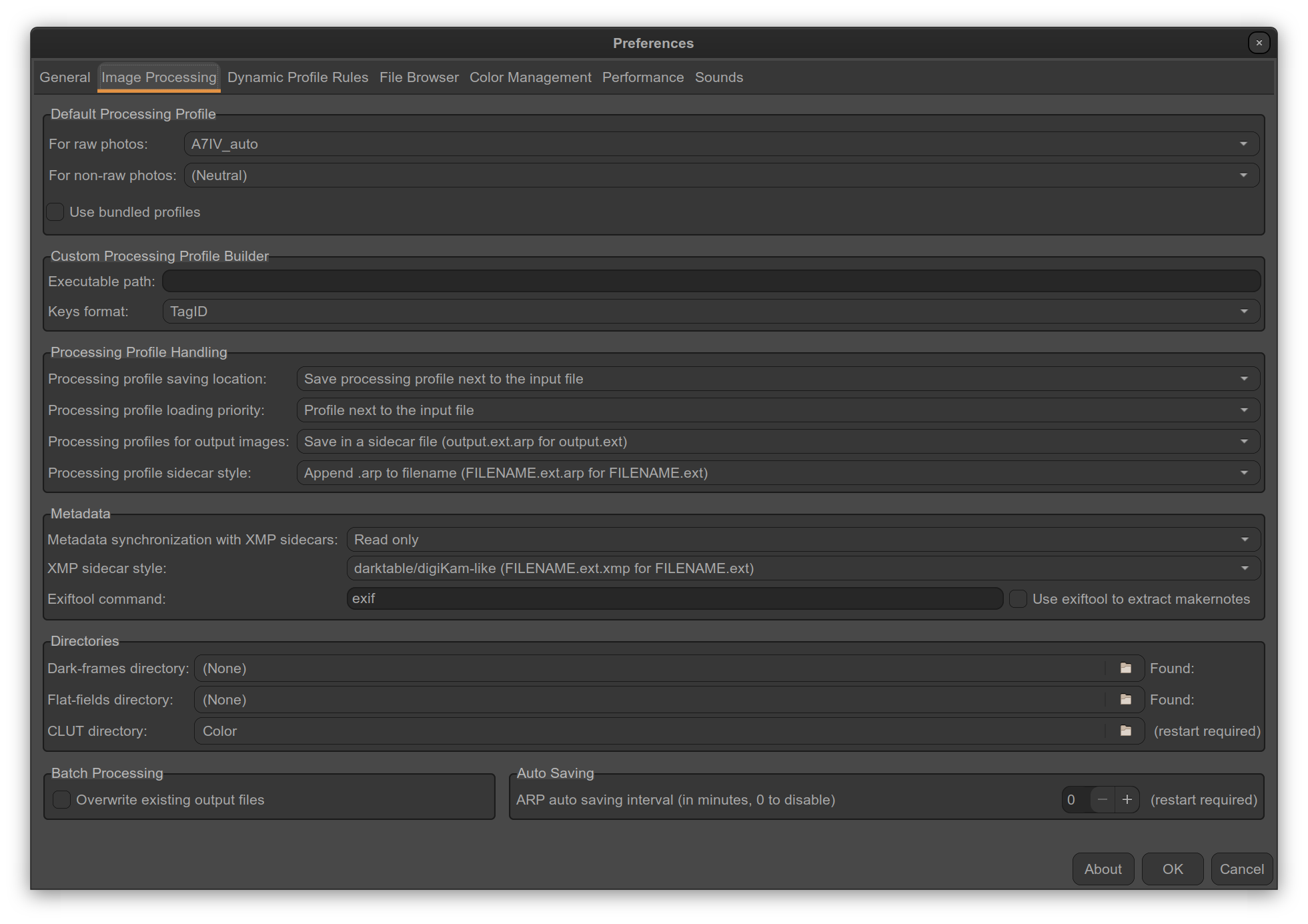
Save them in the CLUT directory.
1 Like
The message says “warning” and not “error”, so it’s probably okay.
In a message from @sguyader on 23 Feb, he gives the link to the json and py files:
You wrote:
There are 4 files listed there. Do they all need to be saved to the CLUT directory? And how should those json files be edited?
Two files are for AgX-emulsion (which is the film emulator creted by A, Volpato). These are:
The other two files can be used to interface a differentr Spectral Film Simulation to ART as created by @agriggio about 15-20 days ago.
Files can be edited with whatever editor you have (e.g. Notepad or Notepad++ in Windows).
Lastly, when I installed agx-emulsion from the link you provided (GitHub - andreavolpato/agx-emulsion: Spectral simulation of analog photography processes) I got the following error…
I see there is no change in A. Volpato sources since when I took them. I did the operation by using the download of a single .zip file technique which I expanded it in whatever directory. I don’t remember if there was any warning during the subsequent download of requirements and installation. Anyway I used Python 3.11 under Windows and not uvx.
Regards,
Topoldo
2 Likes
Just coming back to this - I’ve noticed that the “White Point” in the Tone Curve makes a dramatic difference to high luminance areas when AGX Film Emulsion is applied after the Tone Curve.
Switching on the tone curve, with the default White Point value of 1.0 changes bright areas significantly. I’m unsure what AGX ix expecting in terms of white point? 
Edit: I think it makes sense to max out white point in the tone curve if using AGX after (or any other DRT)…
It’s a warning for now, but the dev needs to address it before the deprecation becomes final. That’s why I created an issue for him on GitHub.